Jo Jung-hoon "Cut Civil Servants' Salaries to Provide Disaster Relief Funds" Claims
Civil Servants' Union "Claims Lower Civil Servants' Morale... Lawmakers Should Set an Example First"
Expert "Opinion That Can Easily Emerge from Political Circles"
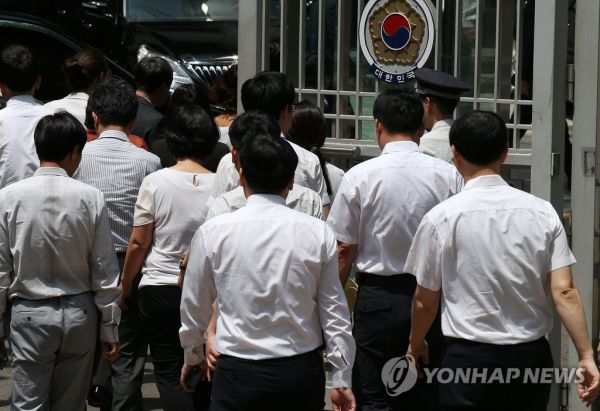 Civil servants who have finished their lunch are entering the Gwanghwamun Government Seoul Office Building.
 Photo by Yonhap News
[Asia Economy Reporter Kim Suwan] Jo Jeonghun, a member of the Transition Era party, has sparked controversy by proposing a 20% cut in public officials' salaries to secure funding for the second round of disaster relief payments in response to the novel coronavirus disease (COVID-19).
Some in the public service sector have opposed this, arguing that they have already shared enough of the burden by fully cutting annual leave compensation after the COVID-19 outbreak and minimizing next year's wage increase rate. Additionally, critics say that Jo's proposal to cut public officials' salaries to fund disaster relief payments unfairly shifts all responsibility onto public servants, and there are calls for senior officials to set an example, leading to conflicts surrounding the proposal.
On the 21st, Jo appeared on YTN Radio's "Lee Donghyung's News Face-off" and stated, "Let's provide emergency disaster relief payments for a second round," and "Let's secure part of the funding by cutting the salaries of public officials and employees of public institutions."
Jo explained, "Based on the scale of the emergency disaster relief payments made in May, our budget needs 12 trillion won," and "The first proposal is to cut public officials' salaries. To instill a sense of urgency in the political sphere and public institutions once again, I propose a 20% salary cut from September to December, a period of four months. This would generate about 2.6 trillion won in funding."
He also suggested creating the second emergency disaster relief fund by adding 2 trillion won from this year's supplementary budget contingency funds and unspent amounts from the first to third supplementary budgets, in addition to the salary cuts for public officials.
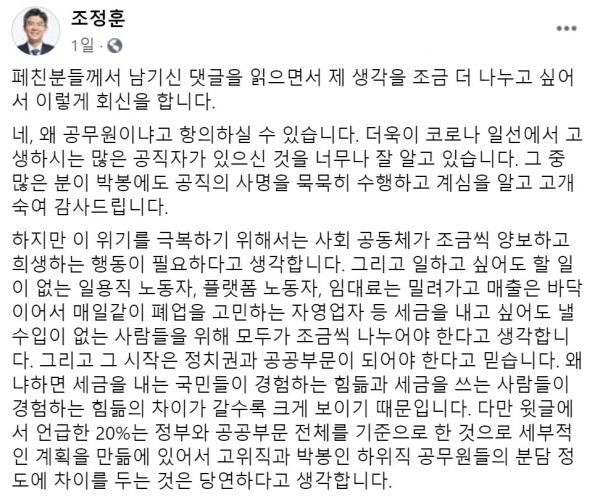 Assemblyman Jo Jung-hoon of the Transition Era party argued for cutting public officials' salaries to secure funding for emergency disaster relief payments related to the novel coronavirus infection.
 /Photo by Jo Jung-hoon Facebook capture
However, netizens criticized his proposal in the comments section of his Facebook page, saying things like, "Don't shift responsibility onto public officials," and "In this situation, instead of encouraging public officials, you are saying discouraging things."
One netizen questioned, "Do you even know that the monthly take-home pay of grade 8-9 public officials hovers around 1.8 million won?" and added, "Public officials are taxpayers and salaried workers too. I don't understand why the responsibility is being shifted onto lower-ranking public officials."
Another netizen said, "Before talking about salary cuts for the staff quietly working at community centers, you should first increase manpower and proceed with the work," and "I am very angry at the idea of cutting the already very low salaries of the hardest-working people, and I think it is reckless."
As the controversy over the proposal to cut public officials' salaries continued, Jo posted on his Facebook on the 22nd, stating, "You may protest asking why it should be public officials. I am well aware that many public servants are working hard on the front lines of COVID-19," but added, "However, I believe everyone should share a little for day laborers and platform workers who want to work but have no work, and self-employed people who are struggling with rent arrears and plummeting sales and are contemplating closure daily, as they have no income to pay taxes."
In response, some public officials have criticized Jo's proposal, questioning why only public officials should be forced to sacrifice during this difficult time for all citizens due to COVID-19.
They point out that during the first round of disaster relief payments, they already participated in funding efforts through full cuts to annual leave compensation and donations. Moreover, public officials have recently faced a rapid increase in related duties due to COVID-19, monsoon rains, and heatwaves, entering an emergency work system with overtime and weekend shifts. They argue that public officials have already taken all possible measures, including dedicated responses to various natural disasters and overtime work due to COVID-19.
Frontline public officials also expressed dissatisfaction. Kim (29), a chief clerk at a community center in Seoul, said, "I don't understand why the lowest-ranking employees have to sacrifice," and added, "It might be understandable if the salary was high, but we are also sacrificing for the people during difficult times like COVID-19 and the monsoon season, so the proposal to cut salaries is absurd."
Another clerk, Kim (27), said, "I was newly appointed this year and didn't realize public officials' salaries were this low," and raised her voice, "There is a lawmaker who proposes cutting public officials' salaries to fund disaster relief payments. Shouldn't all lawmakers set an example first before making such proposals? This kind of approach only lowers the morale of employees who want to work hard."
Criticism of Jo's proposal also came from the private sector. Lee Jaeung, former CEO of Socar, emphasized on his Facebook on the 22nd that sacrifices from the private sector, such as high-income earners and high-profit companies, are more necessary than from all public officials.
He said, "Although public officials receive stable salaries, many lower-ranking public officials do not have high income levels. Above all, cutting the salaries of those who are at the forefront of overcoming the COVID-19 crisis does not seem appropriate," and urged, "Please create policies that make high-income workers, business owners, and corporations contribute more than public officials."
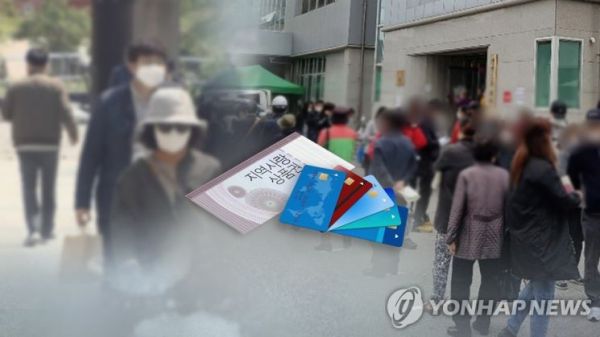 The government has cut civil servants' annual leave compensation (personnel expenses) to secure funds for the first round of emergency disaster relief payments. Photo by Yonhap News
According to the Ministry of Personnel Management, in 2018 and 2019, monthly salaries for grade 9 step 1 and sergeant steps 1 to 3 were below the minimum wage, prompting additional salary adjustments.
Previously, the government cut public officials' annual leave compensation (personnel expenses) to secure funding for the first emergency disaster relief payments. At that time, the government stated that active participation from public officials and the public service sector was inevitable as part of sharing the pain caused by the COVID-19 crisis.
Some have pointed out that when discussing funding for disaster relief payments, the salaries of senior public officials should be cut first.
A representative of the Korean Government Employees' Union told Asia Economy in a phone interview, "It lowers the morale of public officials working on the front lines of COVID-19 prevention," and added, "Most public officials working on the front lines are from the lower-income class. Cutting public officials' salaries would also have a negative economic impact," and criticized, "If there is going to be a discussion about cutting public officials' salaries, it should start with reducing the salaries of lawmakers who receive high pay."
Experts analyzed that this is a proposal that could emerge from the political sphere amid the surge in COVID-19 cases.
Political commentator Lee Jonghun said, "Considering the current situation where the fourth supplementary budget and the second disaster relief payments are being discussed, I think such opinions should come out within the political sphere," and added, "There is bound to be controversy over this proposal, but I believe it is a situation where pain must be shared."
He continued, "This is just the opinion of one lawmaker. Even if this proceeds, it will be concretized through sufficient discussion and agreement," and suggested, "It will not be a blanket 20% cut for all public officials. The government should also save where it can in the budget, and the public service sector needs to participate."
© The Asia Business Daily(www.asiae.co.kr). All rights reserved.



















