Regarding Gyeonggi Province Governor Lee Jae-myung's claim of "300,000 won payment to all citizens," "We should focus on those in greater need"
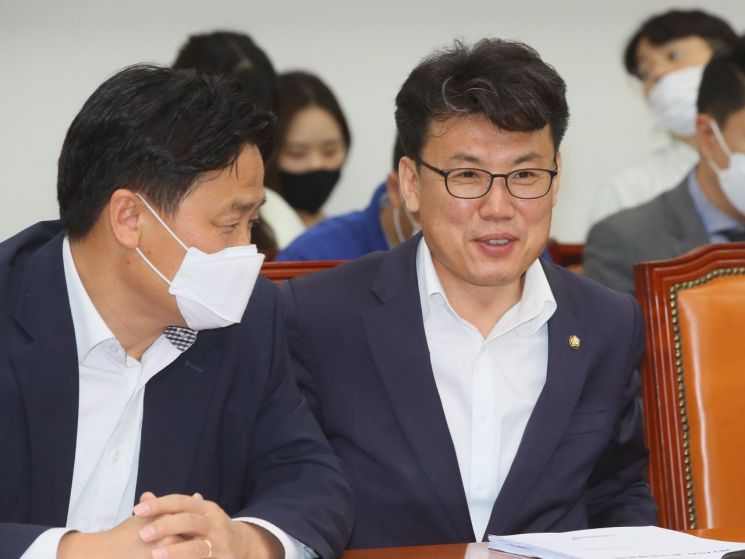
[Asia Economy Reporter Wondara] Jin Seong-jun, Strategic Planning Committee Chairman of the Democratic Party of Korea, stated that the second disaster relief fund in response to the resurgence of COVID-19 should be selectively provided to households below the median income. Regarding the proposal to provide a uniform payment of 300,000 won per person, he expressed the view that "support should be focused on those who are more vulnerable." The first disaster relief fund was previously distributed uniformly to all citizens nationwide.
On the morning of the 24th, Chairman Jin appeared on MBC Radio and said, "The rapid increase in COVID-19 cases is so severe that the activation of social distancing level 3 is being considered, and it is obvious that there will be groups severely affected to the point of struggling to make a living," adding, "I think it is time for the political circles to urgently review the issue of providing the second disaster relief fund."
When asked if he supports selective distribution, he replied, "Yes. It would be ideal to give to everyone, but since a more serious situation could arise, I think it is necessary to reserve fiscal capacity."
Regarding the target recipients, he said, "If we look at the median income in our country, a single-person household earns about 1.76 million won per month, and a four-person household about 3.75 million won. It is said that there are just over 10 million households that do not meet that income. I think targeting those households would be a basis for providing prompt support."
On the scale of payments, when asked if he is considering amounts similar to the first round, such as 1 million won for a four-person household and 700,000 won for a three-person household, he answered, "That is what I have in mind."
Regarding Gyeonggi Province Governor Lee Jae-myung's claim that 300,000 won should be paid to every citizen, he said, "Those with relatively stable incomes are in a better position to bear the burden, so I think it would be better to focus on those who are more vulnerable."
When asked whether discussions on basic income should begin, he responded, "Since this is a discussion about consolidating existing welfare programs into a single basic income system, the welfare level for truly vulnerable people would regress significantly compared to the current level. I do not think that is desirable." He added, "If we try to maintain current welfare while implementing basic income, it would be difficult to sustain with our country's fiscal capacity, so serious discussions are needed."
Regarding Assemblyman Jo Jeong-hoon's suggestion to cut civil servants' salaries to secure funds, he said, "Since the role of civil servants will become even more important in the future, I do not think it is a good idea to simply demand that only civil servants tighten their belts."
On the proposal to temporarily levy a 2% tax on the total income of the top 1% income earners to create a disaster fund, he said, "Since excessive income occurs across all classes, there is an argument that those people should also receive disaster relief funds equally. If we consider that taxes are collected and then redistributed, is it really necessary to go that far?"
© The Asia Business Daily(www.asiae.co.kr). All rights reserved.
![User Who Sold Erroneously Deposited Bitcoins to Repay Debt and Fund Entertainment... What Did the Supreme Court Decide in 2021? [Legal Issue Check]](https://cwcontent.asiae.co.kr/asiaresize/183/2026020910431234020_1770601391.png)
















