Legislative Research Office Releases 'Air Passenger Demand Forecast' Report
Global Air Passenger Traffic Down 58.4% Year-on-Year
"Prolonged COVID-19 Crisis... Deterioration in Air Travel Demand Sentiment"
"Increased Demand for Contactless and Non-Face-to-Face Services in Aviation Sector"
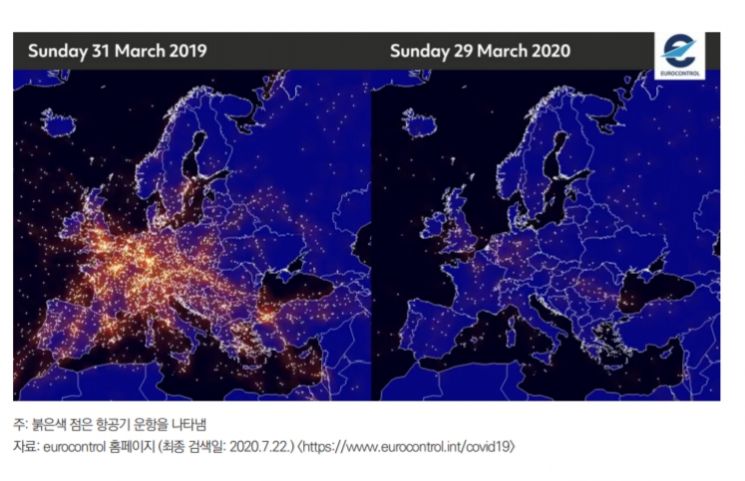
[Asia Economy Reporter Kim Bo-kyung] Due to the impact of the novel coronavirus infection (COVID-19), air travel demand has plummeted, resulting in a roughly 72% decrease in South Korea's international air passenger numbers in the first half of this year compared to last year.
According to the 'Post-COVID-19 Global Air Passenger Demand Outlook and Implications' published on the 22nd by the National Assembly Legislative Research Office, air passenger demand has significantly contracted, especially for international flights, due to COVID-19. The timing of the end of the pandemic remains uncertain, and near-future air travel demand forecasts are not optimistic.
From January to June this year, South Korea's air passenger volume decreased by 61.7% compared to the same period last year. Among these, the international flight decline rate was 71.5%, higher than the domestic flight decline rate of 33.6%.
During the same period, global air passenger traffic volume dropped by 58.4% year-on-year. International flights (-62.2%) decreased more sharply than domestic flights (-51.6%).
This year, passenger numbers, seat supply, and airline revenues are expected to decline significantly across all regions worldwide.
According to an ICAO (International Civil Aviation Organization) survey, compared to projections assuming normal operations, actual passenger numbers this year are expected to decrease globally by 2.4 to 2.9 billion, seat supply by 43 to 51%, and airline revenues by $324 billion to $387 billion.
In particular, the decline in airline passenger business revenues in the Asia-Pacific and European regions is expected to account for about 60% of the total decrease.
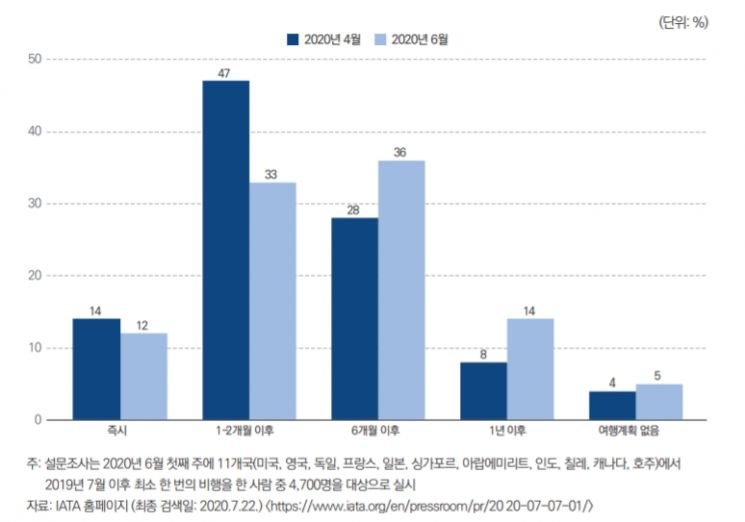
Even after the COVID-19 pandemic subsides, it is expected to take some time for air travel demand to recover.
According to a survey conducted by IATA (International Air Transport Association) in June regarding air travel after COVID-19, 36% of respondents said they would travel "six months after the pandemic subsides." Fourteen percent responded that they would travel "after one year," and 5% said they had "no travel plans in the near future."
The remaining 45% said they would travel within six months after the pandemic subsides, but this figure dropped by 16 percentage points from the April survey (61%). This indicates that as the COVID-19 situation prolongs, the sentiment for air travel demand is deteriorating.
When asked about the most reassuring measures during air travel, the top choices were ▲COVID-19 testing at departure airports ▲mandatory wearing of face masks ▲social distancing onboard.
Other measures ranked in order included ▲COVID-19 immunity certification ▲temperature checks at departure ▲mandatory mask-wearing by flight attendants ▲in-flight disinfection ▲provision of personal hygiene kits for seat area cleaning ▲contactless immigration procedures at airports.
The Legislative Research Office stated, "An unprecedented global decline in air passengers has occurred due to COVID-19," and added, "Airlines and others must strive to alleviate concerns about the possibility of COVID-19 infection to help recover air travel demand."
It also predicted, "Hygiene will emerge as a new competitive factor in future air travel," and "Demand for contactless and non-face-to-face services will increase in the aviation sector."
Furthermore, it advised, "Airlines and airports should consider actively adopting and implementing untact technologies and services such as contactless biometric systems, AI-based security screening, and robot-assisted in-flight and airport services."
© The Asia Business Daily(www.asiae.co.kr). All rights reserved.


















