Concerns Over COVID-19 Surge in Seoul Metropolitan Area... Strengthening Social Distancing
Some Politicians Call for Early Payment of 2nd Disaster Relief Fund
Government Hesitant... Deputy Prime Minister Hong Says "Need Tailored Support"
Experts Say "2nd Support Unavoidable if Impact Worsens"
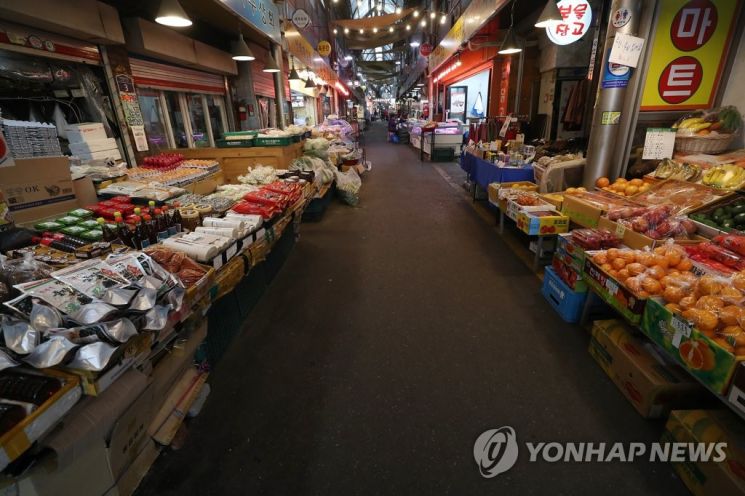 Amid the ongoing economic downturn caused by the novel coronavirus disease (COVID-19), Tongin Market in Jongno-gu appeared quiet on March 17. / Photo by Yonhap News
[Asia Economy Reporter Lim Ju-hyung] As social distancing measures are strengthened again due to the resurgence of the novel coronavirus infection (COVID-19), concerns are growing that the livelihood economy could suffer a severe blow. Some in the political sphere argue that the government should provide additional emergency disaster relief funds to support ordinary citizens. However, the government remains skeptical about issuing a second round of disaster relief funds under the current circumstances, and there are views that the effects of the previously implemented relief funds were not significant compared to the costs, suggesting that political discussions are likely to intensify.
According to the Central Disease Control Headquarters (CDCH) of the Korea Disease Control and Prevention Agency, as of midnight on the 22nd, the number of new COVID-19 cases was recorded at 332. The number of new cases has remained in the triple digits for eight consecutive days since the 15th.
The government has stepped up social distancing measures to curb the spread of COVID-19. From the 19th, social distancing was raised to Level 2 in the metropolitan areas including Seoul, Gyeonggi, and Incheon, and from midnight on the 23rd, it was expanded nationwide.
The health authorities stated that if the spread worsens further, even stronger distancing measures than the current Level 2 should be considered. Jeong Eun-kyung, head of the CDCH, said at a regular COVID-19 briefing held at the Osong Disease Control Headquarters in Chungbuk on the 21st, "The priority is to ensure that Level 2 social distancing is properly implemented," but added, "If the spread continues, we must consider raising it to Level 3."
Given this situation, concerns are mounting that the prolonged distancing period could severely impact the domestic economy and jobs. In the political arena, voices are emerging calling for the issuance of a second disaster relief fund to proactively respond to the economic shock caused by the escalation of social distancing.
Kim Tae-nyeon, floor leader of the Democratic Party of Korea, said at the Supreme Council meeting that day, "As COVID-19 rapidly spreads, the economy is expected to freeze again for about two months," and added, "We need to consider a second disaster relief fund."
Lee Nak-yeon, a lawmaker running for the Democratic Party leadership election, wrote on his Facebook that day, "Discussions on the second disaster relief fund have begun in the political sphere. I agree with the concerns and sincerity," emphasizing, "A thorough review of the effects and challenges of the first relief fund payment should also be conducted simultaneously."
Positive voices about the need for a supplementary budget (supplementary budget) to provide disaster relief funds also came from the opposition. Kim Jong-in, emergency committee chairman of the United Future Party, said at a press conference that day, "I talked about the second disaster relief fund early on," adding, "Considering the second COVID-19 wave, we should quickly prepare a supplementary budget, and disaster relief funds can be included in that scope."
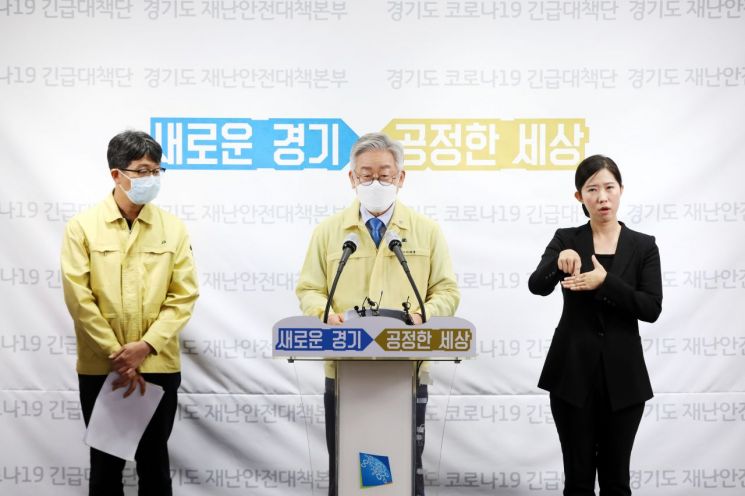 Gyeonggi Province Governor Lee Jae-myung is holding a press conference appealing to the public regarding the metropolitan area outbreak of the novel coronavirus infection (COVID-19) at the Gyeonggi Provincial Government Office in Suwon, Gyeonggi Province, on the morning of the 20th. / Photo by Yonhap News
Meanwhile, some have mentioned specific payment methods and amounts. Lee Jae-myung, governor of Gyeonggi Province, wrote on his Facebook that day, "We need to prepare for the second economic quarantine. It is appropriate to provide disaster relief funds in the form of regional currency-type basic income," explaining, "At this stage, it would be suitable to provide about 300,000 won per person in regional currency that expires within three months to all citizens."
In fact, the first emergency disaster relief fund was found to have had an effect in protecting households during the economic downturn caused by the first wave of COVID-19.
According to the '2020 Q2 Household Trends Survey Results' released by Statistics Korea on the 20th, the average monthly household income in the second quarter (April to June) of this year was 5,272,000 won, an increase of 4.8% compared to the same period last year. Although earned income, business income, and property income all decreased, the public transfer income increased significantly due to the first disaster relief fund policy promoted by the government, offsetting the decline.
On the other hand, the government remains skeptical about issuing a second disaster relief fund. Hong Nam-ki, Deputy Prime Minister and Minister of Economy and Finance, said at the 2nd Korean New Deal Ministerial Meeting and the 14th Central Disaster and Safety Countermeasure Headquarters meeting held at the Korea Eximbank that day, "We cannot ignore the enormous cost burden of disaster relief funds," adding, "Rather than disaster relief funds per se, customized support that can bring similar effects might be more effective."
There is also criticism that the disaster relief funds did not adequately support vulnerable small business owners in the 'local commercial districts.' The Domestic Small Business Sentiment Index (BSI), compiled by the Small Enterprise and Market Service, soared to 88.3 in May when more than 60% of the first disaster relief funds were distributed, but sharply declined to 82.6 and 68.1 in June and July, respectively. Despite a budget of 12.2 trillion won, the policy is criticized for having only a 'temporary' effect.
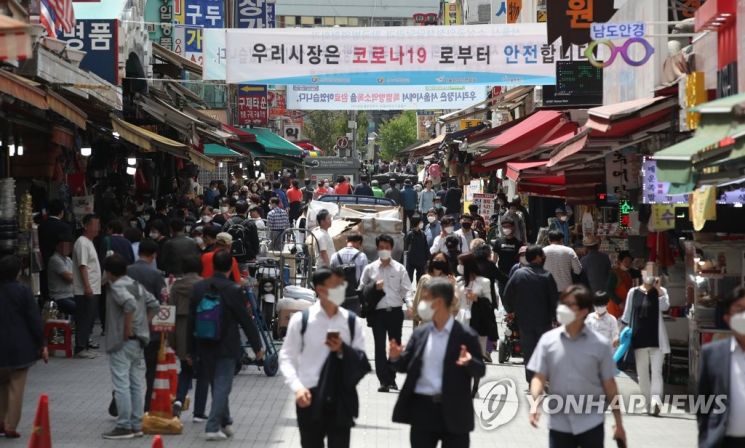 On May 14, the second day after the first emergency disaster relief fund was distributed, Namdaemun Market in Jung-gu, Seoul, was bustling with citizens. / Photo by Yonhap News
As discussions in the political sphere about whether to provide a second disaster relief fund are beginning in earnest, public reactions to the policy are mixed.
A (27), a freelancer living in Seoul, said, "I was recently notified that a lecture was canceled due to the COVID-19 resurgence, which was common during the first wave," expressing, "As a freelancer who earns income through face-to-face lectures, if this spread leads to a second wave, the provision of disaster relief funds is urgent."
B (58), a housewife living in the metropolitan area, said, "When I received the first disaster relief fund, I used it effectively for living expenses," adding, "Since it is paid in regional currency anyway, it can only be properly used in traditional markets. If there is an additional payment, I believe it will help both ordinary citizens and small business owners."
On the other hand, there were claims that more efficient support measures for ordinary citizens are needed rather than disaster relief funds. C (31), an office worker, said, "The intention to help small business owners is good, but I wonder how the aftermath will be handled if money is distributed like this," emphasizing, "Even if support funds are received now, it is money that will eventually have to be returned through taxes, and since it is paid uniformly even to those who are well-off, I think it is a waste of budget. The country's money should be used more wisely."
Experts suggested that if the economic damage caused by strengthened social distancing becomes a reality, the issuance of a second disaster relief fund should be considered.
Kang Nam-hoon, professor of economics at Hanshin University, said in a phone interview with Asia Economy, "If the impact on vulnerable groups becomes severe, a second disaster relief fund seems inevitable," adding, "Under the current circumstances, it seems unavoidable to issue government bonds to cover the insufficient budget."
However, he emphasized the need to carefully decide the timing of the payment so that COVID-19 quarantine policies and economic stimulus measures do not conflict. Professor Kang explained, "We should prepare from now on and start payments when the current Level 2 social distancing is lowered to Level 1."
© The Asia Business Daily(www.asiae.co.kr). All rights reserved.



















