In March's COVID-19 Crash, Stock Prices Struggle to Recover
Demand Remains Weak Despite Oil Price Rebound Amid COVID-19
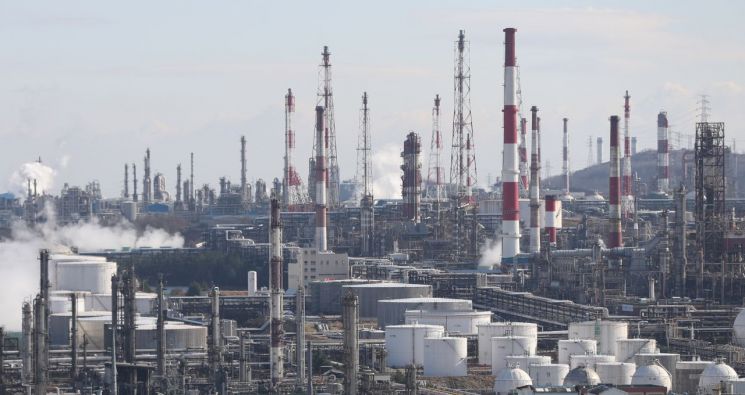
[Asia Economy Reporter Minwoo Lee] Despite the formation of a cyclical market where stock prices rise by industry, oil refining stocks are being overlooked. Although international oil prices have somewhat recovered after a sharp plunge, it is analyzed that they still cannot escape from weak demand due to the impact of the novel coronavirus disease (COVID-19).
According to the Korea Exchange on the 20th, as of 9:42 AM, the stock price of S-Oil was 59,900 KRW, down 0.99% from the previous day. This level is not much different from the high 50,000 KRW range seen in late March when the stock market crashed due to COVID-19. It rose to 79,400 KRW on June 4 but then continued to decline. This contrasts with the KOSPI index, which steadily rose from the 1,400 range to the mid-2,400 range during the same period.
GS’s stock price, which includes GS Caltex accounting for more than half of its sales, is also sluggish. At the same time, it was down 1.72% from the previous day to 34,250 KRW. This remains at a similar level to late March when the stock market was volatile due to COVID-19. After hitting a yearly low of 32,200 KRW in March and recovering to 41,950 KRW in early June, it has not escaped a downward trend for more than two months.
SK Innovation, considered a representative oil refining stock, has steadily risen and recorded a yearly high of 197,500 KRW on the 10th. However, this is interpreted as reflecting expectations for the secondary battery business, regarded as a future growth engine, despite the oil refining business still being sluggish. SK Innovation posted a loss of 1.7752 trillion KRW in the first quarter and recorded an operating loss of 439.7 billion KRW in the second quarter. Although losses related to inventory significantly decreased as international oil prices recovered from the early-year plunge, demand for petroleum products remains weak. Nevertheless, expectations for the secondary battery business and the recent initial public offering (IPO) process of its wholly owned subsidiary SK IE Technology (IET) caused the stock price to rise sharply.
Since international oil prices recorded negative values for the first time in history in April, they have steadily recovered, but given that demand itself has decreased, it is expected that oil refining stocks will find it difficult to regain a leading position in the market for the time being. Sangwon Han, a researcher at Daishin Securities, said, "Due to the nature of the market industry, entering a rising market phase is necessary to become a market leader, but it is still in a downward trend," adding, "Currently, refining margins are below the break-even point (BEP) at around 2 dollars per barrel, and the expansion of electric vehicle adoption is a mid- to long-term risk factor."
© The Asia Business Daily(www.asiae.co.kr). All rights reserved.
![User Who Sold Erroneously Deposited Bitcoins to Repay Debt and Fund Entertainment... What Did the Supreme Court Decide in 2021? [Legal Issue Check]](https://cwcontent.asiae.co.kr/asiaresize/183/2026020910431234020_1770601391.png)