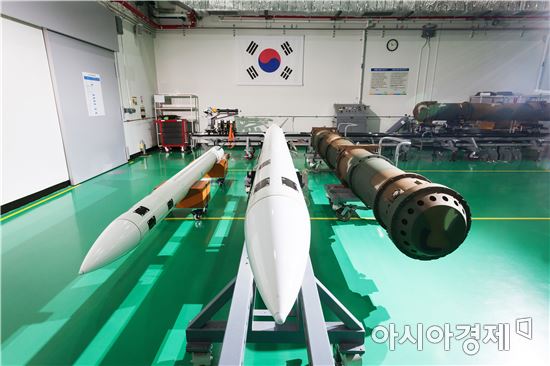
 The upgraded version of the medium-range surface-to-air missile (M-SAM) 'Cheongung,' known as the Korean-style Patriot missile (Cheolmae-II), is expected to enter mass production starting next year.
[Asia Economy Yang Nak-gyu, Military Specialist Reporter] Our military has decided to significantly increase the number of interceptor missiles to respond to North Korea's missile attacks. This plan comes in response to a report by the U.S. Department of Defense stating that North Korea could strike key military strategic points in South Korea with a large-scale ballistic missile attack during wartime. The military plans to densely deploy interceptor missiles mainly around major military bases.
According to military officials on the 19th, the Joint Chiefs of Staff held a Joint Strategic Working Meeting on the 12th and decided to upgrade the performance of the Cheolmae-II (Cheongung) interceptor missile and proceed with mass production.
Our military has deployed 18 batteries of Cheolmae-II after developing it to intercept North Korean aircraft. Cheolmae-II originally refers to the domestically developed medium-range surface-to-air missile (M-SAM) project initiated to replace the Hawk missiles introduced in the 1960s and 1970s.
However, through the Cheolmae-II performance upgrade project, the military has been working to enhance its capabilities to intercept not only aircraft but also ballistic missiles. The domestic defense company LIG Nex1 started the Cheolmae-II performance upgrade in 2012 and received a combat suitability certification in the 2017 test evaluation.
The upgraded Cheolmae-II has been deployed in 7 batteries, but the launchers of the existing 18 batteries used for aircraft interception can also be utilized. As a result, the total number of batteries capable of intercepting North Korean ballistic missiles has increased significantly to 25. Considering that each Cheolmae-II launcher battery is equipped with 32 missiles, approximately 450 ballistic missile interceptor missiles can be deployed.
The military's move to respond to North Korea's ballistic missiles through the Cheolmae-II performance upgrade project is based on the expectation that if war breaks out on the Korean Peninsula, North Korean forces will employ various attack methods, focusing on ballistic missile attacks.
The U.S. Department of Defense Army Division, in its "North Korea Tactical Report," predicted that North Korean forces would isolate Seoul through large-scale attacks using conventional firepower and chemical weapons from the Demilitarized Zone during wartime. The report also assessed that North Korea could strike key facilities such as South Korean ports, intelligence agencies, and U.S. military bases with ballistic missiles. It analyzed that North Korean forces would simultaneously deploy special forces to the rear areas of South Korea using helicopters, light aircraft, and tunnels.
© The Asia Business Daily(www.asiae.co.kr). All rights reserved.
















