Half of Pune Residents Have Antibodies
6 out of 10 in Low-Income Areas
Attention on 'Herd Immunity' Possibility
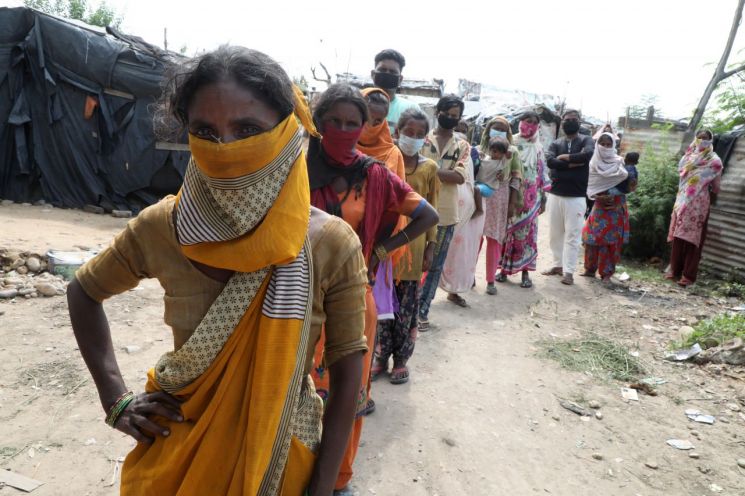 On the 16th of last month (local time), residents in a slum area of Jammu, India, are waiting to get tested for the novel coronavirus disease (COVID-19).
 A survey found that more than half of the residents in a community in India have antibodies against the novel coronavirus infection (COVID-19). In low-income residential areas sharing toilets, the antibody formation rate reached 6 out of 10 people. This survey is attracting attention regarding the possibility of forming herd immunity.
According to Indian media such as ANI News on the 18th, a serological survey conducted from the 20th of last month to the 5th of this month on 1,664 Pune residents found that 51.5% of them had COVID-19 antibodies.
In low-income residential areas sharing toilets, the antibody formation rate rose to 62.3%, while in upscale residential or apartment areas, this figure dropped to 39.8%. The survey was conducted by the Pune city authorities in collaboration with local university researchers and the Indian Institute of Science Education and Research (IISER).
The Indian media The Telegraph reported, "Based on these results, scientists will be able to investigate questions related to the herd immunity theory."
Herd immunity refers to a state where a significant portion of the local population has immunity against a specific infectious disease. Experts say that once herd immunity is formed, rapid spread becomes difficult even if additional infections occur.
In this regard, a study released at the end of last month showed that among 6,936 slum dwellers in Mumbai surveyed in June, 57% had formed antibodies.
The antibody possession rate among residents outside the slum areas was also found to be as high as 16%.
Earlier, in New Delhi, a survey conducted from June 27 to last month’s 10th on 21,387 residents found that 23% of them had COVID-19 antibodies.
 The enthusiasm for studying Korean continues to spread steadily in India despite the surge of the novel coronavirus disease (COVID-19). According to the Korean Cultural Center in India on the 26th of last month, two Sejong Institutes, which can be considered the forward bases for the spread of the Korean language in India, will soon open one after another. The photo shows a class at the Sejong Institute of the Korean Cultural Center in India.
 Meanwhile, the daily number of new confirmed cases in New Delhi and Mumbai has recently decreased significantly. New Delhi’s daily new cases once approached 4,000 in June but have recently been recorded at under 1,000.
Pune’s numbers also surged to the high 3,000s in late last month but dropped to 1,875 on the 18th.
However, it is known that concrete verification has not yet been conducted on whether herd immunity is truly effective in preventing virus spread.
Opinions on the antibody formation rate in communities necessary to enable herd immunity vary among experts, ranging from as low as 40-50% to as high as 90%.
Subhash Salunke, chairman of the Epidemic Prevention and Control Technology Committee, told the Hindustan Times, "Since confirmed cases are still increasing, we cannot yet rely on herd immunity," adding, "Instead, more focus should be placed on managing fatality rates."
Meanwhile, India’s cumulative number of COVID-19 confirmed cases was counted at 2,702,742 as of the 18th. The daily new confirmed cases, which had exceeded 60,000, have recently recorded numbers in the 50,000 range for two consecutive days.
© The Asia Business Daily(www.asiae.co.kr). All rights reserved.
![Clutching a Stolen Dior Bag, Saying "I Hate Being Poor but Real"... The Grotesque Con of a "Human Knockoff" [Slate]](https://cwcontent.asiae.co.kr/asiaresize/183/2026021902243444107_1771435474.jpg)












