BOK Issue Note - Measuring and Assessing Employment Vulnerability to COVID-19 by the Bank of Korea
[Asia Economy Reporter Eunbyeol Kim] It has been analyzed that if strong lockdown measures are implemented due to the spread of the novel coronavirus infection (COVID-19), one out of three employed people in South Korea will find it difficult to engage in normal economic activities. Since social distancing measures were implemented after COVID-19, many people have been exposed to the risk of losing their jobs, indicating that a significant proportion of people are engaged in vulnerable jobs.
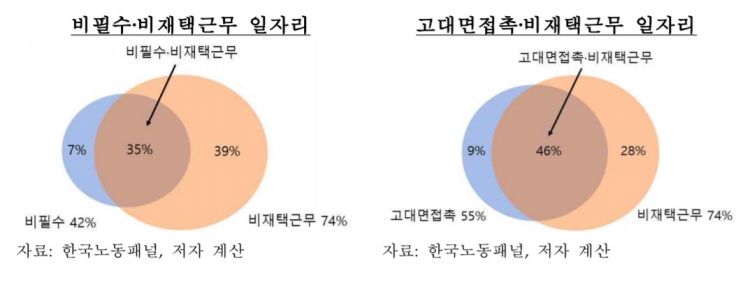
According to the 'BOK Issue Note - Measurement and Evaluation of Employment Vulnerability to COVID-19' published on the 18th by Osam-il, Head of Employment Analysis Team at the Bank of Korea's Research Department, and Lee Sang-ah, a researcher, the proportion of non-essential and non-telework jobs that are highly exposed to short-term unemployment risk was estimated at 35%. This means that more than one in three people are employed in jobs where the work environment is restricted and they cannot work even if they want to when the government imposes lockdown measures.
To identify the employment vulnerability of individual jobs due to infectious diseases, Mr. Oh used three factors: ▲whether the job is essential ▲whether telework is possible ▲the degree of face-to-face contact. The proportion of workers in non-essential jobs was 42%, those in jobs where telework is impossible was 74%, and those in jobs with a high degree of face-to-face contact was 55%. Among these, 35% were employed in jobs that are both non-essential and impossible to perform via telework.
Among the three factors, jobs that are difficult to perform via telework and have a high degree of face-to-face contact accounted for nearly half of all employed persons, at 46%. Mr. Oh said, "In the case of such jobs, it typically takes a considerable amount of time for employment recovery in the long term," adding, "In the long run, there is a tendency for these jobs to be reorganized into other types of employment."
The proportion of jobs that meet all three vulnerability factors was estimated to be about 23% of all jobs.
So, who are the people employed in such vulnerable jobs? The survey results showed that vulnerable groups such as low-income, low-education, youth, women, temporary/day laborers, self-employed, and those not enrolled in employment insurance exhibited relatively higher employment vulnerability. Mr. Oh stated, "In particular, it was estimated that individuals with a high school education or less have a 7 to 24 percentage point higher likelihood of working in non-essential, non-telework, and high face-to-face contact jobs compared to those with a college degree or higher," adding, "there is a possibility that employment restructuring due to COVID-19 will proceed in a way that worsens income distribution."
Using employment vulnerability by industry and occupation to assess the employment impact of COVID-19, it was analyzed that most of the decrease in the number of employed persons after the global pandemic occurred in vulnerable jobs. During the period from March to June, the contribution rates of non-essential, non-telework, and high face-to-face contact jobs to the decrease in employment were approximately 106%, 77%, and 107%, respectively.
Mr. Oh said, "The high contribution rate of employment decrease in non-essential jobs suggests that although lockdown measures were not implemented domestically, economic agents voluntarily responded in ways equivalent to lockdown measures." He also emphasized, "In the future employment recovery process, long-term employment sluggishness in high face-to-face contact and non-telework jobs vulnerable to infectious diseases is likely to lead to employment restructuring by industry and occupation."
© The Asia Business Daily(www.asiae.co.kr). All rights reserved.
!["The Woman Who Threw Herself into the Water Clutching a Stolen Dior Bag"...A Grotesque Success Story That Shakes the Korean Psyche [Slate]](https://cwcontent.asiae.co.kr/asiaresize/183/2026021902243444107_1771435474.jpg)
















