Worse Performance Than the 2009 Global Financial Crisis
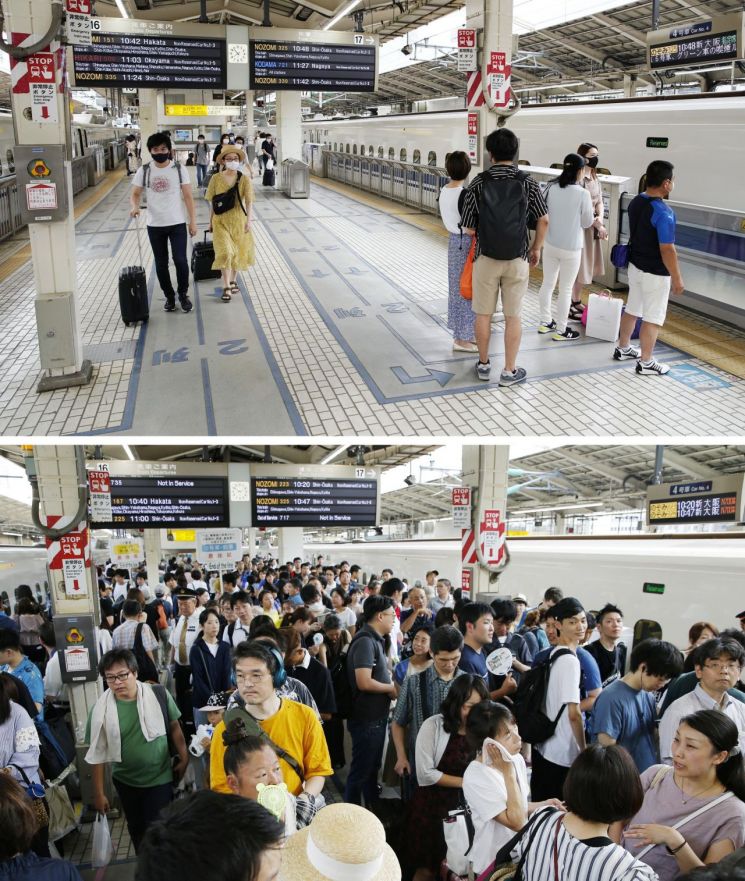
[Asia Economy Reporter Jang Sehee] Japan's economy suffered a greater shock in the second quarter of this year (April to June), when a state of emergency was declared in response to the novel coronavirus infection (COVID-19), than during the global financial crisis.
On the 17th, Japan's Cabinet Office announced that the real gross domestic product (GDP, preliminary figure) excluding price changes for the second quarter decreased by 7.8% compared to the previous quarter, marking a decline for the third consecutive quarter.
The annual real GDP growth rate, calculated assuming this trend continues for one year, is -27.8%.
This is a worse performance than the global financial crisis (Lehman shock) in the first quarter of 2009 (-17.8%), representing the largest contraction since 1955, when related statistics can be back-calculated.
The Japanese government declared the first state of emergency on April 7 in seven metropolitan areas including Tokyo and Osaka, where many confirmed cases were reported, to respond to COVID-19, then expanded it nationwide before lifting it all on May 25. The overlap of the state of emergency period, which restricted outings and travel, with the second quarter had a significant impact on the GDP contraction.
By sector, personal consumption, which has the largest contribution to GDP, sharply declined by 8.2% in the second quarter compared to the previous quarter due to the effects of refraining from going out amid the spread of COVID-19.
Consumption decreased mainly in the service sector such as travel and dining out due to restrictions on outings and business operations during the state of emergency. Corporate capital investment fell by 1.5%, returning to negative growth after two quarters. Exports, centered on automobiles, plummeted by 18.5%, and imports decreased by 0.5% due to weakened demand for crude oil.
Housing investment declined by 0.2%, marking a negative growth for the third consecutive quarter. However, public investment grew by 1.2%.
Meanwhile, although new COVID-19 cases are increasing, the Japanese government expects some recovery in growth in the third quarter (July to September) of this year, during which it will not respond with a state of emergency.
© The Asia Business Daily(www.asiae.co.kr). All rights reserved.

















