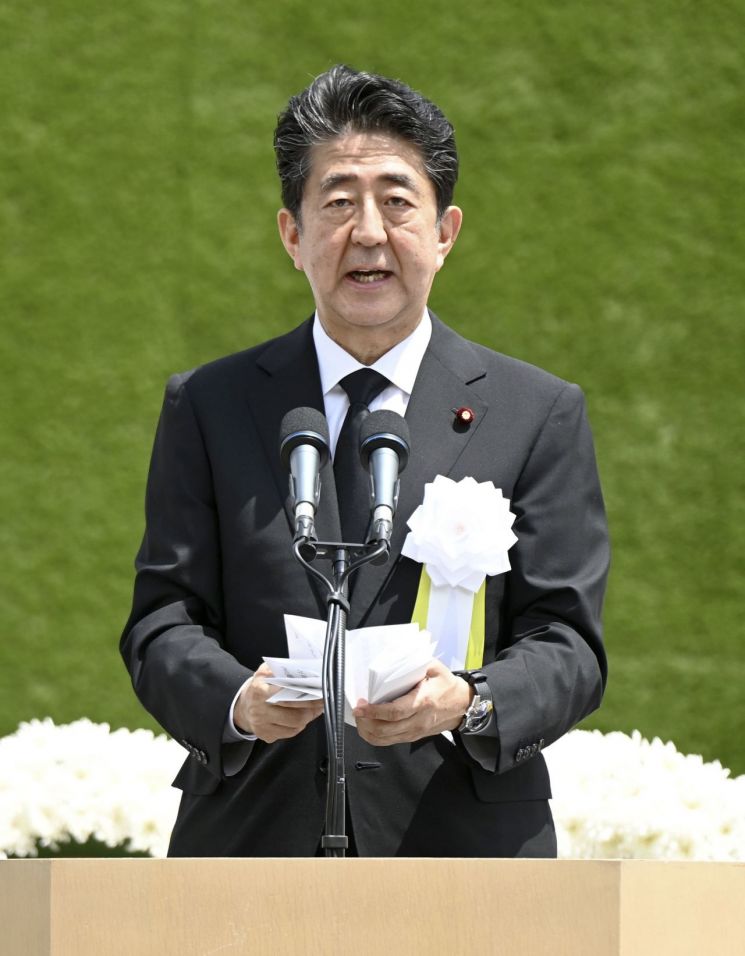
[Asia Economy Reporter Kim Min-young] Japanese Prime Minister Shinzo Abe emphasized "proactive pacifism" at the 75th anniversary event commemorating the end of the Pacific War (defeat) on the 15th. However, there was no mention of responsibility for war aggression.
At the "National Memorial Ceremony for the War Dead" held at Nippon Budokan in Chiyoda Ward, Tokyo, Abe said, "For 75 years after the war, Japan has consistently valued the path of peace," adding, "We have strived to make the world a better place."
He continued, "We will never repeat the horrors of war again, and we will uphold this resolute pledge going forward," emphasizing, "Under the banner of proactive pacifism, we are determined to work with the international community to address the various challenges the world faces now more than ever."
This is the first time since Abe began his second term in December 2012 that he used the term proactive pacifism, which means "security must be maintained by one's own efforts," at a defeat anniversary event.
Until now, Abe had only advocated proactive pacifism through policy speeches in the Diet, using it as a justification for constitutional revision aimed at explicitly enshrining the Self-Defense Forces in the constitution.
At this year's defeat anniversary ceremony, Abe again did not mention Japan's responsibility for war aggression in the past.
Since then-Prime Minister Morihiro Hosokawa in 1993, Japanese prime ministers have acknowledged responsibility for aggression in war, but Abe, who pursues historical revisionism that covers up the dark parts of the past, has not continued this practice for eight years.
Unlike previous years, there were no indirect expressions of reflection such as "humbly facing history" or "engraving the lessons of history in our hearts." This is seen as a clearer indication of the intention not to look back on the dark past.
Japan's Kyodo News pointed out that with discussions intensifying over acquiring the capability for preemptive strikes, which Abe intends to include in new defense policies, questions are being raised about whether the memory of the past horrors is being preserved or drifting away.
Rather than expressing reflection or regret about the past, Abe sent offerings to Yasukuni Shrine, where 14 Class A war criminals who led Japan's imperialist war are enshrined, as in previous years.
Emperor Naruhito, attending the defeat anniversary event for the second time since his accession in May last year, mentioned "deep reflection" again this year.
Emperor Naruhito said, "Although the current peace and prosperity have been achieved through the tireless efforts of the people over 75 years since the end of the war, I am deeply moved when thinking of the many hardships the people have endured," and expressed hope that everyone will unite to overcome the new hardships caused by the novel coronavirus infection (COVID-19) and that happiness and peace will continue.
He added, "Reflecting on the long period of peaceful years after the war and looking back on the past, I sincerely pray that the horrors of war will never be repeated based on 'deep reflection'." The expression of deep reflection by the Emperor began with former Emperor Akihito, Naruhito's father, at the 70th anniversary event in 2015 and has continued this year.
© The Asia Business Daily(www.asiae.co.kr). All rights reserved.
![Clutching a Stolen Dior Bag, Saying "I Hate Being Poor but Real"... The Grotesque Con of a "Human Knockoff" [Slate]](https://cwcontent.asiae.co.kr/asiaresize/183/2026021902243444107_1771435474.jpg)
















