Concerns Over Damage to International Business District Function Following Government's August 4 Real Estate Measures... Seoul City's Position Confirmed: "No Change to Existing Plans"

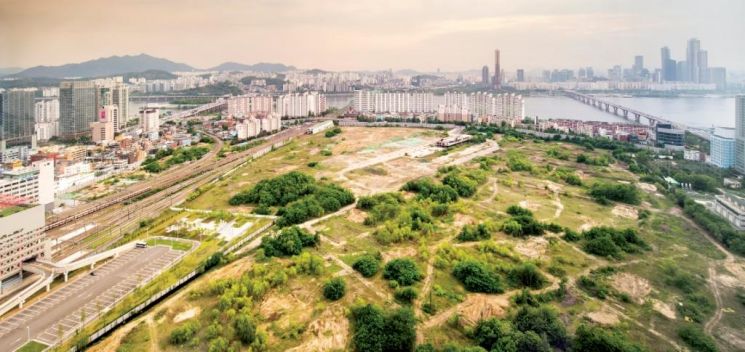
[Asia Economy Reporter Park Jong-il] Yongsan-gu (District Mayor Seong Jang-hyun·photo) has called for the establishment of a development plan for the International Business District (the Yongsan Maintenance Depot site of 510,000㎡ at 40-1 Hangangno 3-ga).
This is due to concerns that the Yongsan International Business District development project might face setbacks following the government's August 4 real estate measures.
On the 4th, the government announced through the ‘Seoul Metropolitan Area and Surrounding Areas Housing Supply Expansion Plan’ that it would supply 132,000 housing units, including new housing site developments such as Yongsan Camp Kim (3,100 units), without prior consultation with the relevant local governments.
The Yongsan Maintenance Depot site is also planned to supply 10,000 housing units by increasing the floor area ratio, which is 2,000 units more than the 8,000 units under the 5.6 measures.
In particular, the increase in housing units compared to the 3,000 units planned in the old International Business District residential development plan established in 2012 has sparked criticism that the core function of the International Business District will be compromised.
However, according to the district office’s confirmation, the International Business District project appears to be progressing without any setbacks so far.
A district official said, “The Seoul Metropolitan Government remains committed to fostering the Yongsan Maintenance Depot as a new hub centered on international business to strengthen Seoul’s urban competitiveness and balance development between Gangnam and Gangbuk,” adding, “Housing supply in the Yongsan Maintenance Depot area is also being reviewed under this principle.”
Seoul City is currently conducting a ‘Yongsan Maintenance Depot Development Guideline Establishment Project’ to create detailed development plans in cooperation with Korail and others. The city plans to complete the designation of the urban development zone and the establishment of the urban development plan by the end of next year.
The district official added, “It is true that there were concerns because housing supply was expanded without specific development plans,” and said, “We will continuously communicate the district’s position to minimize side effects and ensure benefits for residents during the detailed development plan formulation process.”
Furthermore, the official stated, “Unlike Taereung or Gwacheon, Yongsan is in the process of executing existing plans,” emphasizing, “The International Business District project will be pursued without change, and high-quality housing construction befitting its status must be carried out together. We are absolutely opposed to increasing supply solely through rental housing construction as a desperate measure to curb real estate price surges.”
The Camp Kim site is no different. The district plans to strengthen the commercial district functions and supply quality housing so that Camp Kim can be developed as a ‘new business hub in the central Hangangno axis,’ in consultation with the government and Seoul City.
The Yongsan International Business District project, called the ‘largest development project since the era of Dangun,’ first began in 2006 under the government’s ‘Comprehensive Measures for Railway Management Normalization.’ In the same year, Korail launched a bid for the Yongsan Station area development project, and in 2007, together with Seoul City, announced an ‘integrated development’ agreement including Seobu Ichon-dong (Ichon 2-dong).
The master plan was released in 2012. The project implementer, Dream Hub Project Finance Investment (Dream Hub), established development plans within the area for ▲international business facilities and office spaces ▲residential facilities ▲commercial facilities (hotels, department stores, shopping malls, etc.) ▲cultural facilities.
However, due to premature planning, the global financial crisis, and conflicts among investors, the project collapsed in 2013. Dream Hub declared default after failing to pay interest on asset-backed commercial paper. Korail, the largest shareholder, also decided to liquidate the project.
The project resumed in 2016. Korail, having won a lawsuit against Dream Hub to cancel land ownership registration, commissioned the ‘Yongsan Station Area Development Basic Concept and Feasibility Study.’
Alongside this, Seoul City has been continuing the ‘Yongsan Metropolitan Center Future Vision and Realization Strategy (Yongsan Master Plan).’ The Yongsan Maintenance Depot development guideline project is part of this effort.
Korail is also known to have commissioned the Korea Development Institute (KDI) since May to conduct a preliminary feasibility study related to the Yongsan Maintenance Depot development.
Seong Jang-hyun, Mayor of Yongsan-gu, said, “The International Business District is a strategic hub that can drive sustainable growth for the Republic of Korea,” and emphasized, “The development of the International Business District must be resumed so that Yongsan can leap forward as a global central city.”
He also stated, “There is no disagreement between Seoul City and the district regarding maintaining the railway maintenance depot’s function as an international business district,” and stressed, “We will thoroughly consult with the government and Seoul City to relaunch the project, avoiding the unfortunate mistakes made during past project implementation.”
© The Asia Business Daily(www.asiae.co.kr). All rights reserved.

















