'NO Japan 1 Year' 3 out of 4 Consumers "Still Participating in Boycott"
Uniqlo Closes 9 Stores Including Gangnam Branch in August
Japanese Tobacco and Gaming Industries Unaffected by Boycott Movement
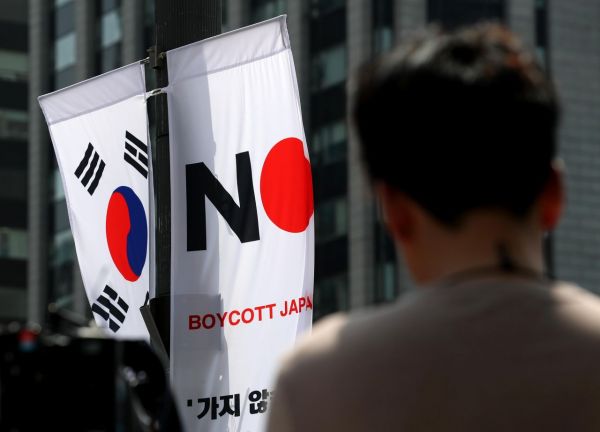 A banner stand installed in August last year on Sejong-daero, Seoul, reading 'No (Boycott) Japan: We do not go, we do not buy.' Photo by Asia Economy DB
[Asia Economy Reporter Heo Midam] "We must not become a nation that forgets its history."
Today (the 15th), on the 75th anniversary of Liberation Day, calls for participation in the boycott of Japanese products are growing stronger. The boycott movement, triggered by Japan's export restrictions in July last year, is still actively ongoing even after one year.
As a result, product categories targeted by the boycott, such as Japanese clothing, beer, and automobiles, are experiencing difficulties due to a sharp decline in domestic sales. In particular, the clothing brand 'Uniqlo,' which emerged as a representative brand of the 'NO Japan' movement, closed nine stores this month alone due to the boycott's impact. Some have evaluated the boycott as largely successful.
However, some industries, such as tobacco and gaming, where substitutes are hard to find, have seen sales increase, leading to criticism that the boycott has transformed into a 'selective boycott' based on consumer needs. Experts emphasize that harshly criticizing those who purchase Japanese products is not appropriate.
Recently, various online communities have posted articles titled 'Japanese Imports Compared to Last Year Amid Japan Boycott,' 'Economic Retaliation No Japan Then and Now,' and 'The Boycott Movement is Eternal.' These posts compare the sales of major Japanese companies before and after the boycott, urging netizens to continue participating in the boycott.
On social media, the 'List of Boycotted Japanese Products' is being shared again. The list includes automobile brands such as Lexus and Honda; electronics brands such as Sony, Panasonic, and Canon; clothing brands such as Descente, Uniqlo, and ABC Mart; and beer brands such as Asahi, Kirin, and Sapporo.
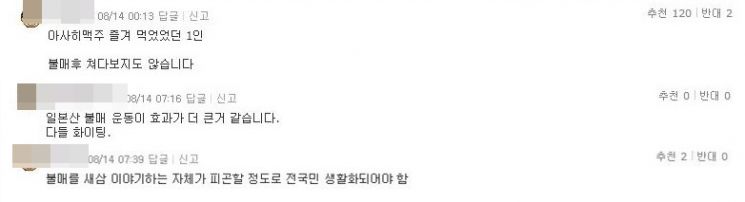 Recently, the boycott movement against Japanese products has been resurging, mainly on online communities. Photo by Online Community 'BobaeDream' Homepage Capture.
Due to citizens' boycott efforts, the performance of Japanese companies operating domestically is plummeting. The Japanese clothing brand 'Uniqlo' decided to close nine stores nationwide, including the Gangnam and Seocho branches in Seoul, throughout August. This is the first time since Uniqlo entered the domestic market in 2005 that it has closed multiple stores simultaneously.
The Japanese passenger car industry also took a direct hit. Although the total automobile import value in the second quarter of this year increased by 17.7% compared to the same period last year, the import value of Japanese passenger cars decreased by 65.6%.
The majority of the public still expresses willingness to participate in the boycott. According to the 'August Consumer Behavior Survey' conducted by the Korea Broadcast Advertising Corporation (KOBACO) on the 12th, 75% of respondents said they are currently participating in the boycott of Japanese products. In other words, three out of four consumers still join the 'NO Japan movement.'
Office worker Kim (27) has also been boycotting for a year. Kim said, "I used to frequently use Japanese cosmetics, but after the 'NO Japan movement,' I have been favoring domestic cosmetics more," adding, "At first, I thought not using Japanese products would be inconvenient because I used many Japanese products like cosmetics, pens, and beer."
He continued, "Now, after a year, not using Japanese products has become a habit," and "If people around me use Japanese cosmetics, I recommend alternative products they can use."
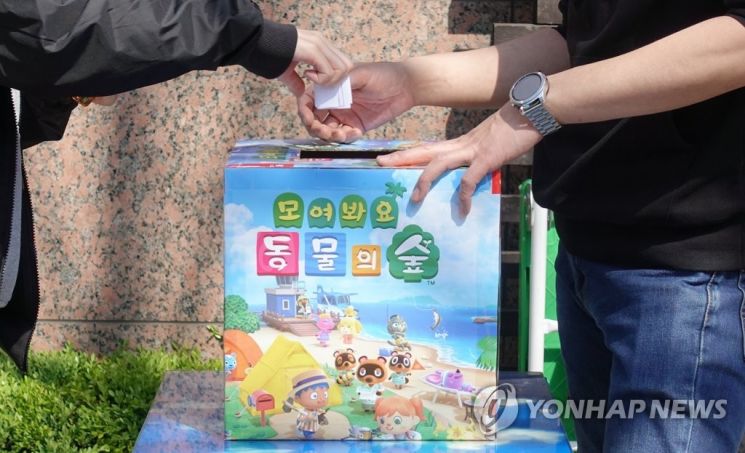 Last April, a citizen was entering a purchase lottery for the Nintendo Switch Animal Crossing edition in front of Sindorim Technomart, Guro-dong, Guro-gu, Seoul.
 [Image source=Yonhap News]
However, the tobacco and gaming industries have avoided the boycott's impact because substitutes are hard to find. In some cases, sales have even increased, leading to criticism of a 'selective boycott.'
A representative example of the 'selective boycott' is the game 'Animal Crossing: New Horizons,' released by the Japanese game company Nintendo last March.
At that time, hundreds of people lined up at stores to get this edition, and nationwide shortages caused netizens to pay premiums just to obtain it.
Office worker Lee (26), who said he purchased 'Animal Crossing,' stated, "'Animal Crossing' is hard to replace with another game. While it would be good to avoid Japanese products, using them is not a sin," adding, "Boycotting or purchasing is a personal choice."
Experts point out that forcing others to participate in the boycott infringes on consumer rights.
Professor Lee Eunhee of Inha University's Department of Consumer Studies said, "The momentum of the boycott itself has decreased compared to last year," adding, "The main boycott items are ▲Uniqlo ▲automobiles ▲beer. Except for these three symbolic boycott items, consumers sometimes buy Japanese products according to their needs. The case of people lining up to buy 'Animal Crossing' is a representative example."
She continued, "It is inappropriate to excessively criticize others for purchasing Japanese products," emphasizing, "While persuasion regarding others' purchasing behavior is possible, infringement is not. To protect consumer rights, harsh criticism should be restrained."
© The Asia Business Daily(www.asiae.co.kr). All rights reserved.
![Clutching a Stolen Dior Bag, Saying "I Hate Being Poor but Real"... The Grotesque Con of a "Human Knockoff" [Slate]](https://cwcontent.asiae.co.kr/asiaresize/183/2026021902243444107_1771435474.jpg)


















