Sampyo Group Utilizes Various Industrial Byproducts as Construction Base Materials for Eco-Friendly Management
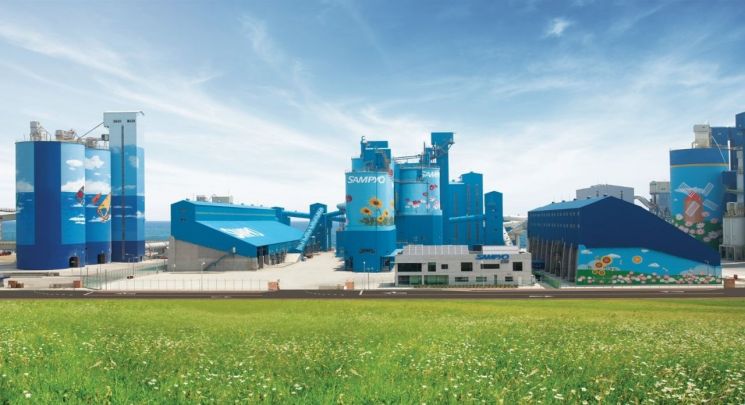
[Asia Economy Reporter Kim Jong-hwa] Cement companies are drawing attention for collecting various industrial wastes and using them to produce cement or blended materials.
Construction basic materials specialist SAMPYO Group has identified eco-friendly business as a future core business and is focusing the group's capabilities on it. This is to fulfill social responsibility by improving the environment and creating new social values through eco-friendly business.
SAMPYO Group's environmental resource business affiliate SP Nature Co., Ltd. operates fly ash factories in three locations: Boryeong and Dangjin in Chungnam, and Suncheon in Jeonnam. It produces blended materials that replace cement in the concrete manufacturing process by utilizing by-products generated from thermal power plants.
At the Dangjin and Cheonan plants, slag generated from steel mills is processed to produce blast furnace slag cement, a construction basic material. In March, SP Nature established a special purpose company (SPC) called 'Costure' with Korea South Power to reduce imports of Japanese coal ash and gradually increase waste recycling rates.
SAMPYO Group is the only company in the industry operating a dedicated organization for eco-friendly business. SP Nature's environmental resource division processes steel scrap, the main material for rebar, by utilizing discarded scrap metal, end-of-life vehicles, and waste home appliances. It also operates eco-friendly incineration plants and wastewater sludge drying facilities, which handle sediment generated from sewage treatment.
Another affiliate, SAMPYO Cement, uses household waste as fuel for cement production. In September last year, it built a 'Combustible Household Waste Fuel Preprocessing Facility' in Samcheok City, Gangwon Province, and has been using combustible household waste as a substitute for bituminous coal, a fuel for cement production. Of the total facility project cost of 2.25 billion KRW, SAMPYO Cement invested 2 billion KRW, and Samcheok City invested 250 million KRW. After completion, SAMPYO Cement donated the facility to Samcheok City.
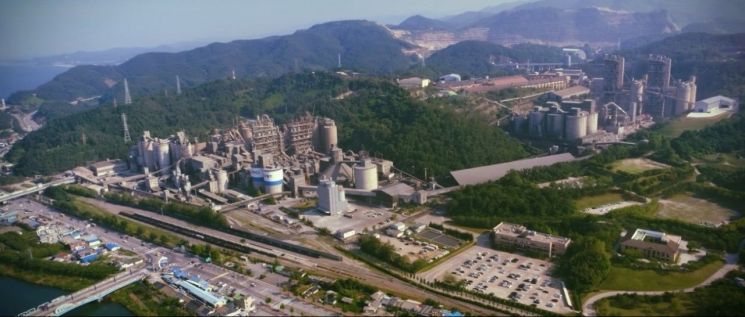
This facility can process 70 tons of household waste per day, and currently about 20,000 tons of household waste per year are utilized as fuel through the facility. From September to December last year, it processed an average of 727 tons of waste per month, and from January to July this year, it processed an average of 820 tons per month, being recognized as a representative win-win model between companies and local governments.
In addition, SAMPYO Cement actively manages air pollutant emissions through the use of a stack automatic measuring system (TMS). This contributes not only to reducing local governments' waste disposal budgets but also to extending the usage period of waste disposal facilities.
In November last year, SAMPYO Group obtained Environmental Product Declarations (EPD) certification for four specifications (△25-35-150 △25-30-150 △25-27-150 △25-24-150) of ready-mixed concrete products produced at 27 business sites nationwide. Earlier in August last year, two mortar products received the highest grade in the 'Eco-friendly Building Material Certification (HB Mark)' from the Korea Air Cleaning Association.
Furthermore, SAMPYO Group produces ready-mixed concrete that meets eco-friendly standards by introducing its own quality standards (SKS·SAMPYO KS), which are stricter than the Korean Industrial Standards (KS). To ensure thorough raw material management and quality differentiation, it operates the 'SAMPYO Concrete Testing and Evaluation Institute' in Hwaseong, Gyeonggi Province, the only internationally accredited testing institute (KOLAS) in the industry.
A SAMPYO Group official said, "We are considering various ways to fulfill corporate social responsibility, public interest, and social value creation, and are actively striving to realize them. Eco-friendly business for resource recycling and environmental improvement is one of SAMPYO Group's practical measures."
© The Asia Business Daily(www.asiae.co.kr). All rights reserved.

![Clutching a Stolen Dior Bag, Saying "I Hate Being Poor but Real"... The Grotesque Con of a "Human Knockoff" [Slate]](https://cwcontent.asiae.co.kr/asiaresize/183/2026021902243444107_1771435474.jpg)
















