Under Social Distancing Level 3, All Remote Classes
Increase in Video Submission Assignments Evaluation
Introduction of AI Learning Tailored for Lower Grades in Elementary School
[Asia Economy Reporter Lee Hyun-joo] Due to the impact of the novel coronavirus infection (COVID-19), the short summer vacation for elementary and middle schools will end next week. The first semester, conducted after an unprecedented online school opening, recorded a remote class participation rate of 98.9%, but issues such as decreased concentration due to the combination of remote and in-person classes, limitations in student-specific feedback, and concerns about the inability to provide emotional and character education through face-to-face interaction were also raised. How will school classes change after experiencing the COVID-19 situation? Based on the measures announced by the Ministry of Education, changes for the second semester are summarized in a Q&A format.
- Will all grades in elementary, middle, and high schools attend school in person starting from the second semester?
▲ Except for the metropolitan area and Gwangju, most regions’ elementary, middle, and high schools will have all grades attend school daily. This aims to supplement the limitations of remote classes and provide educational opportunities for emotionally stable growth by having all students attend school together. However, in overcrowded classes with more than 30 students per class or in large schools with up to 1,000 students, the number of students attending school is expected not to exceed two-thirds. This policy can be autonomously adjusted depending on the school situation. The Gwangju Metropolitan Office of Education, which recommends maintaining two-thirds attendance, stated it will maintain this until the 28th and may implement full attendance from the 31st if social distancing level 1 is maintained during this period. The metropolitan areas of Seoul, Gyeonggi, and Incheon have been instructed to maintain two-thirds attendance in the second semester.
- Is remote learning only used when students do not attend school?
▲ After the first-ever online school opening, schools conducted remote classes. There were three main types: interactive classes using real-time platforms, assignments-based learning, and using pre-recorded content. Based on these models, classes that link online and offline learning are expected to be introduced. In the second semester, the number of classes where teachers stand in front of students as before is expected to decrease significantly. Since some opinions indicated that it is difficult for teachers to conduct classes wearing masks, some schools are preparing to operate remote classes inside classrooms. Depending on the characteristics of each school, class times can be flexibly adjusted as lunch breaks and other times may be extended due to distancing and other quarantine measures. If social distancing is raised to level 3, all classes will be conducted remotely. The Ministry of Education plans to provide class models by grade group and subject to activate various blended classes by the end of this month.
- How will the evaluation of video-based assignments change?
▲ The Ministry of Education presented four types of evaluations related to remote classes. Type I involves assignments using real-time platforms, Type II involves video submissions, and Types III and IV involve assignment-based tasks such as book reports, essays, or submissions via social networking services (SNS). Previously, the Ministry excluded Types III and IV, which are difficult to observe directly, from evaluations and limited Types I and II to arts and physical education subjects. From the second semester, under social distancing level 1, students can choose between performance assessments and written exams. Also, from the next semester, the number of subjects allowing video submission evaluations will increase. For elementary schools, this will expand to all subjects; for middle schools, all subjects except Korean, English, Math, Social Studies, and Science will be recognized; and for high schools, all subjects except basic and inquiry subjects will be eligible. However, assignments where the performer cannot be confirmed, such as assignment-based types, will still not be reflected in evaluations. Exceptionally, assignments completed at home during remote classes and used during in-person classes can be evaluated.
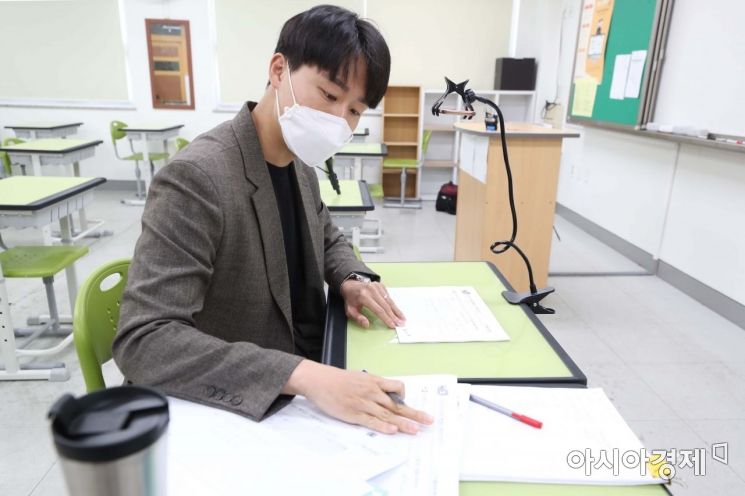 On March 30, a teacher is recording a class video at Hwibong High School in Dongdaemun-gu, Seoul, which was designated as a remote education pilot school. Photo by Mun Ho-nam munonam@
- It is said that a pass grading system will be introduced for middle school 1st and 2nd grades.
▲ When social distancing reaches level 3, evaluations may not be conducted for middle school 1st and 2nd grades. Grades may not be calculated at all, or a pass (PASS) system may be introduced. The Ministry of Education’s policy is "evaluation is not necessarily omitted, and schools can decide autonomously." Even if level 3 is reached, middle school 3rd grade and high school students will have minimal evaluations such as written exams on limited attendance days. When social distancing reaches level 3, creative experiential activities and behavioral characteristics and comprehensive opinions can also be recorded in student records based on remote or non-face-to-face activities.
- What are the plans for AI introduction and utilization to address learning gaps?
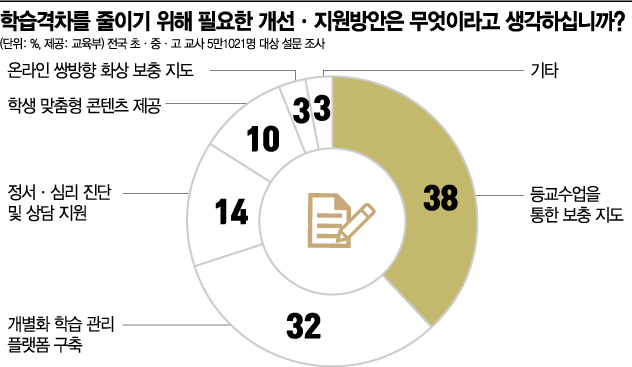
▲ According to the Ministry of Education, among 381,029 parents surveyed, 48% were satisfied with remote classes, but 74% responded that their children were not receiving sufficient learning through remote classes. To supplement this, elementary school lower grades will have full attendance, and artificial intelligence (AI) will be introduced to address learning deficits and improve basic academic skills. Starting in September, for lower elementary grades, math subjects will recommend customized learning content by analyzing individual learning data to predict areas of deficiency. For English, an 'AI Elementary English Speaking Practice System' based on the English curriculum for grades 3 to 6 will be introduced. This system allows practice of words, letters, and free conversation. Full utilization will begin in March next year. For elementary Korean, a program that can diagnose Hangul acquisition levels will analyze each student's vocabulary level and reading tendencies and recommend customized books based on AI. Through this, content for vocabulary learning and post-reading activities will be provided.
© The Asia Business Daily(www.asiae.co.kr). All rights reserved.

![Clutching a Stolen Dior Bag, Saying "I Hate Being Poor but Real"... The Grotesque Con of a "Human Knockoff" [Slate]](https://cwcontent.asiae.co.kr/asiaresize/183/2026021902243444107_1771435474.jpg)
















