Car Association "Sales and Production in Major Countries Show Slower Decline YoY from May to June"
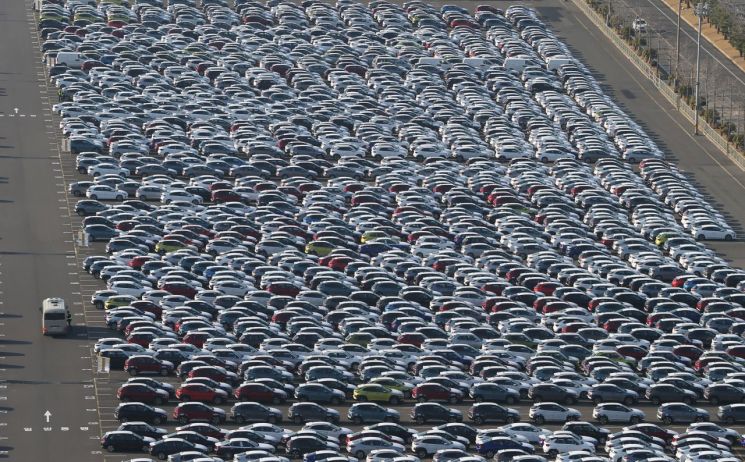
[Asia Economy Reporter Kim Ji-hee] As the decline in sales in major automobile markets slows down from the second half of this year, it is forecasted that the annual automobile sales volume for this year will record the low 70 million units, about 20% less than the previous year.
The Korea Automobile Manufacturers Association announced on the 14th that after reviewing forecast data from major research institutions, automobile sales in 2020 are expected to be between 70 million and 72 million units, a decrease of 18-21% compared to last year's 88.39 million units. Market research firm IHS Markit had predicted in April that the annual automobile sales volume this year would fall below the 70 million mark to 69.6 million units, but due to demand recovering faster than expected despite the COVID-19 pandemic, they slightly raised the forecast to 70.1 million units in June. Last month, Hyundai Motor Global Business Research Institute projected sales in the low 70 million range, and this month GlobalData released an analysis estimating around 73 million units.
Investigations into recent sales and production status in major countries also support this outlook, showing that the decline has been slowing since May and June compared to the same period last year. With signs of demand recovery, the sales decline rate in the second half of this year is expected to ease to around -10%, compared to -29.2% in the first half.
By country, China has shown a noticeable recovery in demand, with sales increasing for three consecutive months since April after hitting a low of -79.1% in February. Developed countries such as Europe, the United States, Canada, and Japan hit bottom in April and May, then showed recovery, recording a softened decline rate in the 20% range in June compared to the previous year. In particular, France saw a 1.2% increase in sales in June year-on-year, supported by subsidy policies. On the other hand, emerging countries such as India, Mexico, and Brazil are experiencing slower demand recovery, with sales still down more than 40% in June due to weakened consumer sentiment caused by COVID-19.
Meanwhile, South Korea’s domestic sales have been increasing for four consecutive months since March. This is analyzed to be largely due to the effects of individual consumption tax cuts and new car launches compared to major overseas countries.
Production in the first half of the year is also showing signs of expansion or a reduction in the rate of decline starting in June. China has maintained continuous growth since recovering 2.3% in April, with production in June soaring 22.5% year-on-year. The United States, Germany, and Canada showed signs of recovery, with production declines improving from 60-80% in May to 20% in June compared to the previous year. Brazil (-58.5%) and India (-59.5%), where sales recovery is delayed, remain stagnant in production volume.
In South Korea, production volume decline is narrowing from -36.9% year-on-year in May to -10.7% in June due to increased export production following demand recovery in advanced overseas countries.
Sales in the second half of the year are expected to see a slowdown in the decline rate compared to the first half, as demand recovery is anticipated not only in China but also in advanced countries such as the United States, Western Europe, and Japan. Sales in these advanced countries showed a 20% decline year-on-year in June, improving to a 10% decline in July, indicating a positive trend.
Emerging countries and other regions also showed reduced sales decline in July compared to the previous month in Mexico, Brazil, and Australia, while Russia even shifted to an increase.
Jung Man-ki, Chairman of the Korea Automobile Manufacturers Association, stated, “It is fortunate that there are signs of global demand recovery in the second half of the year, despite the automobile industry facing difficulties such as liquidity shortages and reduced export orders due to overseas demand contraction caused by COVID-19.” He emphasized, “Until global demand recovers, continuous support policies for smooth liquidity and domestic demand stimulation measures such as a 70% cut in individual consumption tax are necessary.”
© The Asia Business Daily(www.asiae.co.kr). All rights reserved.

















