Visited SH Corporation's Dongdaemun-gu Public Redevelopment Briefing
Unlike Public Reconstruction, Early Popularity Successfully Achieved
Questions Focused on Construction Company, Additional Contributions, Project Speed, and Rental Ratio
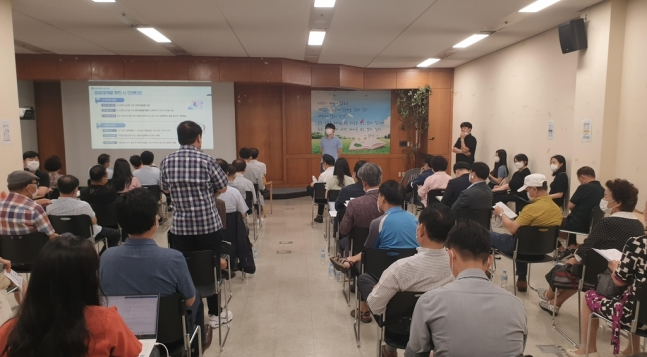 Public Redevelopment Resident Briefing Session
(Seoul=Yonhap News) Photo by Kim Jiheon - On the afternoon of the 13th, at Dongdaemun-gu Office in Seoul, a participant is asking a question to an SH Corporation employee during the public redevelopment resident briefing session.
[Asia Economy Reporter Onyu Lim] "Residents want an A-grade construction company. Even for public redevelopment, is it possible for the complex name to have Samsung (Raemian) or Hyundai (Hillstate) instead of SH?"
On the afternoon of the 13th, about 50 residents from major redevelopment areas in Dongdaemun-gu gathered in the underground company academy room of Dongdaemun-gu Office in Seoul. They were there to attend a public redevelopment briefing session hosted by Seoul Housing and Communities Corporation (SH Corporation) (photo).
Public redevelopment is a redevelopment project promoted with the participation of public entities such as SH Corporation. The core is to provide incentives such as increased floor area ratio, simplified approval procedures, and exemption from the price ceiling system in exchange for increasing rental housing.
The redevelopment areas participating in the briefing included Jeonnong 8, 9, and 12 districts, Cheongnyangni 6 district, and Jegi 6 district. Residents' interest in public redevelopment was surprisingly high. This contrasts with public reconstruction, which has not received much response due to excessive donation requirements.
A resident of Jeonnong 9 district asked about the method of selecting the construction company, saying, "The value of apartments differs by 100 million to 200 million KRW depending on the brand." In response, SH Corporation explained, "The choice of construction company and brand is up to the residents, whether private or public," and added, "It is a misunderstanding to think that the construction quality deteriorates under public redevelopment."
Specific rental ratios were also a concern. SH Corporation explained that the rental supply accounts for 50% of the remaining units excluding those allocated for union members.
SH Corporation particularly stated that choosing public redevelopment can reduce the union members' contribution compared to general redevelopment. While the number of units increases due to exemption from the price ceiling and increased floor area ratio, the fees SH Corporation takes during the project process are only about 4% of design, construction, and supervision costs, so there is room to lower the contribution.
Residents in the early stages of the districts responded relatively positively. A representative of the Jeonnong 9 district promotion committee, which is still in the pre-designation stage, said, "If the rental portion is about 50% excluding the union members' allocation, we are willing to proceed." On the other hand, areas like Dapsimni 17 district, which has already received management disposition approval, and Jegi 6 district, which is about to receive project implementation approval, are cautious. Although additional contributions will be reduced, they have to go through procedures such as architectural review again.
© The Asia Business Daily(www.asiae.co.kr). All rights reserved.

















