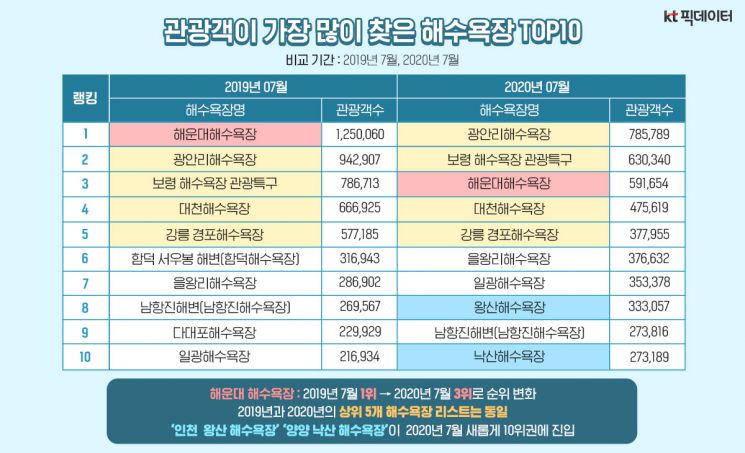
[Asia Economy Reporter Joeslgina] Due to the impact of the novel coronavirus infection (COVID-19), it has been found that this year, more people are visiting lesser-known small and medium-sized beaches instead of famous beaches. Haeundae Beach, which used to suffer from overcrowding every summer and ranked first in visitors, has dropped to third place. It was also confirmed that teenagers prefer Gwangalli Beach, while people in their 50s favor Boryeong Beach.
KT announced on the 14th that this was identified through big data analysis of visitors to major beaches nationwide from June to July this year. This data was calculated based on visitors who stayed for more than 30 minutes at a specific beach, excluding populations residing or working in the area where the beach is located.
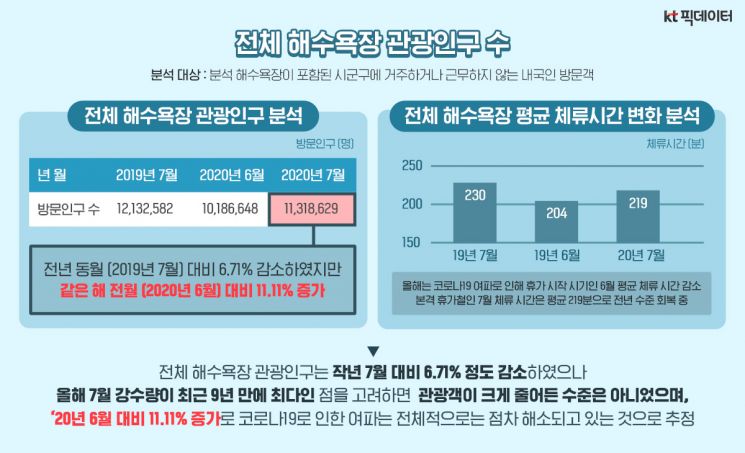
As of July, the total number of beach tourists was 11,318,629, a 6.71% decrease compared to the same month last year, but an 11.11% increase compared to the previous month. KT stated, "Considering that the rainfall in July this year was the highest in nine years, the decrease in tourists is not significant," and added, "It is estimated that the impact of COVID-19 is gradually being resolved overall."
Big data analysis results showed that some small and medium-sized beaches experienced high growth rates in tourists. Compared to July of the previous year, the number of visitors to Nanjiseom Beach (Dangjin, Chungnam, 372.27%), Mosanggae Beach (Namhae, Gyeongnam, 108.01%), Yeongildae Beach (Pohang, Gyeongbuk, 104.48%), Sageunjin Beach (Gangneung, Gangwon, 100.17%), and Jeungsan Beach (Samcheok, Gangwon, 81.47%) increased significantly.
On the other hand, famous beaches such as Haeundae Beach (Busan, -52.67%), Goraebul Beach (Yeongdeok, Gyeongbuk, -48.18%), and Dadaepo Beach (Busan, -47.15%) saw large decreases.
Haeundae Beach, which had maintained the number one spot in visitors, dropped to third place in visitor rankings. Gwangalli, Boryeong, Daecheon, and Gyeongpo Beaches, which ranked 2nd to 5th as of July last year, all remained within the top five but saw a decrease of about 100,000 to 200,000 users. Meanwhile, Wangsanh Beach and Naksan Beach newly entered the top 10.
Popularity by age group also showed differences. Based on July visitors, teenagers and people in their 20s most frequently visited Gwangalli Beach, those in their 30s and 40s preferred Haeundae Beach, people in their 50s favored Boryeong Beach, and those in their 60s and 70s or older mostly visited Gwangalli Beach. KT analyzed that Daecheon Beach was popular among family tourists in their 30s and 40s accompanied by teenagers and children under 10.
Additionally, analysis of visitor residences for the top beaches in July showed that most beaches had many visitors from adjacent cities and provinces including their residence areas, whereas Gwangalli Beach and Haeundae Beach had many tourists residing in Seoul as well as Busan. Furthermore, beaches located in Gangwon Province had more tourists visiting from Seoul and Gyeonggi than from neighboring areas.
Since July this year, KT has been providing the ‘Beach Congestion Traffic Light’ service for 50 major beaches nationwide in cooperation with the Ministry of Oceans and Fisheries to prevent the spread of COVID-19. The beach congestion traffic light service indicates congestion relative to the appropriate number of people: green for 100% or less, yellow for 100-200%, and red for over 200%.
KT aggregates population big data in real time and provides beach congestion data at 30-minute intervals. This allows tourists to check how crowded a beach is in advance, which is expected to have a significant dispersal effect during the vacation season. Beach congestion traffic light status can be checked on the ‘Sea Travel’ website (www.tournmaster.com) and KT’s One Navi.
Kim Chaehee, Executive Director of KT AI/Big Data Business Division, said, “Through this big data statistics, we were able to confirm that the trend of beach visitors is changing due to social distancing caused by COVID-19,” and added, “KT will continue to strive to provide diverse and useful services to the public using big data.”
© The Asia Business Daily(www.asiae.co.kr). All rights reserved.


















