Despite Development Evolution, Divided Opinions on Whether to Intercept with Missiles or Lasers
When Countries Deploy Hypersonic Missiles, Flight Trajectory Prediction Becomes Difficult, Making Interception Challenging
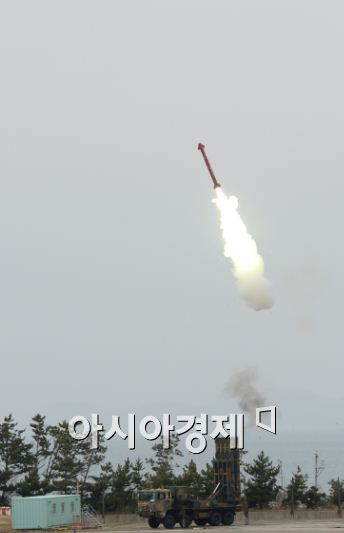 The basic model of 'Cheolmae-II' is a surface-to-air guided missile designed to intercept enemy aircraft flying at medium to high altitudes (10 to 15 km). (Photo by Agency for Defense Development)
[Jang Sang-geun, Former Senior Researcher at the Agency for Defense Development] The operational concept of the Missile Defense System (MD) is as follows. First, an early warning satellite detects the moment a ballistic missile is launched. Because the Earth is round, it is difficult for radar to detect objects beyond the horizon, so the ballistic missile must ascend to a certain altitude before it can be detected by radar. The trajectory of a ballistic missile is adjusted during the acceleration phase when the rocket is firing to ensure the missile is accurately aimed at the target. After the rocket burn ends, the missile flies toward the target by inertia.
Most ballistic missiles separate their warheads during the late ascent phase, and at this time, decoys are also released to confuse the enemy. Above a certain altitude, where there is no air resistance, light decoys follow the same trajectory as the heavier actual warheads.
When entering the atmosphere, air resistance slows down the decoys, distinguishing them from the warheads, but since there is little time left before impact, it becomes difficult for the defense system to respond. Once ballistic missile detection is made using radar, interceptor missiles are launched, and various types of interceptor missiles respond depending on the flight phase of the ballistic missile. These can be classified into systems that intercept during the ascent phase, systems like GMD (Ground Based Midcourse Defense) that intercept during the midcourse phase, and systems like THAAD that intercept during the terminal phase.
Future Missiles Likely to Develop into Intelligent Missiles Using Video Information
Development of Interceptor and Attack Missiles Incorporating Artificial Intelligence (AI) Expected
Ascent-phase interception systems using airborne lasers are also under development, but currently, opinions differ regarding the effectiveness between missile-based interception and energy-based systems such as lasers.
Missile technology is rapidly advancing, and recently, as the performance of missile defense systems (MD) has been enhanced, countries like China, Russia, and the United States are actively developing Hypersonic Weapon technologies such as HGV (Hypersonic Glide Vehicle) to improve survivability. This reflects efforts to invest in research and development to avoid falling behind other countries.
Hypersonic weapons are no longer just weapons seen in science fiction comics. Possessing weapons that can reach targets faster than the opponent will bring victory within reach. While ballistic missiles follow ballistic trajectories that make trajectory prediction relatively easy for defense systems, hypersonic weapons fly to their targets with arbitrary maneuvers, making flight path prediction comparatively difficult. The U.S. X-51A Waverider, HAWC (Hypersonic Air breathing Weapon Concept), and China’s WU-14 are leading examples of system development in this field. The ongoing battle between offense and defense continues, and the U.S. has announced plans to begin research on systems to intercept these Hypersonic Weapons (Hypersonic Defense).
▲ Nuclear Deterrence and Mutual Assured Destruction= Meanwhile, from a strategic perspective on missile development, nuclear deterrence and mutual assured destruction are often discussed. During the Cold War, nuclear weapons were possessed amid intense confrontation, but nuclear weapons were never actually used. The prevailing understanding is that the best way is to prevent their use, and the concept of Mutual Assured Destruction (MAD) ? a state where nuclear war would lead to mutual annihilation ? was established. Strategies to maintain this MAD state are considered by each country.
Missile development incorporates various physics and mathematical theories and integrates numerous advanced technologies from fields such as aerospace, electrical, electronic, computer, and mechanical engineering. More specifically, in control/electronics technology, precision control, intelligent control, navigation sensors, and ultra-small MEMS (Micro Electro Mechanical Systems) technologies are applied. In airframe structure and launch technology, fluid analysis, flow control, thermal protection, autonomous launch, and electromagnetic launch technologies are used. Sensor technologies include antennas, signal processing, semiconductor technology, image processing, wide-area electronic jamming, and space environment technologies.
Information and communication technologies with high applicability include real-time embedded systems, modeling & simulation, information fusion, big data, virtual/augmented reality, Internet of Things, and information security ? all related to the Fourth Industrial Revolution. Propulsion technologies combine high-energy and (hypersonic) engine technologies and thermal management. Material technologies involve intelligent/smart structural materials, intelligent multifunctional composites, and nanomaterial technologies. There are many fields where young talents can contribute to the advancement of missile technology development.
Recently, with the development of microprocessors, sensors, and network technologies, missiles are advancing toward higher intelligence and speed through the sharing of various video information and data. In particular, artificial intelligence (AI) technologies, which are gaining attention in the Fourth Industrial Revolution, are gradually being integrated into missile technologies. Despite these technological advances, it is remarkable that scientific principles from hundreds of years ago still remain unchanged.
© The Asia Business Daily(www.asiae.co.kr). All rights reserved.
















