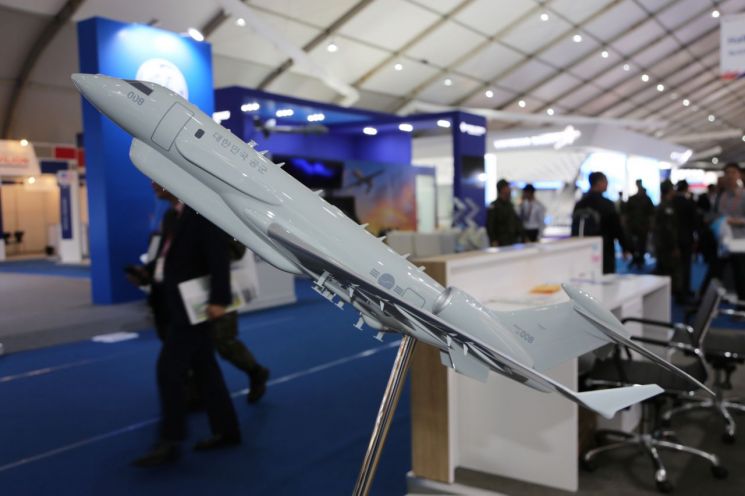
[Monthly Defense Times Editor-in-Chief An Seung-beom] The Joint Mobile Target Surveillance and Control Aircraft project, known as Joint STARS, will be actively pursued during the 2021-2025 Defense Mid-term Plan period.
The Joint Mobile Target Surveillance and Control Aircraft is a ground surveillance and command control aircraft, with plans to begin aircraft acquisition in 2023. The Korean-style Joint STARS aircraft project involves procuring a model tailored to the operational requirements of the Republic of Korea Armed Forces from overseas, securing four units with a budget between 1 and 2 trillion KRW. The goal is to deliver the first aircraft by 2023, the year of the wartime operational control transfer.
Currently, it is known that American companies Raytheon, Boeing, and Northrop Grumman will participate in the Korean Joint STARS project. The U.S. E-8C and the UK ASTOR aircraft are operated as Joint Mobile Target Surveillance and Control Aircraft, but these models no longer have production lines.
The most promising candidate is Raytheon, which developed the UK Royal Air Force’s ASTOR aircraft, proposing the ISTAR-K platform developed for use after the 2020s. The ISTAR-K is based on the Canadian Bombardier Global 6500 business jet platform, with core equipment including the HISAR-500 active electronically scanned array radar and multi-spectral long-range optical devices.
Boeing proposes the canoe-shaped APS-154 radar system mounted on the P-8 Poseidon maritime patrol aircraft. Northrop Grumman plans to participate in the competition by offering a modified version of the RQ-4 Global Hawk high-altitude unmanned reconnaissance aircraft.
Raytheon has signed a Memorandum of Understanding (MOU) with Korea Aerospace Industries’ aerospace division and formed a team to import and modify aircraft and equipment domestically, demonstrating the fastest project responsiveness.
The U.S. E-8C Joint STARS is a discontinued aircraft and not available for purchase, and the downsized model is the UK Royal Air Force’s ASTOR aircraft, of which five units are in operation. The E-8C Joint STARS was active during the 1991 Gulf War, while the UK’s ASTOR was first acquired in 2005 and saw action in the Afghanistan War.
The system developed over time is the ISTAR-K, which has received U.S. State Department export approval since 2018. The detection range for ground mobile targets is known to be up to 250-300 km.
Boeing prioritizes proposing the APS-154 radar system, currently mounted on the U.S. Navy’s P-8 Poseidon patrol aircraft according to mission requirements, to be installed on a naval patrol aircraft platform. However, there is an issue regarding the ambiguity of the operating entity, similar to the F-35B vertical takeoff and landing stealth fighter. Separately, Boeing also has a plan to develop a Joint Mobile Target Surveillance and Control Aircraft equipped with such equipment on a B737NG aircraft.
Northrop Grumman suggests that an additional order of the RQ-4 Global Hawk high-altitude unmanned reconnaissance Joint Mobile Target Surveillance and Control variant would suffice, and since the operator would be the Air Force, this is advantageous in the competition.
Meanwhile, while the Joint Mobile Target Surveillance and Control Aircraft project and the Airborne Signal Intelligence Collection Aircraft project are emphasized in the 2021-2025 mid-term plan, there is concern that the Stand-Off Electronic Warfare Aircraft project might be delayed due to lack of mention.
Moreover, there are rumors that, having lost out in the requirements verification by the Korea Institute for Defense Analyses (KIDA), the project might pivot to the EA-18G Growler close-range electronic warfare aircraft.
© The Asia Business Daily(www.asiae.co.kr). All rights reserved.
![User Who Sold Erroneously Deposited Bitcoins to Repay Debt and Fund Entertainment... What Did the Supreme Court Decide in 2021? [Legal Issue Check]](https://cwcontent.asiae.co.kr/asiaresize/183/2026020910431234020_1770601391.png)