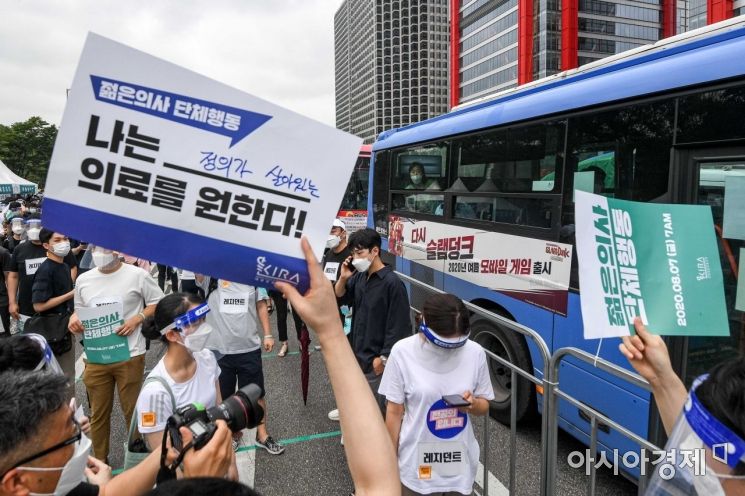
 On the 7th, residents participated in the "National Doctors' General Strike Rally Against the Implementation of the Four Major Medical Evils Policy" held near Yeouido Park in Seoul, urging opposition to the expansion of medical school quotas. Photo by Jinhyung Kang aymsdream@
[Asia Economy Reporter Cho Hyun-ui] On the 14th, more than one out of every four local clinics nationwide will enter a collective strike in protest against the government's medical policies, such as the expansion of medical school quotas. However, since personnel responsible for essential duties such as emergency rooms and medical institutions at the hospital level or higher will not participate, it is expected that there will be no chaos at the level of a medical crisis.
The Ministry of Health and Welfare confirmed that as of 2 p.m. the previous day, 8,365 out of 33,836 clinic-level medical institutions nationwide (24.7%) are expected to enter a collective strike. The ministry stated, "Since it is vacation season, the rate of closures on the day is expected to be higher," and added, "There are currently no reports of hospital-level institutions closing."
Some medical institutions may experience longer outpatient waiting times, causing inconvenience to patients. Kim Heon-ju, Director of Health and Medical Policy at the Ministry of Health and Welfare, stated the day before, "There will be some inconvenience such as longer waiting times for treatment."
However, professors affiliated with general hospitals and doctors engaged in life-critical duties such as emergency rooms, intensive care units, dialysis rooms, and delivery rooms will not participate in this collective strike.
The government has requested the Korean Hospital Association and others to extend treatment hours and maintain the emergency medical system to minimize treatment gaps caused by the collective strike. Major university hospitals have also taken measures such as postponing some surgeries and examinations and reallocating personnel due to concerns about treatment disruptions.
The government will post information about medical institutions operating on the day on the websites of the Ministry of Health and Welfare, the National Health Insurance Service, the Health Insurance Review and Assessment Service, and each city and province. Emergency medical portals and applications (apps) will also share emergency treatment status.
The government has stipulated that if the closure rate of medical institutions in a region exceeds 30%, local governments will issue orders to resume operations to the medical institutions. Medical institutions that violate the order to resume operations may face administrative sanctions such as a 15-day suspension of business.
The large-scale collective strike led by the Korean Medical Association is the third of its kind in the 2000s, following the 2000 pharmaceutical separation incident and the 2014 opposition to telemedicine.
© The Asia Business Daily(www.asiae.co.kr). All rights reserved.
![User Who Sold Erroneously Deposited Bitcoins to Repay Debt and Fund Entertainment... What Did the Supreme Court Decide in 2021? [Legal Issue Check]](https://cwcontent.asiae.co.kr/asiaresize/183/2026020910431234020_1770601391.png)















