[Sejong=Asia Economy Reporter Kim Hyunjung] The government will provide disaster recovery funds to farms damaged by heavy rains. In addition to reinforcing repair facilities to prevent further damage, loans will be implemented, and living expenses of 1.23 million KRW for a family of four will also be supported.
According to the Ministry of Agriculture, Food and Rural Affairs on the 13th, due to the record-breaking heavy rains nationwide since the 1st, as of the 13th, 27,932 hectares of farmland have been flooded, washed away, or buried. Among these, rice damage accounted for 22,304 hectares, making up 80% of the total. This heavy rain caused flooding of 3% of the total rice cultivation area (730,000 hectares). Other crops such as field crops (1,802 hectares), vegetables (1,638 hectares), and special crops like ginseng (698 hectares) were also damaged. Due to the flooding of livestock sheds, about 400 Korean cattle, 6,000 pigs, and 183 poultry including chickens and ducks died.
The government plans to provide disaster recovery funds such as pesticide costs, green onion costs, and living expenses to farms damaged by the heavy rains. Pesticide costs for rice and soybeans are 590,000 KRW per hectare, and for vegetables 1,920,000 KRW per hectare; green onion costs for rice and soybeans are 3,040,000 KRW per hectare, and for fruit and vegetable crops 7,070,000 KRW per hectare. Cattle will be compensated 1,400,000 KRW per head, and living expenses of 1.23 million KRW (based on a family of four) will be supported.
Additionally, the interest rate on agricultural and livestock management funds borrowed by damaged farms will be reduced from the existing 1.5% to 0%. Repayment can be deferred for up to two years. After notifying the list of eligible recipients to the NongHyup (National Agricultural Cooperative Federation) through the town, township, and neighborhood offices, NongHyup will take collective action.
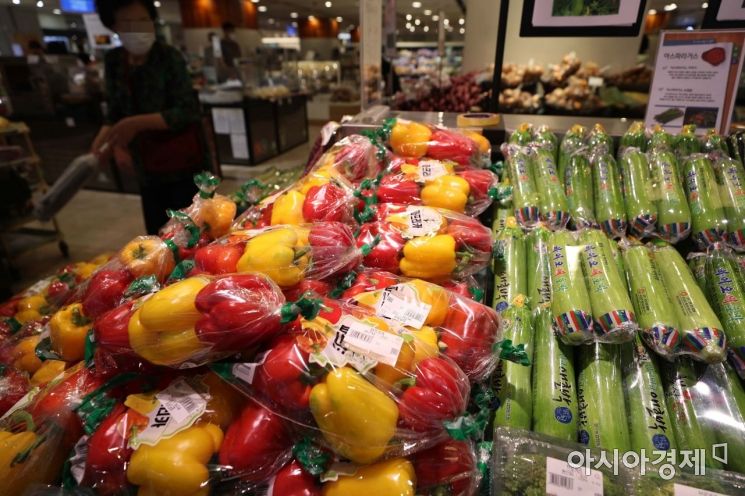 On the 9th, as prolonged monsoon rains and flooding hit, vegetable prices fluctuated while citizens shopped at a large supermarket in Seoul. Photo by Mun Ho-nam munonam@
New loans for disaster countermeasure management funds (interest rate 1.5%) will also be expanded to 100 billion KRW. The loan period is one year. To resolve management crises caused by disasters, 20 billion KRW will be provided as low-interest refinancing funds for existing loans, and emergency living stabilization funds will be loaned interest-free up to 10 million KRW per household for cooperative members in special disaster areas.
To support the restoration of residential facilities in rural areas damaged by heavy rains, additional allocations of rural housing improvement funds will be made to necessary areas, providing loans for housing renovation. This plan supports loans up to 200 million KRW (fixed or variable interest rate of 2%) for housing improvement costs for detached houses with a total floor area of 150 square meters or less.
To facilitate smooth flood recovery, household services such as laundry and cleaning will be provided to 13,000 households including those headed by seniors over 65, multicultural families, and grandparent-grandchild households. For farmers enrolled in crop disaster insurance, livestock disaster insurance, and agricultural safety disaster insurance, damage assessments will be conducted promptly to ensure insurance payments are made without delay.
To prevent pests and diseases such as rice blast, which are expected to surge after the flood, since the 10th, local governments and NongHyup have been mobilizing equipment such as wide-area sprayers and drones to carry out pest control. Priority will be given to pest control in farms with small-scale or elderly farmers who find self-control difficult and in areas with large-scale damage. NongHyup will also provide pesticide discounts of 15-50% and technical guidance necessary for crop growth management.
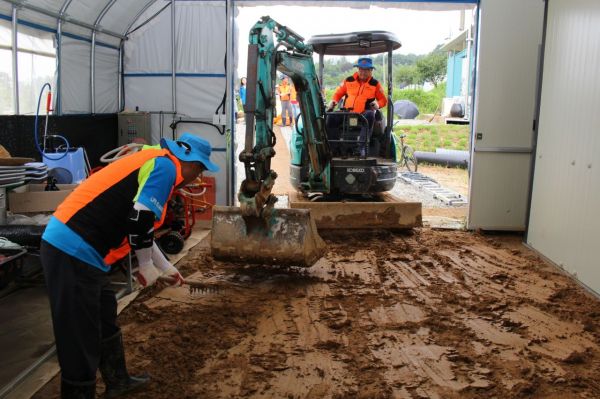
Field personnel support will be deployed to remove and maintain soil around vinyl greenhouses and livestock sheds to minimize livestock damage. In cooperation with local governments, 994 livestock quarantine officers and 866 public veterinarians will be dispatched to livestock-damaged farms to conduct clinical surveillance and emergency animal medical support. Feed support will also be provided to damaged farms in cooperation with the Korean Hanwoo (Korean cattle) Association.
African Swine Fever (ASF) prevention will be strengthened. Using 1,014 disinfection vehicles, extensive disinfection will be conducted on rivers, roads, and farm entrances in border areas, and nationwide disinfection of farms including flood-damaged areas will be promoted. Telephone and text message surveillance for pig farms will also continue.
To help farms quickly resume operations, six agricultural machinery manufacturers will participate in nationwide repair volunteer services for damaged agricultural machinery such as tractors and combines. The repair service, running until the 11th of next month, will be prioritized in special disaster areas and the Seomjin River basin, with other areas starting from the 18th.
Additionally, the Ministry of Agriculture, Food and Rural Affairs will carry out emergency repairs on 22 agricultural drainage pumping stations that have ceased operation due to flooding to enable their restart. ICT-based leakage meters will be installed on reservoir embankments to detect early signs of collapse or other abnormalities. This is being implemented at 1,142 sites with a total storage capacity of over 300,000 tons, with 238 sites (21%) scheduled for installation by the end of this year and completion by 2025. Flood response capabilities will also be enhanced through reservoir overflow expansion, emergency sluice gate installation, and drainage pump replacement.
To alleviate supply instability and stabilize prices caused by temporary shortages of agricultural products due to the heavy rains, supply quantities will be adjusted through flexible release of stockpiled goods. Discount events for vegetables will also be held in cooperation with NongHyup and large supermarkets. Initially, discount events will focus on facility-grown vegetables such as lettuce, young radish leaves, and cucumbers, whose prices surged due to the rainy season. At 2,300 NongHyup Hanaro Mart locations nationwide, special discount sales of "Selling Flood-Damaged Agricultural Products" focusing on lettuce, young napa cabbage, young radish leaves, and cucumbers will be held until the 23rd of this month. Large supermarkets such as E-Mart, Homeplus, Lotte Mart, NongHyup Hanaro Distribution, and GS Retail will provide discount coupons up to 10,000 KRW (20%) for purchasing facility-grown vegetables like perilla leaves and pumpkins, as well as leafy vegetables.
© The Asia Business Daily(www.asiae.co.kr). All rights reserved.


















