Overall Approval Rating, Democratic Party Leads... First Time Since Party Formation
Democratic Party's Support Declines Across All Generations, Significant Drop Among 18-29 Age Group
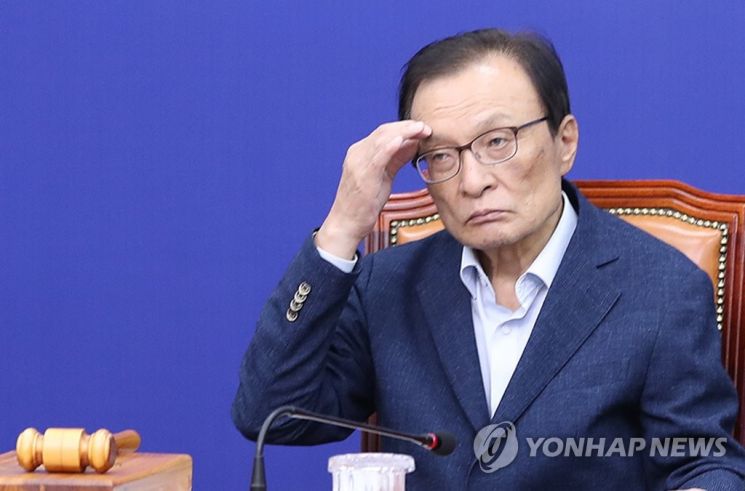 Lee Hae-chan, leader of the Democratic Party of Korea, is listening to a speech at the Supreme Council meeting held at the National Assembly in Yeouido, Seoul, on the morning of June 22.
 [Image source=Yonhap News]
[Asia Economy Reporter Han Seung-gon] As the support rate for the United Future Party surpassed that of the Democratic Party of Korea (DPK) for the first time, the DPK experienced a decline in support across all age groups. In particular, the support rate among those in their 20s and 30s dropped by about half, leading to inevitable criticism that the party has neglected the youth demographic.
Criticism is emerging among young people, suggesting that the handling of the late Park Won-soon, former Seoul mayor’s sexual harassment allegations, the regularization of irregular workers at Incheon International Airport Corporation (In-guk-gong), and successive controversies over real estate policies have influenced the drop in support.
According to the preliminary weekday tally for the second week of August, released on the 13th by Realmeter based on a survey of 1,507 voters nationwide conducted from the 10th to the 12th commissioned by TBS, the United Future Party’s support rate rose by 1.9 percentage points to 36.5% compared to the previous survey.
The DPK’s support rate fell by 1.7 percentage points during the same period, dropping to 33.4%. Age group analysis showed that the DPK could not avoid a downward trend across all generations. Among respondents aged 18 to 29, the DPK’s support rate sharply declined from 45.7% to 28.6% during this period.
Among those in their 30s, who are affected by the Moon Jae-in administration’s real estate policies, the DPK’s support rate fell by more than 20 percentage points, from 58.8% to 38.0%. Support among those in their 40s dropped by over 10 percentage points, from 59.1% to 47.1%. The support rate among those in their 50s plummeted by more than 30 percentage points to 24.9%. Support among those aged 60 and above was halved, falling from 44.8% to 21.8%.
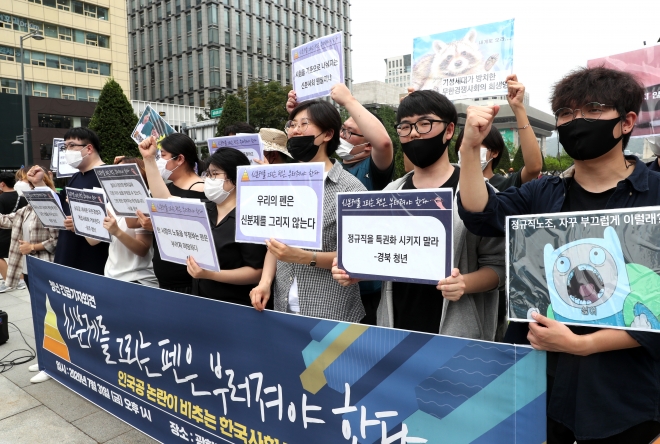 On the afternoon of the 31st of last month, members of the Youth Union held an "Emergency Youth Press Conference on the Controversy over Regular Employment at Incheon International Airport" at Gwanghwamun Square in Seoul.
 [Image source=Yonhap News]
Youth in their 20s immediately raised the issue of the 'In-guk-gong' incident. Kim, a job seeker, said, "I want to ask if young people’s perspective on the In-guk-gong incident is still simply seen as a problem stemming from 'fake news,'" emphasizing, "This issue remains unfair. Job seekers in their 20s have significant dissatisfaction with this matter."
Meanwhile, harsh criticism was also directed at the DPK’s handling of the late Park Won-soon’s sexual harassment allegations. A woman in her 30s working at a company in Seoul said, "What stuck with me while reading the articles was the secondary victimization by DPK members," expressing frustration over the statement, "'To treat former Mayor Park as a perpetrator is defamation of the deceased’s honor,'" adding, "That comment basically means not to say anything at all, which was absurd."
Park, a company employee in his 30s who is sensitive to government real estate policies, said, "It is good that the government is making efforts to stabilize housing prices," but added, "The problem is whether the policies are appropriate. I don’t oppose real estate policies just because of a particular party or administration. On weekends, real estate criticism rallies are held, so please listen carefully to what they say."
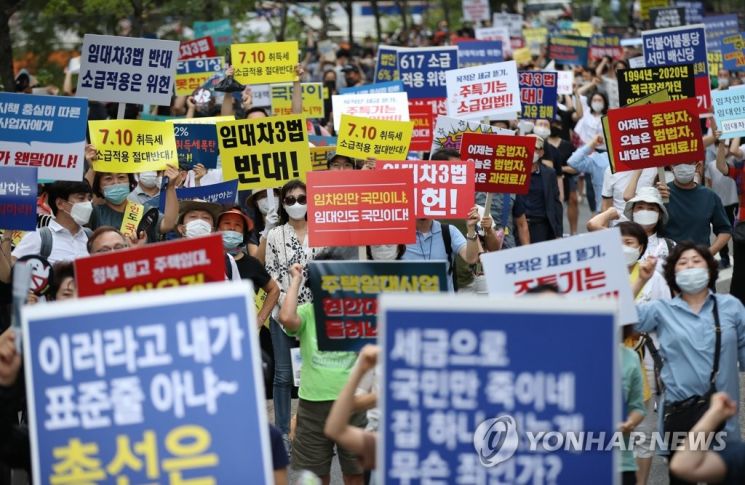 On the afternoon of the 25th last month, participants of the "Candlelight Rally Against the Overuse of Retroactive Real Estate Regulation Policies, Nationwide Tax Resistance Movement" shouted slogans in front of the Korea Deposit Insurance Corporation in Jung-gu, Seoul.
 [Image source=Yonhap News]
Previously, even pro-Moon Jae-in communities such as mom cafes posted comments like "This government’s real estate policy is a failure." On the 1st, a post titled "Jeonse prices continue to rise due to the three lease laws" was uploaded on the Naver mom cafe 'Moms Holic.' Comments criticizing the Moon administration’s real estate policies, such as "All the measures the government introduced to control housing prices ultimately just raise taxes" and "Real estate policy is a failure," were posted under the article.
The analysis of the DPK’s declining support rate by polling agencies is not much different from the youth’s criticism.
A Realmeter official interpreted, "Amid worsening public opinion on real estate policies, the 'fearless middle kick' targeting moderate voters?such as United Future Party lawmaker Yoon Hee-sook’s speech at the plenary session, visits to flood recovery sites in Honam, calls for a proactive 4th supplementary budget, and the inclusion of the May 18 spirit in the party platform draft?played a role."
Voices of self-reflection also emerged within the DPK. On the 12th, Representative Yang Hyang-ja explained in an interview with CBS Radio’s 'Sisa Jaki Jung Kwan-yong' that the causes of the DPK’s declining support rate included "(the incidents involving former mayors such as Park Won-soon), the Incheon International Airport Corporation incident, and housing issues, which have continuously led to a drop in support." She added, "People had expectations and trust when they made the DPK the ruling party in the general election, but even a slight disappointment leads to greater disillusionment."
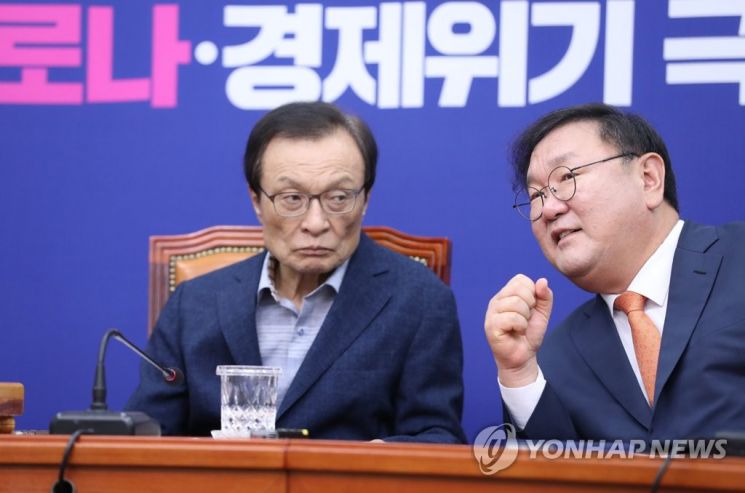 Lee Hae-chan, leader of the Democratic Party of Korea, and Kim Tae-nyeon, floor leader, are talking at the Supreme Council meeting held at the National Assembly in Yeouido, Seoul, on the morning of the 8th of last month.
 [Image source=Yonhap News]
On the 13th, Park Ju-min, a candidate for the DPK party leader, posted on his Facebook that the recent decline in the party’s support rate is "clearly a warning from the people to our party," and expressed "reflection." He added, "Seeing the recent drop in support makes me deeply contemplate the party’s innovation and future."
Park emphasized, "I will innovate. I will communicate with party members and work together with the people," adding, "The party should have taken on the role of directly persuading the people, but ultimately fell short. I feel responsible and reflect on this. I will change." He continued, "We will increase opportunities and channels for the party to communicate directly with the people. We will use this as a chance to reaffirm the importance of social dialogue and consultation and create a party open to the voices of the people."
There is also a view that the cause of the decline in support is related to real estate policies. Gyeonggi Province Governor Lee Jae-myung, after attending the 'Gyeonggi Province Policy Forum for the Introduction of a Fair Procurement System' held at the National Assembly Members’ Office Building on the 13th, told reporters that the biggest cause of the DPK’s declining support rate is "the real estate issue," adding, "It seems the people have some new expectations. Politics should always respect the will of the people and improve their lives, and I see this as a whip urging us to make more efforts."
Meanwhile, Kim Jong-in, the emergency committee chairman of the United Future Party, said to reporters after the emergency committee meeting on the same day (the 13th), "Because the people of our country are wise, they have evaluated what was done well and what was done poorly," but added, "Support rate polls are just one trend. There is no need to discuss various issues based on them." He emphasized, "It is important to quietly do what the party can do and produce results."
© The Asia Business Daily(www.asiae.co.kr). All rights reserved.



















