[Asia Economy Reporter Lee Ji-eun] The top 10 policies of the United Future Party, embracing progressive values such as basic income and economic democratization, were unveiled on the 13th. This is an attempt to broaden the party's spectrum, which has been skewed toward conservatism, to the center. The policies include criticisms of the current government's real estate policies and ruling party figures, along with alternatives.
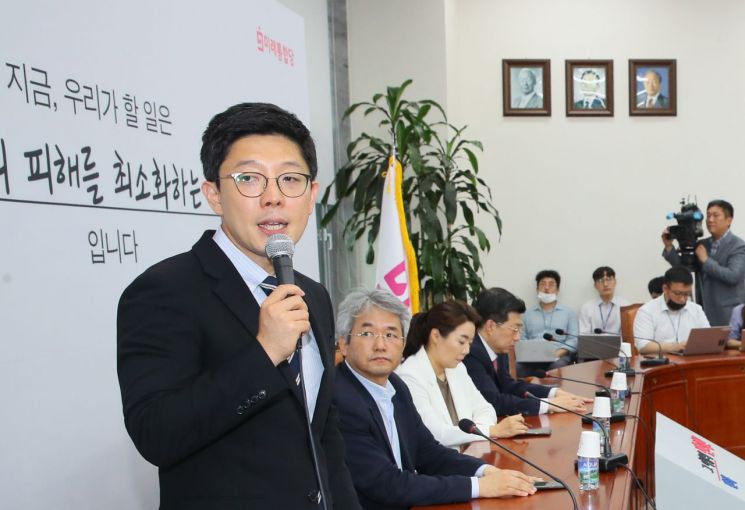
On the 13th, Kim Byung-min, Chair of the United Future Party's Special Committee on Party Platform and Policy, said, "These policies do not represent one side's ideology or stance, but include areas that no party has reformed."
The 10 policy directions prepared by the special committee are: ▲ A country of opportunities open to all ▲ Economic innovation leading future changes ▲ Accompanying the vulnerable and realizing economic democratization ▲ A society where all workers are respected ▲ Political reform made together with the people ▲ Judicial reform for all ▲ A clean planet and sustainable Korea ▲ A country where my life is free ▲ A gender-equal society where both men and women are happy ▲ Diplomacy and security opening our tomorrow.
Specifically, the detailed plans within these policy directions include ▲ Basic income ▲ Lowering the age of eligibility for election ▲ Abolishing the Office of Civil Affairs and the Office of Personnel ▲ Abolishing the president's authority to appoint public broadcasting CEOs ▲ Abolishing TV license fees ▲ Introducing a running mate system for metropolitan governors and superintendents of education.
In particular, the first policy task, basic income, was also the first topic raised by Kim Jong-in, the United Future Party's Emergency Committee Chairman, after his appointment. Chairman Kim said, "We included basic income as the first policy task," adding, "The state should support people to live free and stable lives through basic income, meaning to respond to the Fourth Industrial Revolution."
He also emphasized the introduction of a zero-tolerance principle for admissions fraud in the context of 'fair opportunity.' Chairman Kim stated, "The 'Cho Kuk incident' brought fairness, transparency, and admissions issues to the forefront as a national issue, but the current government has not come up with measures to establish any zero-tolerance principle," explaining the purpose of its introduction.
To solve the real estate problem, which has become the 'Achilles' heel' of the Moon administration, the party proposed easing supply and financial regulations. Chairman Kim said, "We will supply sufficient housing in desirable areas and ease financial regulations so that anyone who works hard can own a home," adding, "We will definitely solve the problem of skyrocketing real estate prices under the Moon administration."
He also mentioned Kim Tae-seop, a Democratic Party lawmaker who was disciplined for violating party lines, saying, "We will minimize party-line voting and guarantee legislative activities based on the constitution and conscience."
The party plans to reduce the president's personnel authority by abolishing the Office of Civil Affairs and the Office of Personnel. Chairman Kim said, "(The Moon administration) promised that the president would not hold absolute power in the Blue House, but even in the fourth year, such a situation has not changed," adding, "The prime minister's basic personnel authority and the personnel authority of each minister should be guaranteed."
Regarding a 'gender-equal society,' he also stressed the need to prepare a manual to prevent secondary victimization. Chairman Kim said, "Sexual violence still occurs in the public sphere of our society," adding, "Although the social problem was exposed due to the late Mayor Park Won-soon's case, secondary victimization against victims continues unabated."
Regarding the previously announced 'four-term limit for lawmakers,' the party plans to implement it without retroactivity, treating current lawmakers as equivalent to first-term members. Chairman Kim said, "If the content passes, current lawmakers in 2020 will only be able to serve until 2032," adding, "We will be going down a path never taken before." The United Future Party plans to prepare its party platform and policies by the end of next month after revising the party name. Legislation on mandatory youth nominations for local councils and lowering the age of eligibility for youth candidates is also expected to be completed before the 2022 local elections.
© The Asia Business Daily(www.asiae.co.kr). All rights reserved.

















