"Signs of Housing Price Stabilization"... Government and Ruling Party Fuel Real Estate Public Sentiment
Opposition "Doubt Their Ears" "President's Sole Opinion" Criticism
President Moon's Approval Rating Drops... United Party Surpasses Democratic Party in Party Support
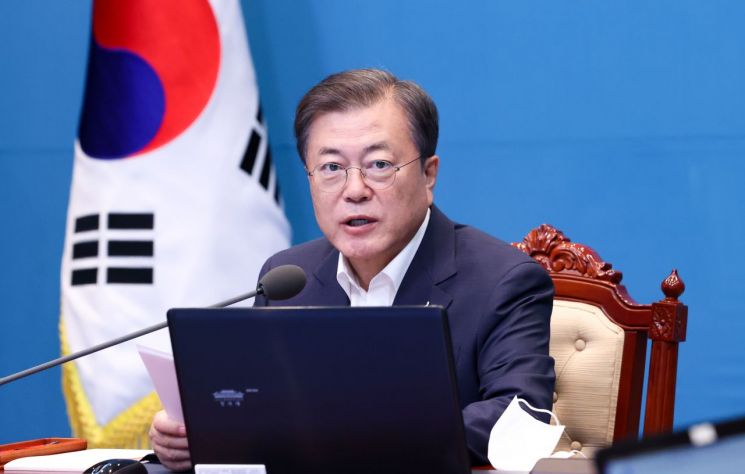 President Moon Jae-in is presiding over a senior secretaries and aides meeting at the Blue House on the afternoon of the 10th. Photo by Yonhap News
[Asia Economy Reporter Kim Ga-yeon] As voices of citizens opposing the government's real estate regulation policies grow louder, criticism is emerging that the ruling party is out of touch with public opinion, following repeated remarks within the party that "the rate of house price increases is stabilizing."
Citizens raised their voices, saying that the ruling party not only lacks understanding of the lives of ordinary people but is also pushing policies forcefully. Criticism has also come from the political sphere for failing to gauge public sentiment.
Experts suggested that the government is speaking out of touch with the public's experience and recommended presenting realistic measures to soothe public sentiment.
Lee Ho-seung, Chief Secretary for Economic Affairs at the Blue House, said on June 12 on CBS Radio's 'Kim Hyun-jung's News Show,' "Since the announcement of the tax strengthening measures on July 10, the rate of increase in housing prices in Seoul has shown a downward stabilization trend from 0.11 to 0.04, and this downward stabilization trend is expected to continue. We will soon be able to confirm the market stabilization effect more clearly."
Lee added, "Real estate market stabilization will definitely be achieved, and the government’s efforts in that direction will not stop. By renewing contracts for two years plus two more years and introducing a system that limits rent increases to 5% upon contract renewal, there is some impact on new tenants. Based on past experience, jeonse (long-term lease) prices will also recover stability."
Jin Sung-jun, Chairman of the Democratic Party's Strategic Planning Committee, also said on the same day on KBS Radio's 'Kim Kyung-rae's Strongest Current Affairs,' "After the announcement of the July 10 real estate measures, the housing transaction volume in Seoul has plummeted to one-tenth of the previous level. Also, the apartment price increase rate continues to decline. Many experts say that the leading indicators to watch for real estate market stabilization are transaction volume and price increase trends."
Regarding criticism from the opposition, he pointed out, "We should work together to stabilize house prices, but the opposition keeps saying otherwise. It makes one suspect that they might be hoping for house prices to rise or even inciting it."
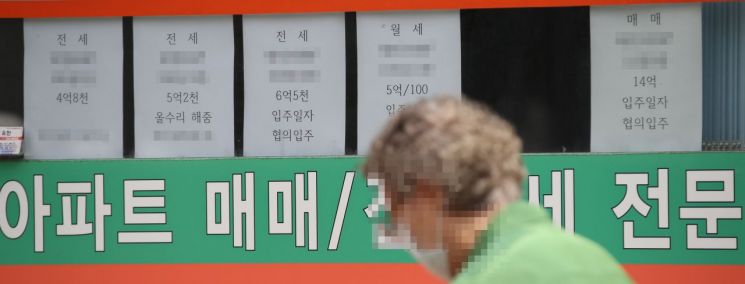 An analysis by a private research firm revealed that the average price of apartments in Seoul has surpassed 1 billion KRW. The photo shows a real estate office in Mapo-gu, Seoul, on the afternoon of the 12th. Photo by Yonhap News
With positive evaluations of real estate policies coming from the Blue House, the Democratic Party appears to be lending its support.
President Moon Jae-in said at the Blue House senior secretaries and aides meeting on the 10th, "The overheated housing market is beginning to stabilize, and the upward trend in house prices is showing signs of calming down." He added, "As the effects of the measures take full effect, this trend is expected to accelerate."
When criticism from citizens followed this remark, the Blue House defended President Moon's statement, saying, "It is true that the rate of house price increases has slowed over the past month."
Regarding these statements from the government and the Democratic Party, citizens expressed frustration, saying, "They have no grasp of reality whatsoever." Despite growing public criticism of real estate policies, there were continued accusations that the government is ignoring the voices of the people.
Citizens continued their criticism with remarks such as "Is it considered stable if prices just stop rising amid a housing price explosion?", "Who would believe it when they say it's stable after raising all the house prices?", "Are they from another planet?", "They are trying to avoid responsibility for policy failure," and "It truly is a 'country never experienced before.'"
In particular, criticism has been raised regarding the Korea Appraisal Board statistics cited by Lee and others as evidence of the 'real estate market stabilization.' The housing price statistics from KB Kookmin Bank and the Korea Appraisal Board differ due to differences in samples and calculation methods, resulting in different values.
On May 23, Minister of Land, Infrastructure and Transport Kim Hyun-mi responded during a parliamentary economic sector questioning session to the question, "How much do you think house prices have risen?" by saying, "According to the Korea Appraisal Board statistics, I understand they have risen by 11%." However, according to KB Kookmin Bank statistics, the median apartment price in Seoul rose by 52% over the three years of the Moon Jae-in administration, showing a significant difference.
Public opposition to the government and ruling party can also be seen in recent opinion polls. According to a survey conducted by Realmeter commissioned by TBS from June 10 to 12 with 1,507 voters nationwide, President Moon's approval rating was 43.3%, down from the previous week. Negative evaluations of his administration rose by 0.1 percentage points to 52.5% compared to the previous week.
In particular, party support ratings showed the Democratic Party and the United Future Party at 33.4% and 36.5%, respectively. The gap in support is within the margin of error at 3.1 percentage points, but the United Future Party has overtaken the Democratic Party for the first time since its founding. A Realmeter official analyzed, "Amid worsening public opinion on real estate policies, the United Future Party gained the support of moderate voters through Representative Yoon Hee-sook's speech at the plenary session, visits to flood recovery sites in Honam, calls for a proactive 4th supplementary budget, and the inclusion of the May 18 spirit in the party platform draft."
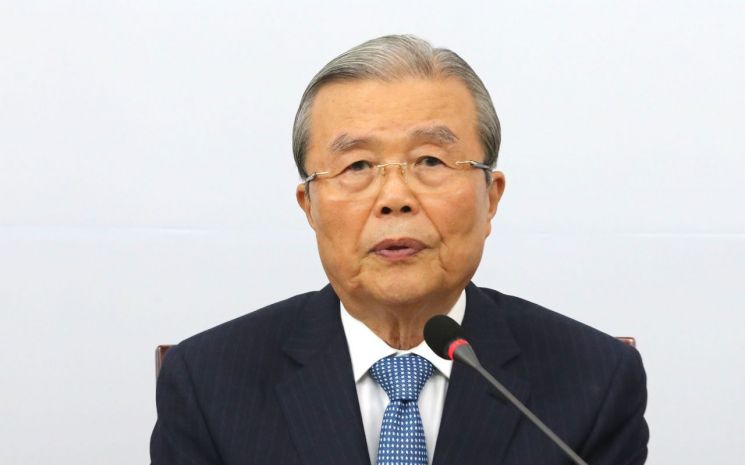 Kim Jong-in, Emergency Response Committee Chairman of the United Future Party / Photo by Yonhap News
The opposition party immediately voiced criticism of the government policies and a series of ruling party actions.
Kim Jong-in, Emergency Committee Chairman of the United Future Party, met with reporters at the National Assembly in Yeouido, Seoul, on the 11th and strongly criticized President Moon's remark that "house prices are stabilizing," saying, "That is the president's personal opinion. Whether real estate policies are effective or not is a matter for the general public to judge, not something the president can declare alone."
Kim Eun-hye, spokesperson for the United Future Party, also said in a statement, "I couldn't believe my ears," and criticized, "I have no words for the self-praise that real estate measures are showing effects in front of desperate citizens." She added, "Is there some other reason why the president cannot take a single step back from his real estate policy, which he claimed confidence in during his speech earlier this year? It seems the Blue House is becoming a lonely castle, a secluded palace."
Choi Hyung-doo, floor spokesperson for the United Future Party, also questioned, "Are they listening to the worries of ordinary people who are 'monthly rent sharecroppers'?" He said, "The president's anti-economic analysis and prescriptions on real estate issues are shattering the dreams of homeownership for ordinary people and the younger generation. In an already scarce job market, pouring most of their salary into enormous monthly rent, the Blue House has no idea about a future where saving for a home is just a dream."
Experts analyzed that while the real estate market has temporarily entered a lull, it is premature to say it has stabilized.
Political commentator Lee Jong-hoon said on YTN's 'Night Focus' on the 11th, "Because the statements are so different from the feelings experienced in the housing market, criticism arises first. At first glance, the remarks might make one think 'have house prices started to decline?' but upon closer examination, it means the rate of increase is stabilizing. There are criticisms that this might cause a kind of optical illusion."
Regarding the citation of Korea Appraisal Board statistics, he said, "The Korea Appraisal Board statistics are not frequently cited in the market. The housing transaction increase rates announced by KB Kookmin Bank and related statistics are cited more often. The Blue House suddenly brought out the Korea Appraisal Board statistics, so there is criticism that they are selectively using favorable statistics."
He added, "It is clear that the market has temporarily entered a wait-and-see phase. Since the government has simultaneously released multiple real estate measures, anyone intending to buy a house would hesitate and reconsider. This is a temporary lull. It is somewhat premature to immediately consider the market stabilized based on statistics from this period."
© The Asia Business Daily(www.asiae.co.kr). All rights reserved.



















