Ruling Party's Push for Lease and CIO Bills Spurs Public Desire for Checks
United Future Party's Swift On-Site Actions Play a Role
Opposition Gains by Default, Critics Note Reflexive Benefit
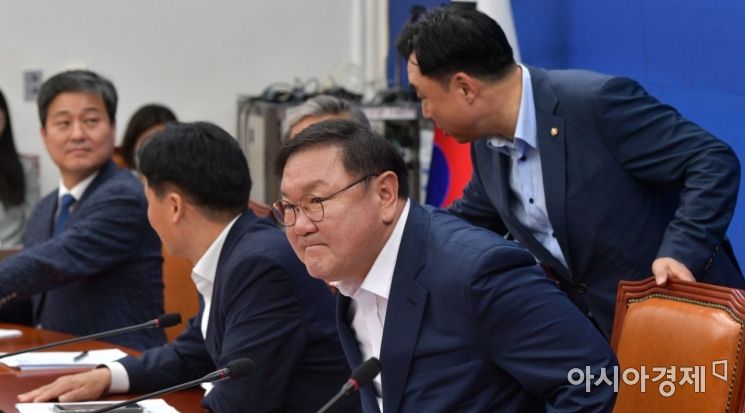 Kim Taenyeon, floor leader of the Democratic Party of Korea, is attending the policy coordination meeting held at the National Assembly on the 6th. Photo by Yoon Dongju doso7@
[Asia Economy, reporters Lee Jieun and Kang Nahum] The Democratic Party of Korea has ceded its lead in approval ratings to the United Future Party. As the "crisis theory" surrounding the Democratic Party, which had confidently pushed forward with reform legislation based on its 176 seats, gains traction, the relationship between the ruling and opposition parties is entering a new phase.
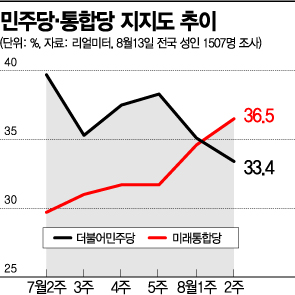
According to the results of a Realmeter poll released on August 13 (commissioned by tbs, 1,507 respondents, response rate 5.3%, margin of error ±2.5 percentage points at a 95% confidence level; for details, refer to the National Election Survey Deliberation Commission website), the United Future Party recorded a record-high 36.5% approval rating since its founding, surpassing the Democratic Party's 33.4%. This reversal in approval ratings between the two parties is the first in 46 months since the impeachment crisis in October 2016.
The decline in the Democratic Party's approval rating is largely attributed to the controversy over its "ruling party's unilateral dominance." The party, having monopolized standing committees and forcefully passed real estate policy bills and three follow-up laws for the Corruption Investigation Office for High-ranking Officials (CIO) based on its 176 seats, is seen as having provoked a public desire for checks and balances. In particular, the backlash from real estate policies, controversies over multiple home ownership among Blue House aides, and the sexual assault allegations involving the late Park Wonsoon, former mayor of Seoul, have further inflamed already negative public sentiment.
In contrast, the United Future Party, perceived as the "underdog," has garnered sympathy and focused on public debate rather than street protests that had previously drawn public disapproval. Notably, the party has also taken a more proactive approach than the Democratic Party in response to recent national disasters such as flood damage.
Despite this reversal in approval ratings for the first time in about four years, the United Future Party has remained composed. Kim Chongin, the party's emergency committee chairman, told reporters that day, "We simply take this as a trend for reference; there is no need for further comment," adding, "We will do what we can for the future, and we will be judged by our results." He emphasized, "The public is wise enough to judge for themselves what is done well and what is not."
Kim Manheum, director of the Korea Political Academy, said, "Dissatisfaction with the ruling party and changes in the United Future Party have acted in combination. In the case of the ruling party, the way it handled real estate bills fueled public resentment, which led to a sharp drop in approval ratings," adding, "On the other hand, the United Future Party's changes since the 'Kim Chongin system' seem to have been effective in boosting its approval ratings."
However, some argue that the rise in the United Future Party's approval rating is not solely due to its own merits, but rather a reflection of the ruling party's decline. Kim Hyungjun, vice president of the Korean Political Science Association, said, "The United Future Party did not earn its approval rating through its own efforts. It appears to be a reflexive effect stemming from negative sentiment toward the government and ruling party." He added, "While real estate policy is an issue, the United Future Party's dismissive attitude toward it has been a bigger problem. The party's recent personnel reforms have also been less than impressive."
Kim Yongho, professor of political science and diplomacy at Inha University, also commented, "The United Future Party is benefiting by default. Aside from arriving at flood recovery sites slightly earlier than the Democratic Party, there is little to commend. There is no visible leadership, no clear policy alternatives, and the party has yet to clarify its stance on the impeachment issue."
Nevertheless, unless the Democratic Party finds a turning point, many predict that this trend in approval ratings will continue for some time. Accordingly, some analysts suggest that the Democratic Party may seek to moderate its approach, for example by seeking opposition cooperation in pursuing future reform legislation.
The Democratic Party currently faces major issues such as the launch of the CIO and the relocation of the administrative capital. All of these require opposition cooperation. During a dinner meeting on August 6 with Joo Hoeyoung, floor leader of the United Future Party, Kim Taenyeon, floor leader of the Democratic Party, expressed his apologies for pushing through real estate-related bills, which could be seen as a signal for bipartisan cooperation. Attention is focused on whether the Democratic Party will show a different approach to parliamentary management in response to its approval rating crisis.
© The Asia Business Daily(www.asiae.co.kr). All rights reserved.

















