Even with the 'Water Management Basic Act', It Remains Ineffective
Mainstream-Tributaries-Power Dams Managed Separately
Meanwhile, K-water and Meteorological Agency Blame Each Other
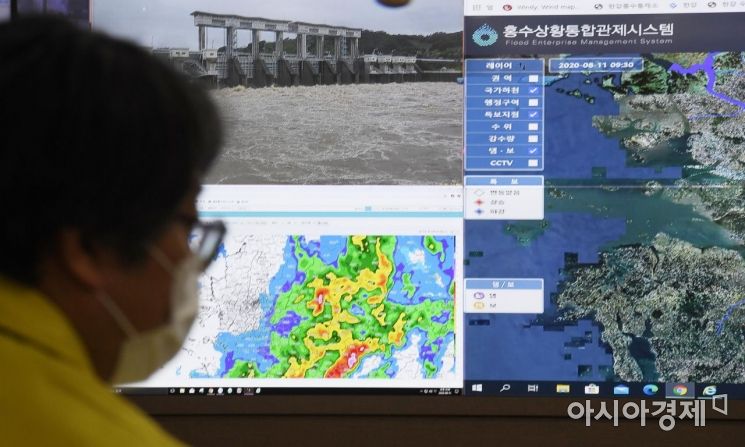
[Asia Economy Reporters Kim Bo-kyung and Lee Hyun-joo] Amid recent large-scale damage caused by floods and heavy rains, the dam operation and river management tasks scattered across the Ministry of Environment, Ministry of Land, Infrastructure and Transport, and Ministry of Trade, Industry and Energy have once again come under scrutiny. While the Korea Water Resources Corporation under the Ministry of Environment and the Korea Meteorological Administration have been exchanging accusations over the sudden increase in discharge from Yongdam Dam in Jinan-gun, Jeonbuk Province, the Ministry of Environment fueled the controversy over the Four Major Rivers Project by stating that "the weirs of the Four Major Rivers have no flood prevention effect."
According to related ministries on the 13th, in 2018, the government unified water management functions by transferring water resource functions from the Ministry of Land, Infrastructure and Transport to the Ministry of Environment, but the management of river facilities such as dams and weirs and water management remain scattered across ministries. The authority to manage river facilities lies with the Ministry of Land, Infrastructure and Transport, while water management authority belongs to the Ministry of Environment, resulting in a de facto dual system. Additionally, there are about 10,000 dams nationwide, each managed by different entities. Power dams are managed by Korea Hydro & Nuclear Power under the Ministry of Trade, Industry and Energy, while multipurpose dams and water supply-only dams are managed by the Korea Water Resources Corporation.
In such a situation where work areas are subdivided by ministry, there are criticisms that it is difficult to respond systematically when disasters such as floods occur. In particular, this large-scale flood damage is the first to occur since the flood control function was transferred from the Ministry of Land, Infrastructure and Transport to the Ministry of Environment. Professor Choi Seung-il of Korea University’s Department of Environmental Systems Engineering pointed out, "To handle intense heavy rains, measures for water management should have been established and continuously maintained," adding, "It is not reasonable to judge right or wrong only now after not prioritizing such budgets and policies." Professor Choi emphasized, "The Ministry of Environment also needs to reorganize its own water management organization," and stressed, "To enhance consistency in water management, water-related organizations such as water supply and sewage, aquatic ecosystems, and water resources must be strengthened and enabled to work properly."
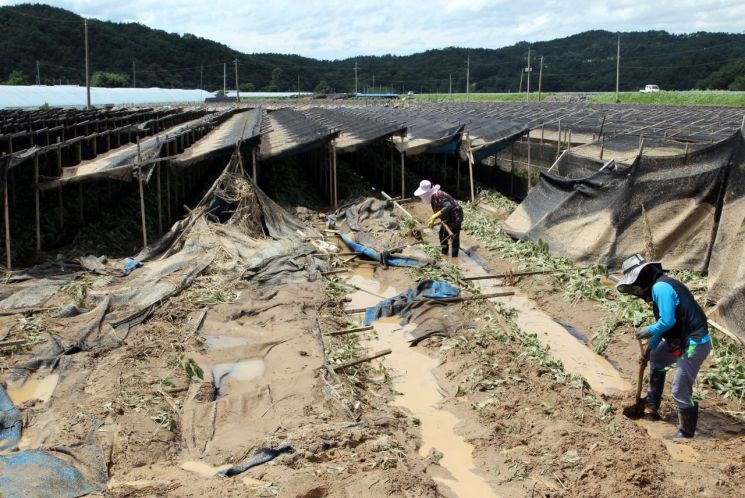 Farmers are carrying out repair work on the 9th in Pyeongchon-ri, Buri-myeon, Geumsan-gun, Chungnam, where the ginseng fields were flooded due to the overflow of the Geum River caused by the discharge from Yongdam Dam, and the water has receded.
 [Image source=Yonhap News]
Because tasks are scattered across ministries, the Ministry of Environment has failed to act as a control tower and appears only eager to shift responsibility among the agencies involved. On the 12th, the mayors of four regions in the Chungcheong area, which suffered large-scale flooding due to Yongdam Dam discharge, visited the Korea Water Resources Corporation, stating, "The failure to control Yongdam Dam water levels is the cause of the flood damage," and urged for damage recovery and compensation. During the heavy rains on the 8th, the Korea Water Resources Corporation increased the discharge from Yongdam Dam to 2,900 tons per second. The sudden influx of a large volume of water caused massive damage downstream. The mayors pointed out that there was an opportunity to lower the water level of Yongdam Dam by releasing water in advance before the 8th.
In response, the Korea Water Resources Corporation held a briefing at the Government Complex Sejong on the 12th, stating that they had no choice but to increase the discharge due to unexpected rainfall. They also said, "It is difficult to say that the inaccuracy of the Korea Meteorological Administration’s forecast had no impact on the damage." This implies that the forecast error by the Korea Meteorological Administration was a cause for increasing the discharge. The Korea Meteorological Administration rebutted the next day, releasing materials stating that "appropriate meteorological information was provided" regarding the rainfall around Yongdam Dam and Hapcheon Dam. According to the Korea Meteorological Administration, the Jeonju Meteorological Office forecasted heavy rainfall of over 300mm in some areas from the 6th to the 7th and 8th. However, in the Jinan area, 215.0mm of rain was already observed from midnight to 5 p.m. on the 7th, and the Korea Meteorological Administration announced through a "short-term forecast" at 5 p.m. on the 7th that the rainfall continuing until the next day was expected to be 80-150mm (up to 250mm in some areas).
Meanwhile, the Ministry of Environment, based on investigations conducted in 2014 and 2018, stated that "the weirs of the Four Major Rivers have no flood prevention effect," further fueling the controversy over the Four Major Rivers Project. Regarding claims that the damage was severe because the Seomjin River was excluded from the Four Major Rivers Project, the ministry explained, "The Seomjin River could not withstand the heavy rain that occurs once in 500 years."
© The Asia Business Daily(www.asiae.co.kr). All rights reserved.
![User Who Sold Erroneously Deposited Bitcoins to Repay Debt and Fund Entertainment... What Did the Supreme Court Decide in 2021? [Legal Issue Check]](https://cwcontent.asiae.co.kr/asiaresize/183/2026020910431234020_1770601391.png)

















