Average Apartment Sale Price in Seoul 1.05 Billion Won, 9 Districts Exceed 1 Billion
Not Only Gangnam 4 Districts but Also Mayongseong and Gwangjin-gu... Average Sale Price Surpasses 1 Billion
"Persistent Home Buying Demand... September-October Moving Season Expected to Be Market Turning Point"
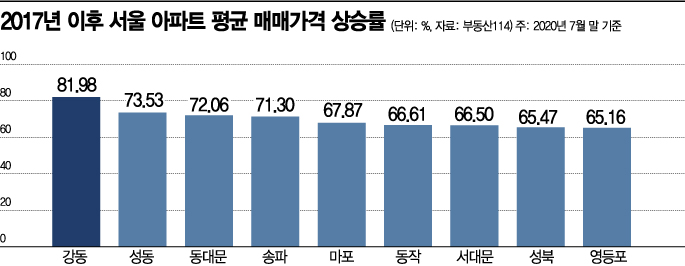
[Asia Economy Reporter Yuri Kim] The average sale price per household for apartments in Seoul has surpassed 1 billion KRW, with Gangdong-gu showing the highest increase rate compared to the end of 2016.
According to Real Estate 114 and others on the 13th, the average sale price of apartments in Seoul surged 62.16%, from 619.78 million KRW at the end of 2016 to 1.0509 billion KRW at the end of last month. Despite more than 20 real estate measures introduced by the current government, the average sale price rose by around 100 million KRW annually, reaching 701.25 million KRW at the end of 2017, 870.19 million KRW at the end of 2018, and 952.11 million KRW at the end of last year. The survey results were calculated by comprehensively considering actual transactions, appropriate market prices received from Real Estate 114 member brokerage offices, and independent investigations.
Among the autonomous districts, Gangdong-gu showed the highest increase rate, rising 81.98% from 567.53 million KRW to 1.03282 billion KRW during the same period. Price increases were not limited to the Gangnam area. Regions with an increase rate exceeding 70% included ▲Seongdong-gu (73.53%) and ▲Dongdaemun-gu (72.06%). Seongdong-gu rose from 619.74 million KRW to 1.07548 billion KRW, and Dongdaemun-gu increased from 438.71 million KRW to 754.88 million KRW. This rate is higher than that of Songpa-gu (71.30%), which is part of the Gangnam 3 districts. Even the district with the lowest average sale price increase among the 25 autonomous districts, Jungnang-gu, rose by 43.47%.
As of the end of July, the districts where the average apartment sale price exceeded 1 billion KRW were ▲Gangnam-gu (2.01776 billion KRW), ▲Seocho-gu (1.95434 billion KRW), ▲Songpa-gu (1.47738 billion KRW), ▲Yongsan-gu (1.45273 billion KRW), ▲Gwangjin-gu (1.09661 billion KRW), ▲Seongdong-gu (1.07548 billion KRW), ▲Mapo-gu (1.05618 billion KRW), ▲Gangdong-gu (1.03282 billion KRW), and ▲Yangcheon-gu (1.01742 billion KRW), totaling nine districts.
Complexes transformed into newly built apartments through redevelopment projects contributed to raising the average sale price increase rate. Yoon Ji-hae, senior researcher at Real Estate 114, explained, "Not only did the Gangnam 4 districts (Gangnam, Seocho, Songpa, Gangdong-gu) rise significantly, with Gangnam-gu surpassing 2 billion KRW for the first time, but areas like Mayongseong (Mapo, Yongsan, Seongdong-gu) and Gwangjin-gu also relatively increased, raising the average sale price."
After the 12.16 real estate measures at the end of last year caused a pause, Seoul apartment sale prices reversed to an upward trend at the end of May and have shown an increase for 11 consecutive weeks up to this month. In particular, the increase rate last month was 0.96%, the highest since December last year (1.08%). Senior researcher Yoon said, "However, the rise has slightly slowed after the announcement of the 8.4 measures," adding, "The moving season in September and October will be a turning point to gauge the market trend."
© The Asia Business Daily(www.asiae.co.kr). All rights reserved.

















