Mandatory Residence for Private Housing under Floor Area Ratio System from Next Year
Decrease in Rental Supply of New Apartments in Parts of Seoul and Gyeonggi Province
Sale to LH Allowed for Business Reasons
[Asia Economy Reporter Moon Jiwon] The government is continuously introducing policies that reduce the actual supply in the private rental market. Although it announced a large-scale housing supply plan through the August 4th measures, it has instead restricted the supply in the private rental market by strengthening the mandatory residence requirements for apartments under the price ceiling system.
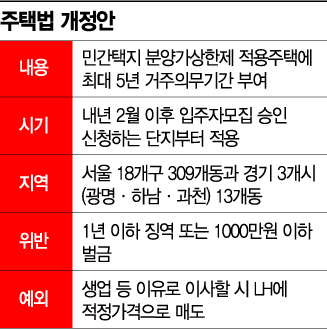
According to the Ministry of Land, Infrastructure and Transport on the 12th, a revision to the Housing Act, which imposes a mandatory residence period on apartments under the private land price ceiling system in the metropolitan area, passed the Cabinet meeting the day before. The amendment will be implemented after a six-month grace period. Accordingly, from February next year, those who purchase apartments under the price ceiling system on private land in the metropolitan area must reside in them for up to five years immediately after moving in. The Ministry plans to set a mandatory residence period of 2 to 3 years through enforcement ordinances. Since apartments sold on public land currently have a mandatory residence period of 3 to 5 years, the intention is to make it shorter than that.
The Buffer Effect of Apartment Jeonse and Monthly Rent Disappears
The areas where the private land price ceiling system applies include 309 neighborhoods in 18 districts of Seoul and 13 neighborhoods in 3 cities in Gyeonggi Province (Gwangmyeong, Hanam, Gwacheon), totaling 322 neighborhoods. In these areas, since homeowners must live in the apartments themselves after completion, the supply of new apartment jeonse (long-term deposit lease) is expected to dry up. Cases where newlyweds secure jeonse housing in new apartments with relatively low deposits immediately after completion will also significantly decrease. The government has also established penalties for those who do not comply with the residence obligation, including imprisonment for up to one year or fines up to 10 million won.
The problem is that the mandatory residence rule applies immediately upon apartment completion. Unlike buying a house through a sale, where the owner can fulfill the residence period at their discretion during ownership, the contract holder must continuously reside from the moment of completion. Because of this, the market is concerned that the buffering role of new apartment complexes in the jeonse and monthly rent market will disappear. Previously, when large new apartment complexes moved in, jeonse and monthly rent units priced below the surrounding market flooded the market, but this effect can no longer be expected due to the mandatory residence rule.
This is not the first time the government has introduced policies that shrink supply in the private rental market. It has already extended the residence requirement for capital gains tax exemption for one-household-one-home owners from 2 to 3 years. Additionally, reconstruction association members must fulfill a 2-year residence obligation to receive move-in rights. The abolition of the long-term rental housing registration system for apartments has also contributed to shrinking rental supply. An industry insider said, "The government's successive regulations reduce the circulation of jeonse in the market, which short-term affects instability in the rental market."
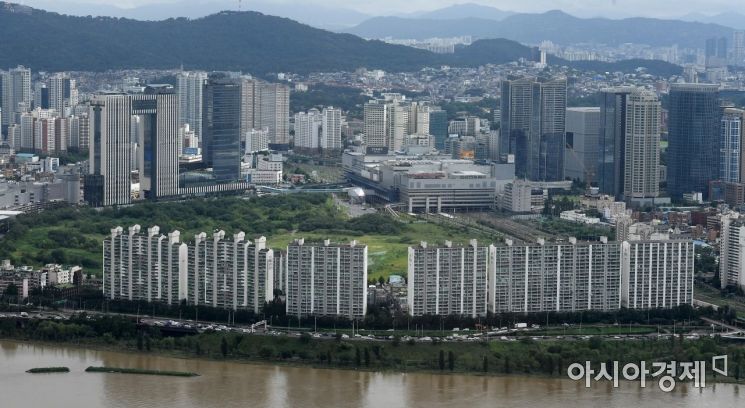 View of the Yongsan Maintenance Depot site as seen from the 63 Observatory in Yeouido, Seoul. Photo by Hyunmin Kim kimhyun81@
The Threshold for Low-Income Buyers in the Sale Market Also Rises
Concerns are also raised that the mandatory residence rule will raise the threshold for low-income, non-homeowners to purchase homes. Through the June 17th real estate measures, the government required that those who take out mortgage loans to buy homes in regulated areas must move in within six months regardless of the house price. This is intended to ensure that only genuine buyers who cannot pay all cash buy homes. Applying the mandatory residence requirement to apartments under the price ceiling system also makes it difficult to cover part of the insufficient down payment with tenants' jeonse deposits. As a result, the sale market is likely to be reorganized around cash-rich buyers with high subscription scores.
Experts believe that the mandatory residence for price ceiling apartments will not significantly help the overheated sale market. Since it favors genuine buyers with ample cash and high subscription scores, it may strengthen a "their own league." Ham Youngjin, head of Zigbang Big Data Lab, analyzed, "The mandatory residence period will not lower competition rates in the sale market. While demand may shift to the sale market, offsetting rapid price rises in the purchase market, rental prices for new apartments may increase."
Meanwhile, according to the revised Housing Act, if a contract holder cannot fulfill the mandatory residence due to unavoidable circumstances such as work, the Korea Land and Housing Corporation (LH) will purchase the property. The purchase price will be determined based on the deposit paid by the contract holder, interest at the level of a one-year fixed deposit, and some consideration of surrounding market prices. The Ministry expects that the longer the residence period before sale, the higher the price, but capital gains will be minimal.
Houses purchased by LH are expected to be used as public housing. A Ministry official said, "Selling immediately after purchase would look strange, so they can be used as public sale housing, etc. Additional review is underway."
© The Asia Business Daily(www.asiae.co.kr). All rights reserved.
![Clutching a Stolen Dior Bag, Saying "I Hate Being Poor but Real"... The Grotesque Con of a "Human Knockoff" [Slate]](https://cwcontent.asiae.co.kr/asiaresize/183/2026021902243444107_1771435474.jpg)












