'White Paper on Cho Kuk' Goes on Sale in Bookstores on the 11th
Refuting Allegations of Children's Admission Corruption, Prosecutorial Investigation of Cho Kuk's Family, and Media Behavior
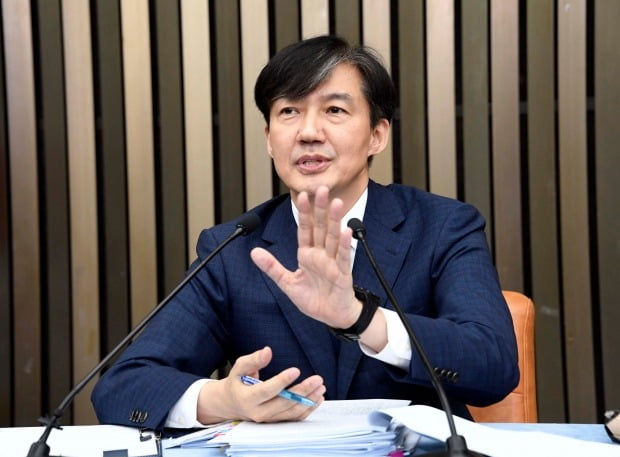 On September 2nd last year, Cho Kuk, then Minister of Justice nominee, held a press conference at the National Assembly and responded to the allegations surrounding him.
 [Image source=Yonhap News]
[Asia Economy Reporter Han Seung-gon] The 'Jo Guk White Paper,' created by supporters of former Minister of Justice Jo Guk who collected donations, was filled with content that effectively refuted point by point the prosecution's investigation into Jo, the media coverage of it, allegations of his daughter's admission corruption, and controversies such as the private equity fund. Former Minister Jo emphasized that he was not involved at all in the production and writing of the white paper.
The 'Prosecution Reform and Candlelight Citizens' (Jo Guk White Paper), published by the Jo Guk White Paper Promotion Committee, began sales at offline bookstores nationwide from the 11th. The white paper stressed that the so-called 'Jo Guk Incident,' which involved various controversies raised after Jo was nominated as Minister of Justice in August 2019, stemmed not from Jo's personal issues but from social and structural problems.
The white paper defined the prosecution's investigation into Jo as "a situation where the prosecution, under the full support of the media and opposition parties, abused its authority to protect collective private interests, infringing on the president's personnel rights and forcibly indicting the Jo family."
Regarding the allegations surrounding Jo, it emphasized, "There is no absolute morality or absolute fairness in any era or society," and "Perspectives and attitudes toward morality and fairness can only be plotted within general practices and culture."
In particular, controversies such as the allegations of admission corruption involving Jo's daughter were pointed out as issues with the Korean admission system. The white paper stated, "The process by which Jo's daughter became the first author of a thesis clearly showed how social networks operate on a student's 'spec' (credentials)," adding, "The core issue is not the morality of parents and students but the connections formed through special-purpose high schools."
It further stated, "It could have provided meaningful points regarding the inheritance of social class and social status in our society. However, the media thoroughly treated this matter solely as an issue of individual morality and pushed it out of the public discourse."
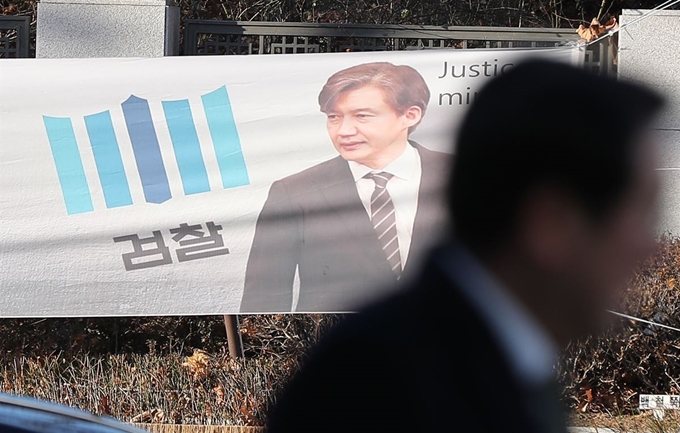 A banner featuring former Minister of Justice Cho Kuk is displayed in front of the Seoul Central District Prosecutors' Office on the morning of December 31 last year, when the prosecution indicted Cho on charges including bribery. Photo by Yonhap News
Regarding the private equity fund investment allegations surrounding the Jo family, it was also framed as a matter that can be understood within common social sense rather than as an individual problem.
The white paper pointed out, "In terms of financial technology, it is common sense to receive help from relatives or acquaintances with investment insight, or even from bank tellers," and "It is also common sense that with an investment amount of about 1 billion won, one cannot practically own and control a private equity fund."
Especially on the controversy over Jo's morality, the white paper actively defended, saying, "While it can be criticized in relation to noblesse oblige, considering the general practices and morality operating among the upper elites of Korean society, it is mostly within the range of 'common sense.'"
The media coverage during the 'Jo Guk Incident' was described as 'Eonran' (言亂, meaning 'chaotic speech'), effectively labeling it as 'yellow journalism.' The white paper criticized, "Most media outlets were focused on stirring public anger and did not analyze whether this issue was a serious disqualification for performing the duties of Minister of Justice."
It went on to argue for the necessity of media reform, stating, "Despairing over the reporting behavior revealed during the Jo Guk phase, the expression 'media ruin theory' even emerged." It also evaluated that "Criticism and allegations surrounding Jo were off the core point."
Meanwhile, the Jo Guk White Paper involved participants such as Professor Jeon Woo-yong of the Academy of Korean Studies, Democratic Party lawmaker Kim Nam-guk, Go Il-seok, CEO of The Briefing, Park Ji-hoon, CEO of DevQuest, Lee Jong-won, CEO of SisaTapaTV, Mr. Im Byung-do, and Kim Yoo-jin, director of the Democratic Media Citizens' Coalition. Additionally, Professor Kim Min-woong of Kyung Hee University, former lawmaker Choi Min-hee, and Kim Eo-jun, head of Ddanzi Ilbo, also participated.
Meanwhile, former Minister Jo stated, "I was not involved at all in the production and writing of this white paper."
© The Asia Business Daily(www.asiae.co.kr). All rights reserved.


















