Export Item Dependency at 46.3%, 10%P Higher than Average
[Asia Economy Reporter Dongwoo Lee] Concerns have been raised that South Korea's future export competitiveness could decline due to the concentration of export items and regions. It is argued that securing export competitiveness through product diversification, pioneering new markets, and strengthening the service industry is necessary.
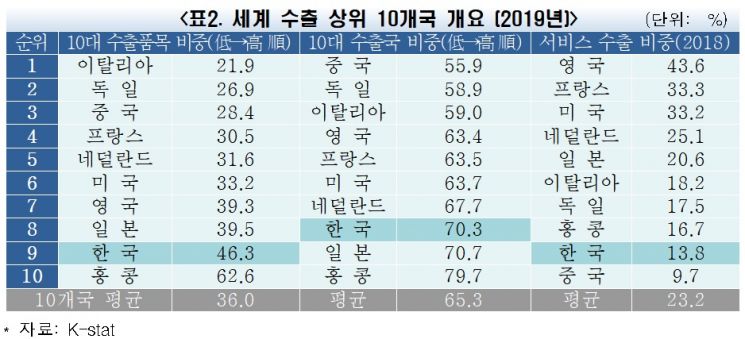
The Federation of Korean Industries (FKI) announced on the 12th that, based on last year's data analyzing the top 10 export countries worldwide in terms of export items, regions, and the proportion of service exports, South Korea ranked 9th with a 46.3% dependence on its top 10 export items.
This figure is more than 10 percentage points higher than the average dependence on the top 10 export items of other countries, which stands at 36.0%. In particular, 14.6% is concentrated in semiconductors, indicating that fluctuations in the semiconductor market have a significant ripple effect on the Korean economy.
South Korea's dependence on its top 10 export countries is 70.3%, which is 5.0 percentage points higher than the average of 65.3% for the 10 countries. Among them, China (25.1%), the United States (13.5%), and Vietnam (8.9%)?the top five export destinations?account for more than half (58.6%). The FKI analyzed that the concentration of exports to the U.S. and China makes it inevitable that ongoing U.S.-China conflicts will negatively impact South Korean exports due to external uncertainties.
China and South Korea share exactly the same top five export countries, and except for automobiles, South Korea's export shares lag behind China's in major competing export items. There are concerns that South Korea's export conditions are deteriorating as competition with Chinese companies intensifies due to the Chinese government's advanced manufacturing industry promotion policies.
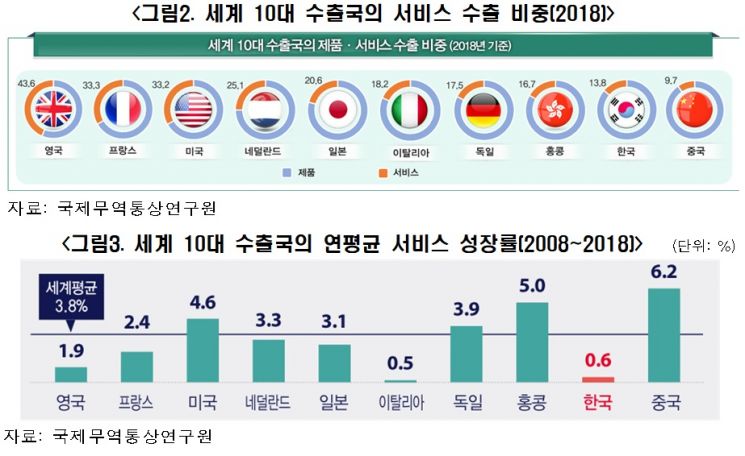
South Korea's share of services in total exports is only 13.8%, ranking 9th among the top 10 countries, placing it near the bottom, and is about one-third of the United Kingdom's (46.3%), which ranks first. Despite the global growth trend in the service industry over the past decade (2008?2018), South Korea's service industry growth rate was a low 0.6%.
In contrast, China's service industry annual growth rate, ranked 10th, is 6.2%, ten times that of South Korea, indicating an urgent need to secure competitiveness in the service sector.
Analyzing South Korea's export share of the world's top 10 items by export value, excluding resources such as oil and gold, it was found that except for the top four items?passenger cars, semiconductors, and wireless communication devices?the share of the remaining six items is only around 1%. Considering that South Korea's total exports account for 2.9% of the world's total exports, the shares for pharmaceuticals and turbojets are less than one-tenth, showing very low market shares.
Over the past five years, South Korea ranked 4th only in semiconductors among the top five items by annual growth rate, while all other items were outside the top 10. In the bio-health sector, which has been growing since COVID-19, South Korea ranked only 11th, 16th, and 32nd in immunological products, medical devices, and pharmaceuticals, respectively. For turbojets, which have an annual growth rate of 12%, South Korea ranked 27th.
International organizations such as the WTO and OECD have analyzed that the South Korean economy is highly vulnerable to external shocks due to its high export dependence on certain items and specific regions. They also pointed out the low level of service exports compared to product exports.
Kim Bong-man, head of international cooperation at the FKI, said, "South Korea's export items have remained stagnant for the past 10 years." He added, "While memory semiconductors, ranked number one globally, are clearly a competitive strength of South Korean exports, the absence of new growth engines to lead the Fourth Industrial Revolution and the post-COVID era poses a significant threat to our future export competitiveness."
© The Asia Business Daily(www.asiae.co.kr). All rights reserved.


















