Theme Stocks Shift from Short-Term Trading to Large-Cap Investments
'BBIG7' and Other Market Leaders Drive Stock Market Gains
[Asia Economy Reporter Song Hwajeong] Mr. A, who owned two apartments in Seoul, recently sold one apartment for 1.8 billion KRW due to strengthened real estate policies. Approaching retirement, Mr. A intended to live in one apartment and rent out the other for retirement income, but he could not withstand the tax pressure. He invested 1.5 billion KRW from the apartment sale into his stock account. Having recently purchased Samsung Electronics, he plans to additionally buy stocks in the trending bio and secondary battery sectors.
Housewife Ms. B recently opened a stock account and bought Kakao shares. Previously unfamiliar with stocks, Ms. B learned at a reunion that most of her friends were investing in stocks. The conversation among friends, whom she met after a long time, was mostly about how much certain stocks had risen recently or which stocks had good earnings. Her friends kindly taught her how to invest in stocks and recommended stocks, saying that it is difficult to save money these days without investing in stocks.
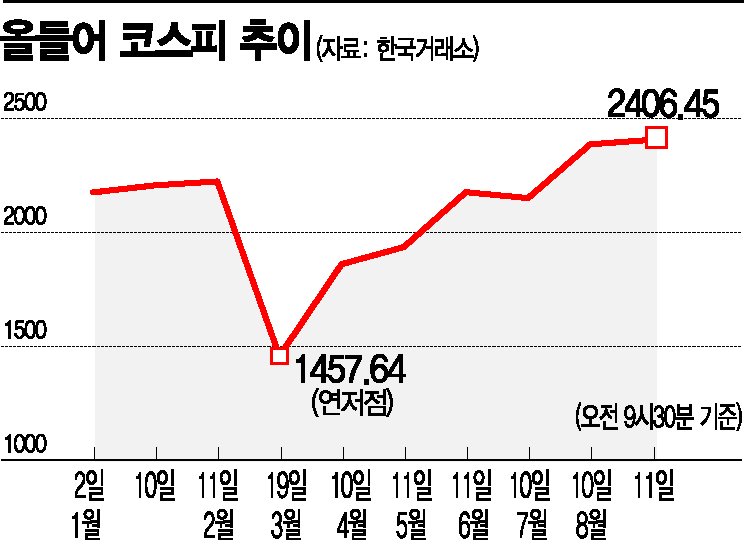
The KOSPI surpassed the 2400 mark. It is the first time in 2 years and 2 months that the KOSPI has reached the 2400 level. The powerful army of retail investors made it possible to lift the KOSPI from the 1400 level, which had fallen due to the novel coronavirus disease (COVID-19), to 2400 in just five months.
As of 10:52 a.m. on the 11th, the KOSPI recorded 2420.30, up 1.42% (33.92 points) from the previous day. The KOSPI surpassed 2400 for the first time since June 15, 2018 (closing price 2404.04). Having risen for six consecutive days and setting new highs for five consecutive trading days until the previous day, the KOSPI continued its strong trend and raised its peak once again. After recovering the 2300 level on the close of the 5th, the KOSPI rose to 2400 in just four trading days. Compared to the beginning of the year, the KOSPI rose 8.41%, and surged 63.7% from the yearly low of 1457.64 on March 19.
The KOSPI’s strength was supported by strong individual buying power. This year, the retail investor movement, known as the Donghak Ant Movement, surged so strongly that the KOSPI was able to recover from the COVID-19 crash. As of the previous day this year, individuals have net purchased 46.4061 trillion KRW. During the same period, foreigners sold 26 trillion KRW and institutions sold 20 trillion KRW.
The retail investors’ enthusiasm for stock investment shows no signs of cooling. Customer deposit balances, which were 28 trillion KRW at the end of last year, now approach 50 trillion KRW. Researcher Seo Jeonghoon of Samsung Securities analyzed, "Excluding changes in credit and unsettled trades, the actual customer deposit balance is estimated to have increased by 14 trillion KRW this year alone," adding, "New funds are flowing in alongside the strong buying trend."
The investment behavior of individuals, who previously focused on short-term trading, has also changed. The deposit turnover rate is currently around 40%, lower than the 80% level in 2007 when individual investors were very active. This suggests that individual investors’ behavior has shifted somewhat from short-term to medium- and long-term investment. The deposit turnover rate is calculated by dividing market trading volume by customer deposits; a higher rate indicates more trading with less capital.
Investment targets have also shifted from mainly theme stocks and small- and mid-cap stocks in the past to large-cap and blue-chip stocks this year. The net purchase by individuals of the 'BBIG7' (Samsung Biologics, Celltrion, LG Chem, Samsung SDI, Kakao, NAVER, NCSoft), which led the KOSPI rise this year, reached 1.7 trillion KRW. During the same period, foreigners and institutions net sold 800 billion KRW and 1.1 trillion KRW, respectively. Individuals drove the rise of the market-leading stocks. Researcher Seo said, "The inflow intensity of individual investors into the KOSPI market this year recorded the highest level in 20 years," adding, "The preference that had been centered on small- and mid-cap stocks has expanded to large-cap stocks, and individuals led the market-leading stocks."
© The Asia Business Daily(www.asiae.co.kr). All rights reserved.
![Clutching a Stolen Dior Bag, Saying "I Hate Being Poor but Real"... The Grotesque Con of a "Human Knockoff" [Slate]](https://cwcontent.asiae.co.kr/asiaresize/183/2026021902243444107_1771435474.jpg)











