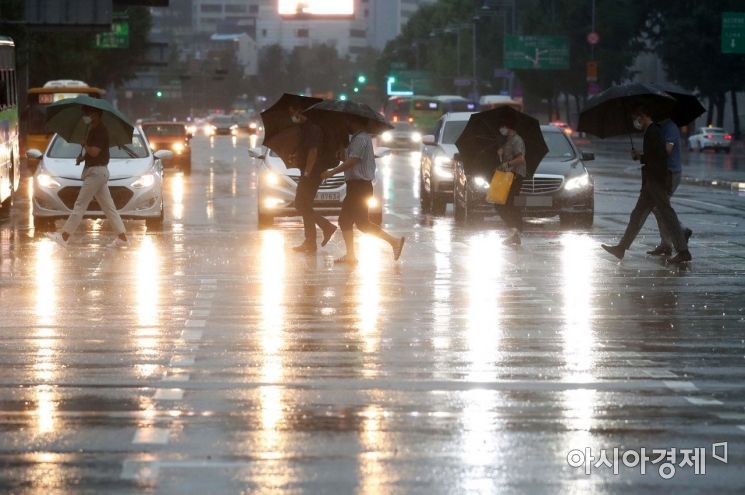
 Due to the influence of moisture from the monsoon front and typhoon, most regions nationwide experienced rain on the 6th. Commuters are hurrying their steps at Gwanghwamun Intersection in Seoul during the morning rush hour. Photo by Mun Ho-nam munonam@
[Asia Economy Intern Reporter Kim Seul-gi] Recently, heavy rains have continued, causing flood damage across the country. Amid this, as the Korea Meteorological Administration's (KMA) weather forecasts have frequently missed the mark, some netizens have reportedly been checking the Norwegian Meteorological Institute's website.
The KMA had previously forecasted that this year's precipitation would be similar to the average level. However, since June, record-breaking monsoon rains have continued, leading to heavy rain warnings nationwide and ongoing flood damage.
As the KMA's weather forecasts have often been inaccurate, posts claiming that precipitation forecasts on foreign meteorological websites are more accurate than those of the Korean Meteorological Administration have been spreading mainly on online communities.
On the 11th, various posts sharing personal experiences appeared on social networking services (SNS) and internet communities, such as "The Norwegian Meteorological Institute is more accurate than the KMA," and "I often refer to overseas meteorological sites like those of Finland, the United States, and the United Kingdom."
These individuals who check domestic weather forecasts on overseas sites such as Norway, Finland, the United States, and the United Kingdom have even been dubbed the 'Weather Asylum Seekers.'
Among the Weather Asylum Seekers, the overseas weather forecast sites highly rated for accuracy include the Norwegian and Finnish meteorological institutes, the U.S. 'AccuWeather,' and the U.K.'s 'BBC Weather.'
In fact, it has been confirmed that the number of people saying "I can't trust the KMA forecasts" has increased.
According to the 'Public Satisfaction Survey on Meteorological Services' released by the KMA in January this year, the satisfaction score for the KMA's local forecasts among the general public last year was 68 points, down 3.4 points from 71.4 the previous year.
Meanwhile, a KMA official explained that abnormal high-temperature phenomena have affected the weather.
The official stated, "This year, abnormal climate phenomena have continued to occur, causing situations that are difficult to predict. The KMA is also making efforts to minimize damage."
© The Asia Business Daily(www.asiae.co.kr). All rights reserved.
![Clutching a Stolen Dior Bag, Saying "I Hate Being Poor but Real"... The Grotesque Con of a "Human Knockoff" [Slate]](https://cwcontent.asiae.co.kr/asiaresize/183/2026021902243444107_1771435474.jpg)











