Since the 1950s, Cars Have Called for "Jaryeok Gaengsaeng"
Closed Economy + Foreign Currency Shortage, Slow Industrial Development
Kim Jong-un Drives Japanese Car to Inspect Flood Damage Site
Kim Jong-un, Chairman of the State Affairs Commission of North Korea, was recently spotted for the first time driving a vehicle himself during a visit to flood-affected areas. Since the 1950s, North Korea has shown a strong commitment to automotive self-reliance, establishing a policy to produce cars domestically rather than importing them, as part of its goal to become a socialist industrial nation. Ironically, the vehicle driven by Chairman Kim was a Japanese Lexus model.
◆ North Korea’s "Automotive Self-Reliance" Since the 1950s... Producing Sedan 'Hwiparam' and SUV 'Ppeokkugi'
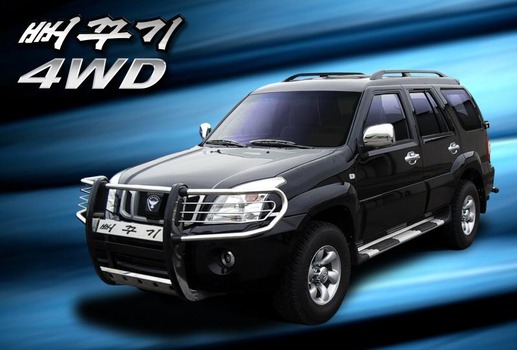
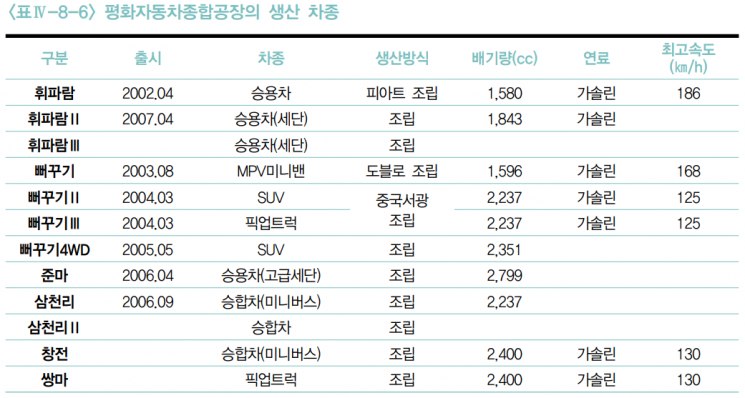
North Korea’s main automobile manufacturers include the Seungri Automobile General Enterprise and Pyonghwa Motors. Pyonghwa Motors is the only company producing civilian passenger cars within North Korea, manufacturing sedans like the 'Hwiparam' and sport utility vehicles (SUVs) such as the 'Ppeokkugi.'
North Korea maintains its policy to develop the automotive industry through 'self-reliance,' but the industry remains stagnant to the extent that it cannot compare with South Korea’s automotive production capacity and output.
According to the 'North Korean Automotive Industry Status' report released by the Korea Trade-Investment Promotion Agency (KOTRA) on the 6th, since 2012, both automobile manufacturing plants have seen almost no research and development or capital investment.
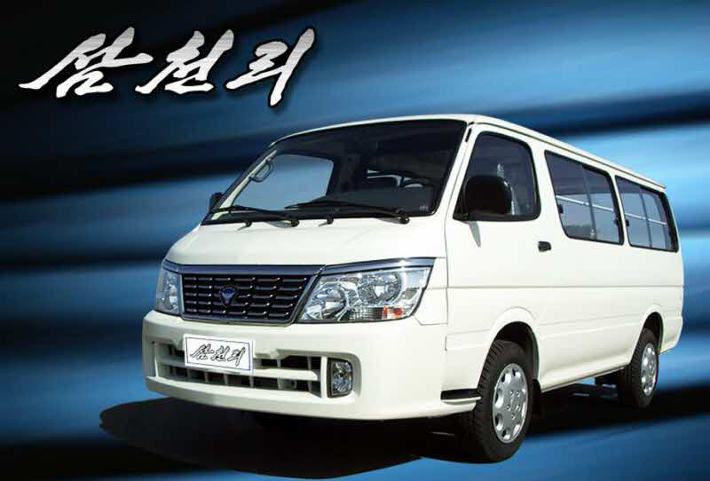
Pyonghwa Motors reportedly no longer conducts independent research and development due to the long development periods and high capital requirements. Instead, it mainly imports automotive parts, semi-finished products, or completely disassembled vehicles from China and reassembles them in North Korea.
The reassembled vehicles are completed by removing the original brand logos attached to the vehicle exterior and replacing them with Pyonghwa Motors’ logo. It is often observed on North Korean streets that the logo on the front of the vehicle differs from the logo placed above it.
KOTRA stated, "Independent research and development related to automobile production in North Korea has been halted, leading to cases where Chinese-made vehicles are sold after changing their logos," and warned, "If the suspension of research and development continues for a long time, North Korea’s own automotive production technology and industry are likely to suffer significant damage in the future."
◆ Closed Economy of 'Self-Reliance,' Slow Technological Integration and Development... Foreign Currency Shortage Due to Sanctions
North Korea’s automotive industry is hampered by its closed economic structure, economic difficulties, and shortage of foreign currency.
A 2015 report titled 'North Korea’s Industry' published by KDB Industrial Bank notes that since the 1990s, power shortages have led to reduced factory operation rates and raw material shortages, causing serious production disruptions. There have also been severe difficulties in tire production due to a lack of rubber raw materials. While automotive parts are highly dependent on external sources, it is estimated that foreign currency shortages caused by accumulated sanctions against North Korea make even raw material procurement difficult.
The aging of production facilities due to lack of investment funds is also severe. Most of North Korea’s automotive industry facilities and factories were built with aid from Eastern European socialist countries, but since the 1970s, the aging of equipment has progressed due to poor loan procurement caused by defaults on debts from these countries.
North Korea has implemented an inward-looking and closed industrialization policy under the principle of 'self-reliance,' which also hampers the automotive industry. This has led to a decline in technological capabilities in areas such as precision machining, engine manufacturing, and other parts production, resulting in a vicious cycle of technological stagnation and production decline.
The report states, "Given the current economic situation in North Korea, fundamental development of the automotive industry in the short term is unlikely," and points out that "bold technology imports from South Korea, China, and others are an urgent task." It also forecasts, "If this issue caused by the closed policy is not resolved first, rapid development like that of the domestic (South Korean) automotive industry will be difficult."
◆ North Korean Workers’ Monthly Salary 3,000 Won, Car Price 3.4 Million Won... Owned by Very Few
The consumer market is as underdeveloped as the production market. North Korean residents lack the social and economic conditions to own cars.
Until 2017, individuals in North Korea were not allowed to register cars. Although regulations have since been relaxed, it remains practically impossible for ordinary citizens to purchase vehicles.
The monthly salary of a North Korean worker is about 3,000 won. The selling price of Pyonghwa Motors’ SUV 'Ppeokkugi' was reported as 3.4 million won (in 2015). This price is based on an official exchange rate of 100 won to 1 US dollar. Considering that the actual exchange rate within North Korea is about 8,000 won to 1 US dollar, the real purchase price is much higher than 3.4 million won.
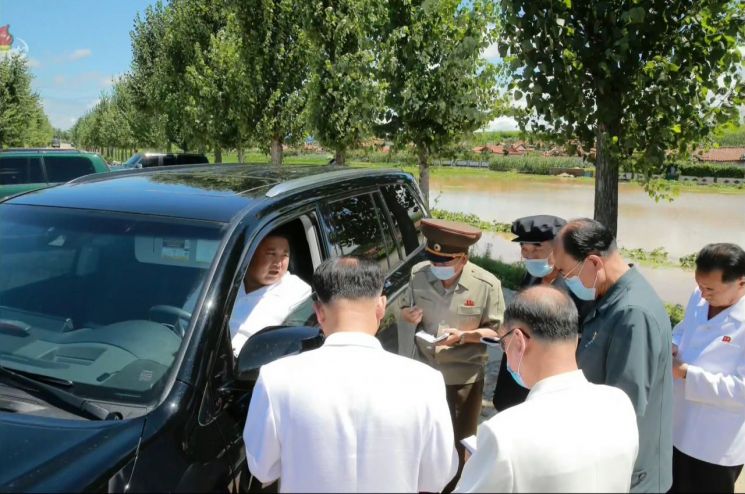 In the inspection photos of Daecheong-ri, Eunpa County, Hwanghaebuk-do, reported by Chosun Central TV on the 7th, Chairman Kim was captured sitting in the driver's seat of a black sports utility vehicle (SUV) covered in mud.
 This vehicle, visually estimated to be a Toyota Lexus LX570 model, has frequently appeared at external events such as the inter-Korean summit in Pyongyang in September 2018 and the completion ceremony of the Yangdok Hot Springs Cultural Recreation Area last December.
◆ Kim Jong-un Prefers Lexus and Mercedes-Benz
Meanwhile, Chairman Kim’s personal vehicles are known to include two Mercedes-Maybach S600 sedans and a Lexus LX570 SUV. The UN Security Council classifies luxury limousines as luxury goods and bans their export to North Korea, so these vehicles are believed to have been smuggled in to evade sanctions.
According to the annual report of the UN Security Council’s Panel of Experts on North Korean Sanctions published in May, Kim’s Lexus LX570 is a model produced after August 2017, equipped with a 5.7-liter engine and four-wheel drive.
© The Asia Business Daily(www.asiae.co.kr). All rights reserved.



















