Ministry of Land Loosens Tuning Regulations One After Another
Driver and Age-Restricted Special Contracts Not Allowed
Many Limitations on Emergency Dispatch Services
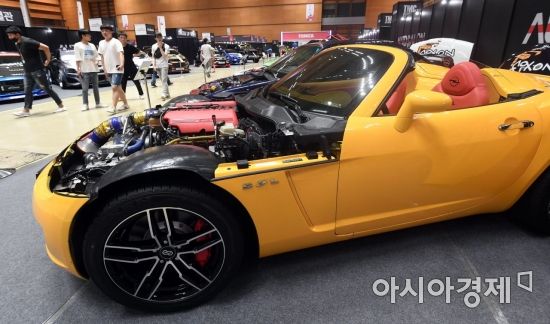 On the 19th, visitors are viewing the tuning car exhibition at the '2018 Seoul Auto Salon' held at COEX in Gangnam-gu, Seoul. Photo by Hyunmin Kim kimhyun81@
[Asia Economy Reporter Oh Hyung-gil] "I am the owner of a camping car who recently experienced a frustrating incident on the Seohaean Expressway. Suddenly, my car broke down and I had to stop on the shoulder. When I contacted the insurance company, they said emergency dispatch is not available for camping cars, and the Road Traffic Authority also informed me that towing is impossible because it is a camping car. I called a private tow truck, but they demanded 200,000 won. If there is a Camping Car Act, emergency dispatch should be made possible. The insurance premiums are expensive, but not providing emergency dispatch service makes no sense. Please don’t fix the barn after losing the cow; make emergency dispatch available for camping cars." (From a post on the Blue House National Petition Board)
The government is accelerating efforts to revitalize the automobile tuning industry, raising concerns in the non-life insurance sector. Although the intention is to ease tuning regulations to create a foundation for a new automobile industry, tuned vehicles remain in a 'blind spot' of automobile insurance, inevitably increasing consumer damages.
According to the non-life insurance industry on the 10th, the Ministry of Land, Infrastructure and Transport (MOLIT) has recently announced a series of regulatory improvement plans to ease tuning regulations. On the 6th, MOLIT issued a legislative notice for the revision of the 'Enforcement Rules of the Automobile Management Act,' which exempts tuning approval for power transmission devices, pickup truck cargo bed covers, lighting devices, noise prevention devices, and more.
In May, MOLIT allowed the installation of camping equipment called 'camper' without changing the type of cargo truck and established standards recognizing tuning to low-emission vehicles such as 'hybrid tuning' (conversion from internal combustion engine to hybrid).
In October last year, MOLIT also revised the 'Regulations on Automobile Tuning,' exempting prior approval and inspection for 27 types of tuning including headlights, auxiliary air conditioners, and noise prevention devices, and relaxed installation standards for 12 items such as roof carriers and luggage carriers.
Camping cars must be insured for business use... Insurance premiums are expensive and emergency dispatch is unavailable
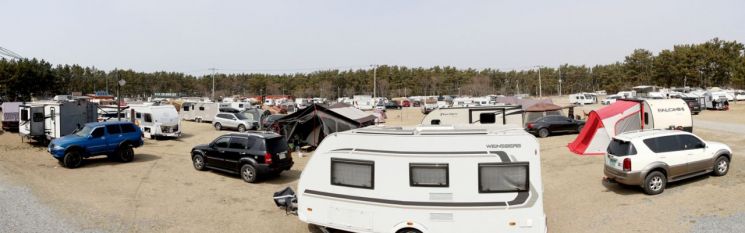
With the continuous improvement of tuning regulations, the number of tuned vehicles including camping cars is expected to increase. The problem is that the impact of regulatory easing may be entirely passed on to the non-life insurance industry. A typical example is camping cars.
Currently, when a regular vehicle is converted into a camping car, it must be insured under business-use camping car or business-use van insurance, not personal automobile insurance. Driver and age restriction riders cannot be applied, and emergency dispatch services are also highly limited.
Because of this, not only are insurance premiums expensive, but camping car owners frequently file complaints against insurance companies for lack of coverage or services. Recently, there have even been claims on the Blue House National Petition Board demanding that insurance services be applied.
In particular, insurance companies refuse to underwrite most automobile tuning except for camping cars. This is similar to the refusal to underwrite interior or performance modification parts.
If a tuned vehicle is involved in an accident, insurance payments are not made. Generally, anything not attached to the vehicle, installed, or listed on the insurance policy is excluded from coverage.
Unlike general non-life insurance, insurance companies need to develop dedicated insurance products for tuned vehicles, similar to separately subscribing to leisure insurance. However, due to a lack of related data such as accident risk rates for tuned vehicles, developing dedicated products is difficult.
Insurance companies are concerned that as the tuning industry grows and consumer compensation demands increase, accident losses will be passed on as burdens to insurers.
An industry insider said, "Although automobile insurance does not apply, tuning vehicle regulations are being eased without institutional improvements from the insurance perspective. If consumer complaints and dissatisfaction increase, insurance companies will inevitably have to bear more responsibility."
© The Asia Business Daily(www.asiae.co.kr). All rights reserved.

















