Government Considering 7-8% Budget Increase This Year
Announcement Expected Late This Month After Ruling Party Talks
Experts Call for Fiscal Rules Legislation
[Asia Economy Reporters Jang Se-hee, Kim Hye-min] As the government is reviewing next year's main budget at the level of 550 trillion won, which is a 7-8% increase compared to this year's budget (512.3 trillion won), concerns are growing that a fiscal cliff could occur in the mid-to-long term as revenue fails to keep pace with expenditures. Experts are raising their voices, urging the government to promptly establish fiscal rules.
According to the ruling party and government on the 10th, the Ministry of Economy and Finance plans to announce next year's budget proposal at the end of this month after consultations with the Democratic Party of Korea this week. The government previously announced a goal to invest 160 trillion won in the Korean New Deal by 2025, with at least 30 trillion won expected to be allocated in the first year. Mandatory expenditures, mainly in employment and welfare sectors such as the introduction of nationwide employment insurance, are expected to increase.
Even if expenditures increase, deficits could be reduced if revenues come in steadily, but the problem is that current tax revenue conditions are unfavorable. According to the Ministry of Economy and Finance's "Monthly Fiscal Trends July Issue," national tax revenue in May was 17.6 trillion won, down 12.6 trillion won (42%) compared to May of the previous year. Corporate tax, in particular, decreased the most to 10.8 trillion won, and the prolonged COVID-19 pandemic is expected to further deepen the revenue shortfall. In fact, An Il-hwan, the 2nd Vice Minister of the Ministry of Economy and Finance, stated, "The economic activity contraction caused by COVID-19 will continue to weaken the revenue base for a considerable period."
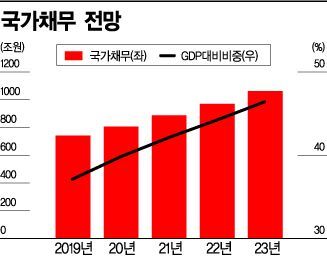
The national fiscal condition has already deteriorated significantly. Based on the 3rd supplementary budget, this year's national debt is expected to reach 839.4 trillion won. It will increase to 935.3 trillion won in 2021 and surpass 1,000 trillion won in 2022, reaching 1,030.5 trillion won (48.9% of Gross Domestic Product (GDP)). The deficit in the management fiscal balance (total revenue - total expenditure - social security funds) is expected to reach 111.5 trillion won this year, which is about 5.8% of GDP.
As fiscal revenue begins to fall short of expenditures, the need to introduce fiscal rules is also growing. In the "2019 Fiscal Year Settlement Analysis" report published by the National Assembly Budget Office, it was stated, "Mid-to-long-term fiscal goals must be established to respond to changes in population and industrial structures, the unification process, and large-scale fiscal demands in climate, environment, and health sectors," adding, "To achieve this, specific fiscal measures such as fiscal rules need to be discussed."
Experts point out that a fiscal cliff, which was feared due to revenue declines amid economic downturns under an expansionary fiscal stance, will occur. Professor Sung Tae-yoon of Yonsei University's Department of Economics said, "Even if more income and corporate taxes are collected, it is impossible to secure a tax base that can bear the fiscal burden." Professor Kim Sang-bong of Hansung University's Department of Economics said, "The fiscal demand from the nationwide employment insurance initiative is expected to be enormous," adding, "If a long-term recession like Japan's occurs, fiscal policy will need to be used, but if fiscal capacity is exhausted, recovery later will be impossible."
A government official said, "If total budget expenditures increase significantly, national debt will rise, and the management fiscal balance will inevitably worsen," adding, "Since the amount will increase greatly in the long term, it is important to set the base for next year's budget." Especially, since the '2065 Long-term Fiscal Outlook' must be released in September, the government plans to prepare the national debt and management fiscal balance more precisely.
© The Asia Business Daily(www.asiae.co.kr). All rights reserved.
![Clutching a Stolen Dior Bag, Saying "I Hate Being Poor but Real"... The Grotesque Con of a "Human Knockoff" [Slate]](https://cwcontent.asiae.co.kr/asiaresize/183/2026021902243444107_1771435474.jpg)
















