Government to Promote 'Special Travel Week' in October for 'Corona Blue'
Japan's COVID-19 Cases Increase 2.4 Times After 'Go To Travel'
July 'Special Travel Week' Tourism Spending Up 26.9%
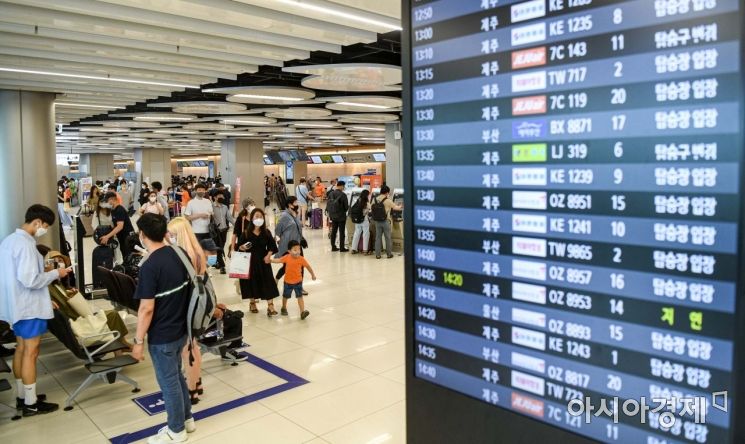 On the 2nd, marking the start of the peak vacation season, the domestic terminal at Gimpo Airport in Seoul was bustling with travelers. Photo by Kang Jin-hyung aymsdream@
[Asia Economy Reporter Heo Midam] As the novel coronavirus infection (COVID-19) prolongs, the government has decided to promote a 'Special Travel Week' in October to alleviate the public's feelings of depression.
However, there are conflicting opinions: some say it is premature to encourage travel while COVID-19 has not ended, while others argue that as the disaster situation continues for a long time, the public suffering from depression should be given an opportunity to recharge.
On the 9th, the Central Disaster and Safety Countermeasures Headquarters (CDSCH) announced that it discussed and reviewed psychological support measures to overcome the so-called 'COVID blues' phenomenon caused by the prolonged COVID-19 pandemic.
The main points include providing consumption coupons, expanding worker vacation support projects, and developing religious and cultural travel courses to ensure the public can rest and recharge with peace of mind. They also decided to select clean rural tourism businesses that comply with quarantine rules to support the public in resting safely.
Earlier, the Ministry of Culture, Sports and Tourism (MCST) had designated the period from the 1st to the 19th of last month as the '2020 Special Travel Week.' According to an analysis announced on the 4th by MCST and the Korea Tourism Organization, based on big data analysis including KT base station detected communication mobility data and BC Card usage performance, domestic tourism was more active during this period than the same period in June (June 3rd to 21st).
Tourism consumption expenditure during this period also increased evenly across all sectors compared to the same period last month, with lodging up 29.9%, travel agency spending up 25.8%, and especially transportation costs showing a high growth rate in the mid-to-high 30% range (public transportation 38.3%, private car 34.2%).
Thanks to the balanced increase across sectors, total tourism consumption expenditure grew by 26.9% compared to the previous month. However, compared to the same period last year, it only recovered to about 87.3%.
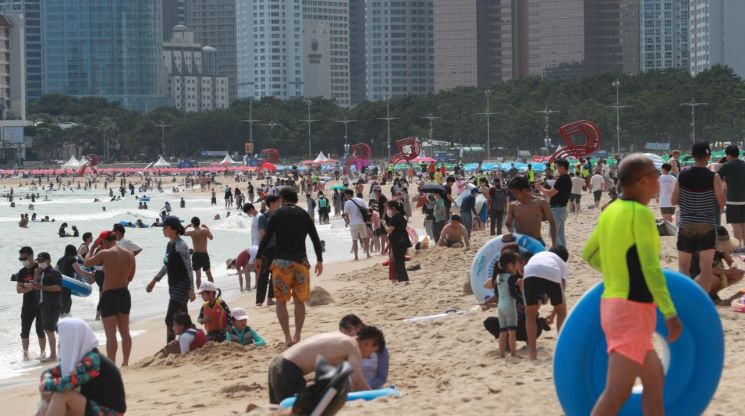 On the afternoon of the 26th of last month, vacationers were cooling off by playing in the water at Haeundae Beach in Busan. [Image source=Yonhap News]
However, there are criticisms that encouraging travel amid the ongoing spread of COVID-19 is premature. The concern is that as many tourists gather at travel destinations, quarantine rules such as social distancing may not be properly observed.
Office worker Kim (28) said, "I think it is premature to encourage travel when COVID-19 has not ended," adding, "I'm already worried because Chuseok is in October, so encouraging travel is not appropriate."
He continued, "Instead of trying to relieve depression caused by COVID-19, the urgent task is to think about how to end it quickly," expressing concern that "by announcing such measures, people who were reluctant to travel might end up traveling. What if confirmed cases surge like during the 'Golden Holiday' period in May?"
As Kim feared, there was a case where confirmed cases surged after a travel promotion campaign. The Japanese government launched the 'Go To Travel' campaign on the 22nd of last month, subsidizing about 50% of domestic travel costs (up to 20,000 yen per night per trip). However, after the campaign, the number of confirmed cases increased about 2.4 times.
Some also argue that announcing such measures while the whole country is suffering from floods is inappropriate.
University student Lee (25) said, "With COVID-19 and floods causing chaos nationwide, encouraging travel now is not right," and pointed out, "It would have been more appropriate to announce the measures after some flood recovery had been done."
 On the 2nd, marking the start of the peak vacation season, the domestic terminal at Gimpo Airport in Seoul was bustling with travelers. Photo by Kang Jin-hyung aymsdream@
On the other hand, there is a view that providing an opportunity to recharge for citizens exhausted by COVID-19 is necessary. Office worker Lee (28) said, "Due to COVID-19, appointments have decreased and I couldn't travel. But since the government is encouraging travel first, I feel I don't have to feel guilty," adding, "The travel industry is also in recession these days, so I hope this measure helps the travel industry overcome difficulties."
In fact, as the COVID-19 situation has continued for over half a year, cases of 'COVID depression' complaining of depressive symptoms have increased. According to the Ministry of Health and Welfare (MOHW) on the 9th, the total number of COVID-related depression counseling cases conducted at the National Trauma Center and others from February to the 3rd of this month reached 374,221 cases. This already exceeds the 353,388 depression counseling cases conducted at mental health welfare centers last year.
Meanwhile, the government plans to continuously strengthen interdepartmental cooperation in the second half of the year to respond to COVID depression and to keep discovering psychological support measures to alleviate the public's depression and anxiety caused by COVID-19. For economically vulnerable groups such as small business owners, psychological counseling will continue to be operated through disaster psychological recovery support centers in 17 cities and provinces nationwide.
However, regarding concerns that COVID-19 might spread further as the travel week coincides with the resurgence of cluster infections mainly in metropolitan area churches, the government stated that it recommends travel to less crowded destinations rather than crowded places like beaches.
Park Neung-hoo, the first deputy head of CDSCH and Minister of Health and Welfare, explained at the COVID-19 regular briefing held at the Government Seoul Office on the afternoon of the 9th, "In this case, it is not travel where many people gather but recommending quiet places to enjoy travel."
Minister Park added, "In a situation where people cannot go out, various psychological depressions and frustrations may increase," and urged, "The government is preparing measures, but I ask the public to take good care of themselves so that we can overcome this crisis more healthily."
© The Asia Business Daily(www.asiae.co.kr). All rights reserved.
![Clutching a Stolen Dior Bag, Saying "I Hate Being Poor but Real"... The Grotesque Con of a "Human Knockoff" [Slate]](https://cwcontent.asiae.co.kr/asiaresize/183/2026021902243444107_1771435474.jpg)


















