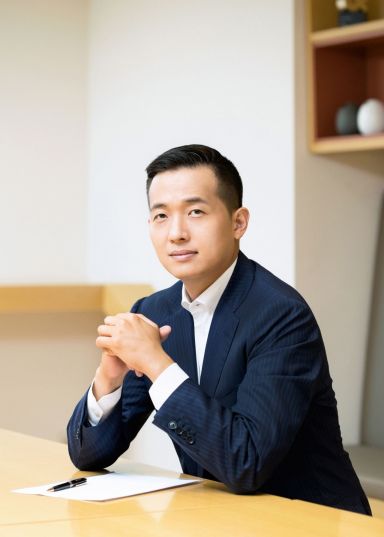
[Asia Economy Reporter Park So-yeon] "Hanwha is shifting from a manufacturer to an IT company." Recently, Kim Dong-kwan, Vice President of Hanwha Solutions, has been focused on successfully transforming Hanwha from a manufacturing company into an IT company. Hanwha Solutions' acquisition of the U.S. software company Growing Energy Labs (GELI) on the 7th is seen as a significant turning point marking Hanwha Group's solar business transition from manufacturing-centered to IT industry-centered. Despite the management uncertainties caused by the spread of COVID-19 this year, Vice President Kim regarded the acquisition of GELI as a core business that must not be missed and ultimately succeeded in the acquisition. This is the first merger and acquisition (M&A) case since the launch of Hanwha Solutions, the integrated corporation formed by Hanwha Chemical and Hanwha Q CELLS & Advanced Materials earlier this year.
From Solar Panel Manufacturer to IT Company... Collecting Global Energy 'Big Data'
According to industry sources on the 10th, Hanwha Solutions acquired 100% of the shares of GELI, a company that develops and sells energy management systems (EMS). The acquisition amount is reported to be in the hundreds of billions of Korean won. Through the acquisition of GELI, Hanwha Solutions plans to transform from a manufacturing company focused on solar cells and modules (solar cells connected together) into a 'future-oriented energy business operator' capable of utilizing software technologies such as big data and artificial intelligence (AI). Founded in the U.S. in 2010, GELI has developed and sells its own management system that controls commercial solar power generation facilities and energy storage systems (ESS) through data analysis technology. Until now, Hanwha Solutions earned profits by selling solar photovoltaic (PV) modules, but with the acquisition of GELI, it can expand its business to leasing solar strategic packages (PV+ESS) to customers in the global market and signing integrated power trading contracts. After collecting users' power data, it becomes possible to provide integrated solution services that analyze usage patterns using GELI's AI technology. Accordingly, users can choose efficient billing systems and sell surplus solar-generated power to other users.

Hanwha Solutions currently holds the number one market share in the solar business in major global countries such as the U.S., Germany, and Japan. As of January 2020, it has an annual global production capacity of 9.6 GW for cells and 11.3 GW for modules. If the solar value chain extends from raw materials and components to products, equipment, and integrated services, Hanwha is currently focusing on the value chain from products to services. Earlier this year, Hanwha withdrew from the polysilicon business, which is the main raw material for the solar industry. The strategy is to focus on high-efficiency products, equipment, and energy management services to increase added value.
Hanwha's Evolving Solar Technology... Next Generation: Floating and Agrivoltaic Solar
Hanwha is evaluated to be about 1 to 2 years ahead of competitors in accumulated solar technology. It is putting effort into developing high-output, high-efficiency products. In particular, the recently unveiled floating and agrivoltaic future solar products at global exhibitions are attracting attention. The new floating solar product can withstand harsh environments of 85 degrees Celsius and 85% relative humidity for over 3,000 hours. It is an eco-friendly product that can generate solar power by floating on seas or lakes. Hanwha has supplied cells and modules for domestic and international floating solar power projects and is focusing on winning orders to participate in the world's largest Saemangeum floating solar power project. Meanwhile, it is also preparing for the agrivoltaic solar business. The agrivoltaic solar business has the advantage of smaller modules than general ones and does not cover all farmland, allowing simultaneous farming and solar power business. Hanwha Solutions has completed research on the sunlight required for crop farming and module technology and is conducting pilot projects. Along with this, it is providing total services including finance, insurance, and construction. Kim Hee-chul, President of Hanwha Q CELLS, said, "We will develop competitive energy solutions and grow into a leading company in the rapidly growing global distributed energy market."
© The Asia Business Daily(www.asiae.co.kr). All rights reserved.


















