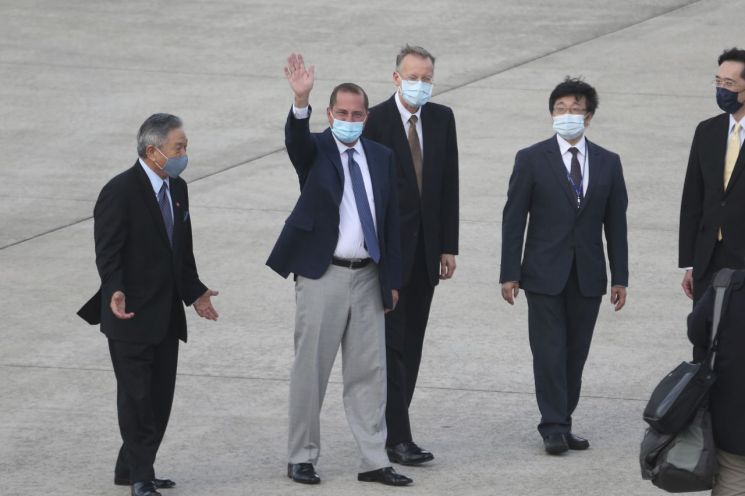
[Asia Economy Reporter Jeong Hyunjin] Alex Azar, the U.S. Secretary of Health and Human Services, visited Taiwan on the 9th. He is the highest-ranking official from the U.S. administration to visit Taiwan since the U.S. severed diplomatic ties with Taiwan in 1979. Despite strong opposition from China, which advocates the "One China" policy, the visit was realized, drawing attention to whether U.S.-China tensions will further escalate.
According to AP News and others, Secretary Azar arrived at Songshan Airport in northern Taipei on the same day. It has been six years since a U.S. cabinet member last visited Taiwan, with Gina McCarthy, the Environmental Protection Agency Administrator, visiting in 2014. The U.S. government recognized the One China principle and severed diplomatic ties with Taiwan when it established diplomatic relations with China in 1979, and since then has not actively engaged in high-level exchanges with the Taiwanese government.
On the morning of the 10th, Secretary Azar, accompanied by James Moriarty, the representative of the American Institute in Taiwan (AIT), which functions as the U.S. embassy in Taiwan, met with President Tsai Ing-wen. In the afternoon, he visited the Ministry of Health and Welfare of Taiwan, gave a lecture at National Taiwan University, and paid respects at the Taipei Guest House, where a memorial altar for former President Lee Teng-hui is set up. He is scheduled to leave Taiwan on the 13th. AP reported that "Secretary Azar is expected to request cooperation in responding to the COVID-19 pandemic."
China has strongly opposed Secretary Azar's visit to Taiwan. On the 6th, China’s Global Times editorial described Azar’s visit as a "provocation" and warned, "Do not cross the line." The Global Times emphasized, "China has many cards, including military ones," and pressured that U.S.-China relations could be damaged even if Donald Trump is re-elected president.
The Trump administration has been strengthening exchanges with Taiwan since taking office to pressure China. Notably, the U.S. agreed last year to sell over $10 billion worth of weapons to Taiwan, including F-16V fighter jets, M1A2T tanks (Taiwan-specific version of the M1A2 Abrams), and Stinger missiles. The administration is also actively supporting President Tsai Ing-wen, who is known for her anti-China stance and is now in her second term.
© The Asia Business Daily(www.asiae.co.kr). All rights reserved.

















