Democratic Party and United Party Support Gap Narrows by 0.8%p
Criticism of 'Legislative Dictatorship' for Pushing Bills by Majority Rule
Choi Jang-jip: "Indiscriminate Decisions by Majority Rule... Nothing More Than Dictatorship"
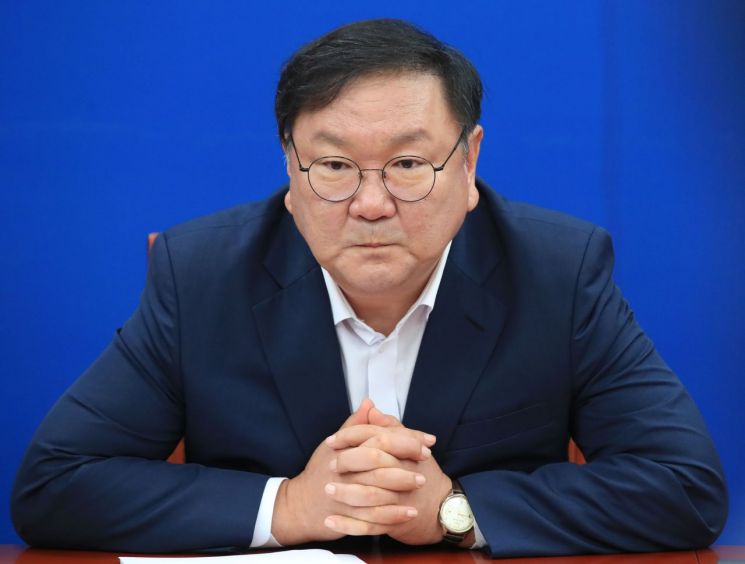 Kim Tae-nyeon, the floor leader of the Democratic Party of Korea, is deep in thought during the policy coordination meeting held at the National Assembly in Yeouido, Seoul, on the morning of the 6th.
 [Image source=Yonhap News]
[Asia Economy Reporter Han Seung-gon] The aftermath of Prosecutor General Yoon Seok-yeol's remarks on 'the facade of democracy,' 'dictatorship,' and 'totalitarianism' during the new prosecutor's oath ceremony on the 3rd continues to ripple through the political sphere.
Immediately, the Democratic Party of Korea has been flooded with strong statements demanding that Prosecutor General Yoon be removed from office, including calls for 'impeachment.' On the other hand, the United Future Party describes his remarks as those of a 'upright public official' and criticizes the Democratic Party as 'legislative dictatorship,' condemning it as the tyranny of the ruling party.
Progressive senior scholar Choi Jang-jip, Professor Emeritus at Korea University, also strongly criticized in an interview with JoongAng Ilbo, saying, "If the rule of the majority becomes an indiscriminate principle of decision-making, it is nothing more than majority dictatorship," leading to unexpected 'dictatorship' criticism of the Democratic Party.
Coincidentally, in a recent public opinion poll on party support, the Democratic Party allowed the United Future Party to close the gap to a neck-and-neck race. In Seoul, the support rate even fell behind.
The gap in support rates between the two parties narrowed to 0.8 percentage points, within the margin of error. As a result, some believe this cannot be ignored. Some argue that the negative opinions toward the ruling party, which appears to disregard opposing views, may have contributed to the decline in the Democratic Party's support rate.
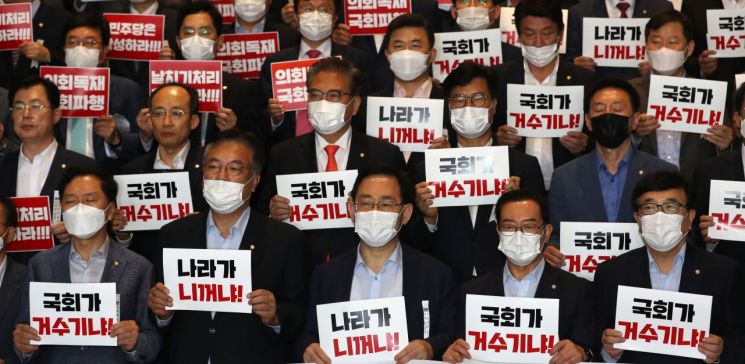 Members of the United Future Party are holding placards and shouting slogans condemning the National Assembly disruption on the rotunda hall stairs of the National Assembly main building after the plenary session ended on the afternoon of the 4th.
 [Image source=Yonhap News]
The so-called 'legislative dictatorship' criticism surfaced on the 3rd. On that day, the real estate policy bills promoted by the Democratic Party passed the National Assembly's Legislation and Judiciary Committee (Legislation Committee) amid the absence of the United Future Party.
On that day, the Legislation Committee also faced turmoil as conflicts arose over the United Future Party's request to form a subcommittee for systematic and detailed review of the bills. Members of the Legislation Committee from the United Future Party issued a statement criticizing, "Chairman Yoon Ho-jung's unilateral actions are anti-democratic and anti-rule of law," and called it "a dictatorial act processing bills according to a scenario designed to follow President Moon Jae-in's orders."
At a press conference, they claimed, "Chairman Yoon forcibly processed real estate-related bills unknown to the public and opposition Legislation Committee members within two hours, ignoring National Assembly procedures on July 29, and today he is again trying to unilaterally decide the committee's schedule."
Meanwhile, the Democratic Party is expected to launch a strong legislative drive again starting with the regular National Assembly session in September to pass the 'Working National Assembly Act' and 'Power Institution Reform Act' in the second half of this year.
However, there is also a view that the opinions of the United Future Party, which has closed the gap to a neck-and-neck race in party support, cannot be ignored. While the bills can be processed as before, the declining support rate may have an adverse effect on the Seoul and Busan mayoral by-elections.
According to the preliminary weekday aggregate of the first week of August conducted by Realmeter on the 6th commissioned by TBS, the Democratic Party's support rate dropped 2.7 percentage points from the previous week to 35.6%. Meanwhile, the United Future Party's support rate rose 3.1 percentage points to 34.8%. The gap between the two parties was only 0.8 percentage points.
Especially in the Seoul area, the United Future Party recorded 37.1%, surpassing the Democratic Party's 34.9%. Among the Democratic Party supporters, those in their 30s (35.6%) dropped 10.1 percentage points from the previous week, and women (36.2%) fell by 3.4 percentage points.
President Moon Jae-in's approval rating also fell 1.9 percentage points from the previous week to 44.5%. Negative evaluations rose 2.2 percentage points to 51.6%, with negative ratings exceeding positive ratings for the fourth consecutive week. The undecided/no response rate was 3.9%.
Opinions among citizens who reviewed these poll results are divided. Kim, a 30-something office worker supporting the Democratic Party and working in Seoul, said, "(The bill processing) is what the people voted for. It is the will of the people," but added, "I think the recent decline in support rates needs to be seriously considered." However, he added, "That said, I don't think there is a strong reason to be overly sensitive to poll results."
On the other hand, Park, a 40-something office worker supporting the United Future Party, criticized, "Ignoring opposing opinions is not democracy," and said, "Sharing opinions and listening well to ultimately serve the people?that's not happening. This could be seen as 'dictatorship' in another sense."
Although the bill procedure is based on majority rule, there are critical views that it is ultimately a tyranny. Professor Emeritus Choi Jang-jip of Korea University said in an interview with JoongAng Ilbo, "Majority rule can be considered a common decision principle in democracy," but added, "Majority rule is not the only democratic decision principle. There are various types of majority rule, such as consensus or compromise. Doing it unilaterally by majority rule without those is not something I can equate with democracy." He further stated, "If the rule of the majority indiscriminately becomes the principle of decision-making, it is nothing more than majority dictatorship."
Professor Choi also expressed concerns about the establishment of the Corruption Investigation Office for High-ranking Officials (CIO), saying, "The president's power is already very strong, and if the president gains a super prosecutor agency like the CIO, there is nothing the president cannot do." He criticized, "Since even elected lawmakers can be subject to investigation, the CIO could become a tool for exercising power."
© The Asia Business Daily(www.asiae.co.kr). All rights reserved.



















