Hankyung Research Institute '2020 Analysis and Implications Report on Temporary Leave Trends'
[Asia Economy Reporter Ki-min Lee] A study has found that due to the surge in business downturns and work stoppages caused by the impact of the novel coronavirus disease (COVID-19) this year, for every one temporary leave worker, the number of employed persons decreases by 0.35 in the following month.
The Korea Economic Research Institute (KERI) revealed this in its report titled "Analysis of Trends in Temporary Leave Workers in 2020 and Implications," arguing that labor policies such as employment flexibility should be implemented to respond to the COVID-19 situation.
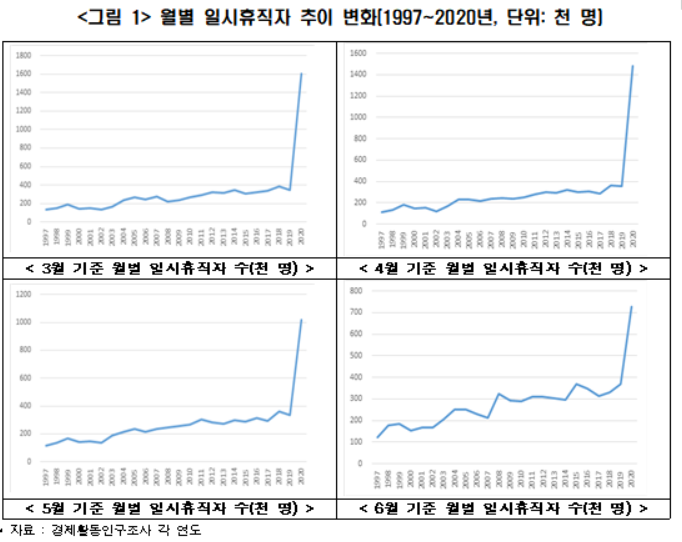
KERI pointed out in the report that the number of temporary leave workers from March to May this year was 1,607,000, 1,485,000, and 1,022,000 respectively, noting that such a precedent did not exist even during the 1997-1998 IMF crisis or the 2008-2009 financial crisis.
According to the report, analysis of the Economically Active Population Survey data showed that based on the average from March to May when temporary leave workers exceeded 1 million, about 58.2% of temporary leave was due to business downturns and work stoppages. This is a significant increase compared to the usual proportion of around 20% for temporary leave caused by business downturns and work stoppages from 2018 to last year.
Looking at the distribution by industry, among the average 1,371,000 temporary leave workers, the health and social welfare services sector had the highest number with 265,000 (19.3% of the total), followed by the education services sector with 241,000 (17.6%). The wholesale and retail trade, accommodation, and food service sectors recorded a total of 207,000 (15.1%) temporary leave workers, and the manufacturing industry also saw 111,000 temporary leave workers.
By occupation, the largest number of temporary leave workers was found among professionals and related workers with 360,000 (26.3%), while simple labor workers also had 332,000 (24.2%) temporary leave workers, indicating that both professionals and simple labor workers were affected by COVID-19.
The report explained that KERI applied a virtual panel model to the 2020 Economically Active Population Survey to estimate the impact of temporary leave workers on employment-related variables and to explore implications regarding changes in the status of temporary leave workers. The analysis showed that temporary leave workers increasingly have a negative impact on the number of employed persons over time.
Analysis targeting those aged 15 to 64 in the first half of this year showed that an increase of one temporary leave worker due to business downturns and work stoppages results in a decrease of 0.35 employed persons in the following month. This result can also be interpreted as the probability of a temporary leave worker becoming unemployed in the next month being up to about 35%. KERI explained that an increase of one temporary leave worker due to business downturns and work stoppages reduces the number of employed persons by 0.58 two months later.
KERI argued that to protect jobs during the economic crisis caused by COVID-19 and to respond to the new employment market in the post-COVID era, it is necessary to strengthen employment and working hour flexibility. Researcher Jin-seong Yoo stated, “It is important to maintain job sustainability by sharing jobs through labor flexibility and reducing the burden on companies,” adding, “For example, expanding labor flexibility through diversification of work types such as time-selective work systems that allow full-time workers to switch to part-time work when needed is necessary.”
© The Asia Business Daily(www.asiae.co.kr). All rights reserved.

















