7 out of 10 Office Workers Say "There Are 'Young Kkondae' in Their 20s and 30s at Work"
Office Workers Tired of Human Relations Choose to Be 'Voluntary Outsiders'
Experts Say "Korea's Hierarchical Culture Is the Cause"
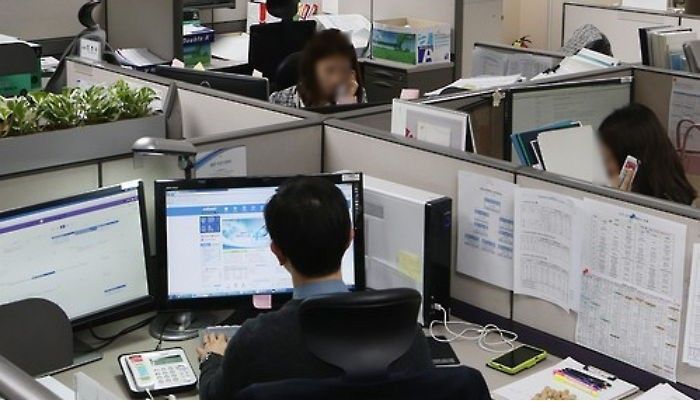 Recently, there has been an increase in people complaining about stress caused by so-called 'young kkondae' in the workplace. The photo is unrelated to specific expressions in the article. [Image source=Yonhap News]
[Asia Economy Reporter Heo Midam] "They say it all for your own good," "That's how it was in our days."
Office worker Kim (28) has been under considerable stress recently due to a senior colleague who is just one year older. Kim said, "There's only a six-month difference in our work experience, but they act as if they are a much senior veteran," adding, "They nag about not placing the spoon properly during lunch and jokingly asked if I hadn't prepared for the talent show during company gatherings."
He continued, "It might be their way of showing friendliness or just a joke, but for the person on the receiving end, it's not like that at all," and lamented, "Actually, older seniors take better care of me and are more comfortable to be around."
Recently, more people have been expressing stress caused by so-called 'young kkondae' in the workplace. 'Kkondae' is a term used to mock the older generation who stubbornly stick to their own ideas.
However, recently, even among the 20s and 30s generations, there have been cases where those with lower status or younger age give unsolicited advice or criticisms under the pretext of guidance. This has led to the creation of a new term, 'yeolgkkon' (young kkondae). Experts analyze that Korea's vertical organizational culture has influenced this phenomenon.
 In a survey conducted last year, more than 7 out of 10 people answered that there are "young kkontae in the workplace."
 [Image source=Yonhap News]
More than half of office workers agreed that there are 'young kkondae' in the workplace. According to a survey conducted last year by Saramin targeting 1,945 office workers, 75.4% of respondents answered that 'there are young kkondae in the workplace.' In other words, more than 7 out of 10 people recognize the presence of 'young kkondae.'
In particular, 'young kkondae' were found to exhibit behaviors such as ▲giving advice and teaching as if their own experience is everything (57.8%, multiple responses) ▲telling others to freely express opinions but ultimately forcing their own answers (41.3%) ▲enforcing hierarchical obedience like 'if a senior tells you to do it, you must' (40.7%).
Kim (27), who works in advertising, also revealed that he had been stressed by a 'young kkondae.' Kim said, "From the moment I joined the company, the immediate senior disliked me. When that senior disliked me, other seniors and colleagues gradually distanced themselves from me," and added, "I wondered if this was workplace ostracism."
He continued, "Even when I voiced my opinions during meetings, they were ignored as a matter of course," and lamented, "I'm exhausted from human relationships. I haven't even been here for three months, but all I want is to quit."
Although many office workers suffer due to 'young kkondae,' most 'young kkondae' themselves think they are far from being authoritative and different from the older generation.
According to the earlier Saramin survey, respondents cited as the top characteristic of 'young kkondae' that 'they think they are different from 40s and 50s kkondae' (48.6%, multiple responses). Following that, answers included ▲'They think they are not authoritarian' (37.7%) ▲'They think they are rational' (33.1%) and so on.
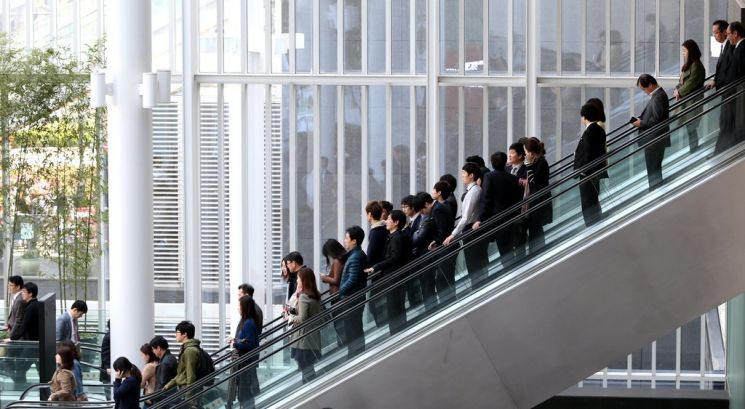 The number of office workers choosing to be so-called 'voluntary outsiders' who avoid socializing with others is increasing. [Image source=Yonhap News]
Given this situation, more office workers are choosing to be so-called 'voluntary outsiders' who avoid mingling with others at work.
Lee (28), a third-year office worker, said, "I feel fatigued from human relationships," and added, "Rather than being with colleagues and feeling stressed, I prefer to have some rest alone during lunch." He continued, "When I was a new employee, I always stayed with seniors and colleagues out of caution, but now I am happier than then."
There are also those who give up on workplace relationships like Lee. According to a survey by the employment portal Saramin targeting 1,314 office workers, 44.1% of respondents identified themselves as 'voluntary outsiders.' Especially by age group, the rates were 30s (49.5%), 20s (44.4%), 40s (39.1%), and 50s and above (28.9%), showing a higher proportion among the 20s and 30s generations compared to the older generation.
Experts attribute the emergence of 'young kkondae' to Korea's hierarchy-centered organizational culture. Professor Kwak Geumju of Seoul National University's Department of Psychology explained, "Korean culture is still vertical. Especially, because we have an honorific language culture, we have to consider whether the other person is above or below us," adding, "Also, in organizations like workplaces or universities, seniors tend to repeat behaviors toward juniors, sometimes resulting in acts similar to 'gapjil' (abuse of power)."
She added, "Because hierarchy is often divided by age, some people deliberately do not reveal their private information within the organization."
© The Asia Business Daily(www.asiae.co.kr). All rights reserved.



















