[Asia Economy Reporter Yuri Kim] The rate of increase in apartment prices in the Seoul metropolitan area has narrowed compared to the previous week. This is due to buyers feeling fatigued by successive government measures and the rapid rise in apartment prices, leading them to adopt a wait-and-see approach. However, overall, there are not many properties on the market, so a seller's market continues mainly in areas near subway stations and mid-to-low priced apartments where demand remains steady. The jeonse (long-term lease) market saw a decrease in demand due to the off-season during the vacation period. The price increase has slowed compared to last week when prices surged significantly just before the implementation of the revised Housing Lease Protection Act.
According to Real Estate 114 on the 7th, the rate of change in apartment sale prices in Seoul recorded 0.09%, a 0.02 percentage point slowdown from the previous week. Reconstruction and general apartments rose by 0.02% and 0.10%, respectively. Additionally, Gyeonggi and Incheon increased by 0.05%, and new towns rose by 0.02%.
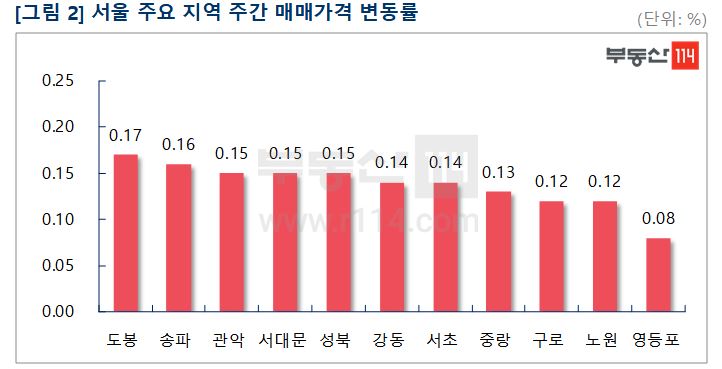
In Seoul, Dobong (0.17%), Songpa (0.16%), Gwanak (0.15%), Seodaemun (0.15%), Seongbuk (0.15%), Gangdong (0.14%), Seocho (0.14%), and Jungnang (0.13%) saw price increases. Dobong continues to attract steady demand for subway station areas and mid-to-low priced apartments under 600 million KRW. Changdong Sanggye Jugong Complexes 17, 18, and 19, Banghak-dong Samik Ceramic, and Ssangmun-dong Dongik Park rose by 5 to 10 million KRW. Songpa saw increases of 5 to 15 million KRW mainly in large apartment complexes such as Sincheon-dong Jamsil Parkrio, Jamsil-dong Lake Palace, and Munjeong-dong Siyeong. Gwanak experienced a 5 to 10 million KRW rise influenced by school district demand, with Bongcheon-dong Gwanak Dream Town and Sillim-dong Sillim Prugio among the notable areas. Seodaemun's Hyeonjeo-dong Doknipmun Geukdong and Hongje-dong Inwangsan Hyundai rose by 7.5 to 10 million KRW. Gangdong saw 5 to 25 million KRW increases mainly in small to medium-sized units in new large complexes such as Godeok-dong Godeok Gracious and Myeongil-dong Raemian Myeongil Station Solvenue.
New towns recorded increases in Ilsan (0.08%), Dongtan (0.06%), Pyeongchon (0.04%), Jungdong (0.02%), Bundang (0.01%), and Pangyo (0.01%), while others remained flat (0.00%). Ilsan's housing prices are strong due to the Goyang Ilsan Techno Valley and GTX development benefits. Juyop-dong Gangseon Complex 19 Woosung and Gangseon Complex 16 Dongmoon, as well as Baekseok-dong Baeksong Complex 5 Samho Poonglim, rose by 5 to 7.5 million KRW. Dongtan saw 5 to 10 million KRW increases in Neungdong Pureunmaeul Posco The Sharp Phase 2, Dongtan Pureunmaeul Doosan We've, and Bansong-dong Narumaeul World Meridian Bando Ubora Phase 2. Pyeongchon experienced 5 to 10 million KRW rises mainly in large units such as Hogye-dong Mokryeon Complex 6 Doosan and Pyeongchon-dong Kkum Hyundai.
Gyeonggi and Incheon saw increases in Hanam (0.16%), Namyangju (0.11%), Gwangmyeong (0.10%), Bucheon (0.10%), Uiwang (0.09%), Anyang (0.08%), and Goyang (0.06%). Hanam's Dae-myeong Riverside Town in Sinjang-dong, Seondong Misa Riverside Phase 2 Prugio, and Sinjang-dong Hanam Union City Aileen's Garden, located near the Hanam Line (extension of Line 5) opening on the 8th, rose by about 10 million KRW. Namyangju's Wabu-eup Doosan We've, Dasan-dong Namyang i-Joheun Jip, and Hwado-eup Poonglim i-One Phase 1 increased by 5 to 10 million KRW. Gwangmyeong saw a 10 million KRW rise as redevelopment relocation demand continued, with large apartment complexes such as Gwangmyeong-dong Gwangmyeong Haemoro Iyeon and Haan-dong Jugong Complexes 6 and 7.
The metropolitan area's jeonse market also saw a reduced rate of increase due to the off-season during the vacation period and the rainy season's impact, with demand decreasing. Seoul rose by 0.07%, down from 0.10% the previous week. Gyeonggi and Incheon increased by 0.03%, and new towns by 0.02%.
Seoul's jeonse market showed an upward trend centered on large complexes with good proximity to workplaces and school districts. By region, Gwanak (0.19%), Songpa (0.18%), Gangdong (0.17%), Seongbuk (0.13%), Yeongdeungpo (0.13%), and Geumcheon (0.09%) rose in that order. Gwanak's Bongcheon-dong Gwanak Dream Town and Bongcheon Woosung increased by 5 to 10 million KRW. Songpa's Bangi-dong Olympic Athlete Village, Sincheon-dong Jamsil Parkrio, and Munjeong-dong Siyeong rose by 10 to 20 million KRW. Gangdong saw 5 to 20 million KRW increases in Godeok-dong Godeok Gracious, Cheonho-dong Raemian Gangdong Palace, and Sangil-dong Godeok Lian Park Complex 3. Seongbuk's Jongam-dong Raemian La Sente, Jeongneung-dong Poonglim i-One, and Hawolgok-dong Wolgok Doosan We've rose by 5 to 10 million KRW.
New towns saw increases in Ilsan (0.09%), Dongtan (0.04%), Jungdong (0.03%), and Pyeongchon (0.01%). Ilsan's Juyop-dong Munchon Complex 16 New Samik and Janghang-dong Hosu Complex 3 Samhwan Yuwon rose by 2.5 to 5 million KRW. Dongtan's demand continued mainly in pilot complex apartments with good living conditions within Dongtan 1 New Town. Bansong-dong Siberdan World Meridian Bando Ubora and Siberdan Poongsung Shinmiju rose by 2.5 to 10 million KRW. Jungdong's Green Town Woosung Phase 2 increased by 10 million KRW, and Pyeongchon's Pyeongchon-dong Kkum Hyundai rose by 5 million KRW.
Gyeonggi and Incheon saw increases in Hanam (0.12%), Guri (0.08%), Anyang (0.08%), Uiwang (0.07%), Namyangju (0.06%), Suwon (0.05%), Osan (0.05%), and Yongin (0.04%). Hanam's Sinjang-dong Dae-myeong Riverside Town and Changwoo-dong Eunhaeng rose by 5 to 10 million KRW mainly in medium to large units. Guri's Gyomun-dong Guri Doosan, Hangaram LG, and Daerim increased by 5 to 10 million KRW. Anyang's Hogye-dong Hanmaeum Imkwang Complex 1 and 2, Hogye E-Pyeonhan Sesang, and Seoksu-dong Seoksu LG Village rose by about 10 million KRW. Namyangju's Dasan-dong Namyang i-Joheun Jip, Hwado-eup Shinmyeong Skyview Green, and Bomi Cheonggwang Plus One increased by 5 to 10 million KRW.
It has been about a month since the announcement of the July 10 measures. Despite the significant increase in tax burdens on multi-homeowners and the government's announcement of large-scale housing supply plans in the metropolitan area, the upward trend in housing prices continues as real demand for mid-to-low priced apartments persists. Ye Kyung-hee, senior researcher at Real Estate 114, said, "However, since the rate of increase in sale prices has slowed compared to last week, it is necessary to monitor the price trend."
The jeonse market saw somewhat fewer inquiries due to the summer vacation off-season. However, since the supply-demand imbalance caused by a shortage of jeonse listings continues, concerns about price increases remain. Senior researcher Ye said, "Concerns about jeonse scarcity are spreading throughout the metropolitan area. With the full implementation of the Housing Lease Protection Act, including the right to request contract renewal and the cap on rent increases, along with low interest rates and increased tax burdens, the speed of conversion to monthly rent is expected to accelerate."
© The Asia Business Daily(www.asiae.co.kr). All rights reserved.

















