Ministry of Economy and Finance Exempts Heavy Capital Gains Tax if Only Half of Mandatory Lease Period Is Fulfilled
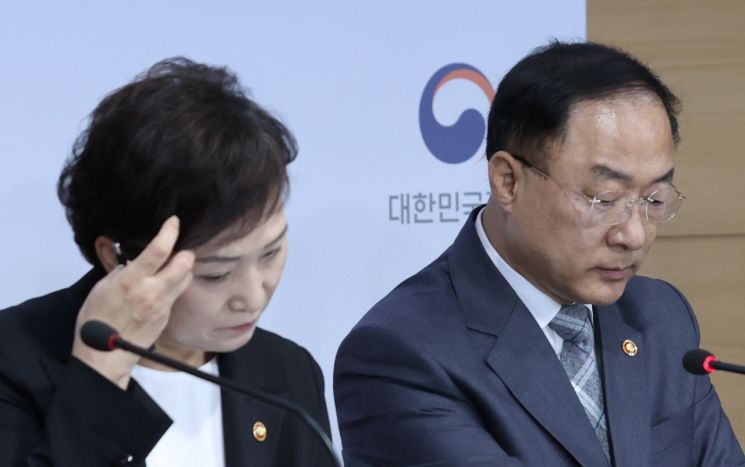
[Asia Economy Reporters Joo Sang-don and Jang Se-hee] The government has decided not to impose additional capital gains tax when selling rental housing that has been rented out for more than half of the mandatory rental period. Also, rental housing will not be included in the comprehensive real estate tax aggregation until the registration cancellation point. The one-household-one-home capital gains tax exemption will also apply when the rental business owner sells a house they reside in. This supplementary legislation was issued by the government just three days after the Democratic Party of Korea forcibly passed multiple real estate-related laws in the National Assembly plenary session without sufficient debate and discussion.
On the 7th, the Ministry of Economy and Finance announced the "Supplementary Measures for Tax Support on Rental Housing following the Amendment of the Special Act on Private Rental Housing" containing these details. The government plans to submit amendments to the Income Tax Act and the Restriction of Special Taxation Act to the National Assembly next month after legislative notice and Cabinet and Vice-Minister meetings.
A government official said, "There was much controversy over the initial capital gains tax surcharge," adding, "According to the existing Income Tax Act, if the registration is voluntarily canceled before completing four years, taxes received up to three years are reclaimed, but we decided to change this part." After the bill passed the National Assembly plenary session on the 4th, controversy arose over retroactive application, prompting the government to belatedly propose supplementary measures. As strong backlash emerged over the National Assembly's forced passage of real estate legislation without sufficient debate, the government eventually presented amendments, which is expected to intensify criticism.
First, according to this supplementary measure, capital gains tax will not be surcharged when selling a house rented out for at least half of the mandatory rental period. If this criterion is met, the additional capital gains tax rate (10%) on houses owned by corporations will also not apply. However, if the rental business registration is voluntarily canceled before the rental registration period ends, the house must be sold within one year to avoid the capital gains tax surcharge. Previously, the government raised the surcharge rate applied when multi-homeowners sell houses in regulated areas by 10 percentage points. Two-homeowners face a 20 percentage point surcharge, and three-homeowners face a 30 percentage point surcharge. Accordingly, the highest capital gains tax rate increased to 62% for two-homeowners and 72% for three or more homeowners. If half of the mandatory rental period has passed, the one-household-one-home capital gains tax exemption will be recognized for five years after registration cancellation for houses where the rental business owner resides. For example, if Mr. A owns three houses and registers two of them as short-term private rental housing (4 years) besides the house he lives in, after two years of rental period, he can voluntarily cancel the registration and avoid capital gains tax surcharge for one year when selling the rental houses. The house he lives in will not be subject to capital gains tax for five years.
Along with this, the government will maintain the benefit of excluding existing rental business owners from comprehensive real estate tax aggregation. From the rental registration date to the registration cancellation date, preferential treatment for necessary expenses under separate taxation on rental income, income tax (30%) and corporate tax (70%) reductions on small registered rental houses, and comprehensive real estate tax exemption benefits on registered rental houses can be received. Also, if voluntary or automatic registration cancellation occurs before the mandatory rental period, taxes already reduced will not be reclaimed.
Experts pointed out that inconsistent and erratic policies make it difficult to expect the originally anticipated effects. Professor Hong Woo-hyung of Hansung University’s Department of Economics said, "Leaving the bill as is and then saying 'we will not reclaim the already reduced parts' cannot be seen as a tax benefit supplement," adding, "Legally, retroactive application cannot be made unless the benefit was wrongly obtained." He further noted, "Due to the lack of consistency among government policies, the policy effects will not materialize at all." Professor Sung Tae-yoon of Yonsei University’s Department of Economics said, "The government encouraged rental business owners to rent, then imposed taxes again," adding, "Ultimately, both rental business owners and tenants were hit, resulting in a heavy tax burden."
© The Asia Business Daily(www.asiae.co.kr). All rights reserved.

















