Decrease in Passenger Flights Reduces Air Cargo Supply, Improving Profitability
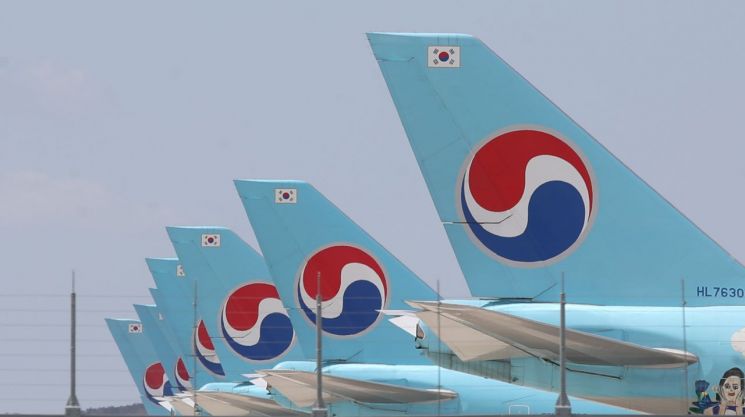
[Asia Economy Reporter Yu Je-hoon] As the aviation industry faces a crisis due to the novel coronavirus disease (COVID-19) pandemic, air cargo freight rates have surged, acting as a "rain in a drought." Industry insiders believe that with the prolonged reduction in passenger flights, the air cargo sector is likely to continue playing a vital role.
According to the TAC Air Freight Index released in Hong Kong on the 7th, as of the 3rd, the freight rate for the Hong Kong-North America route was recorded at $5.70 per kilogram. This is about 40% higher compared to $3.32 per kilogram during the same period last year (first week of August).
Before the full-scale spread of COVID-19, in February, the average air cargo freight rate on the Hong Kong-North America route hovered in the $3 range, maintaining a level similar to the previous year. However, after the outbreak intensified, the monthly average rose sharply to $4.03 in March, $5.69 in April, and $7.73 in May. Although it has since declined somewhat, it still remains about 40% higher than the previous year.
This boom in the air cargo market is due to the global suspension of passenger flights, which drastically reduced the supply of belly cargo (cargo hold under passenger aircraft). Typically, belly cargo accounts for 30-40% of the total air cargo supply.
An official from a national airline stated, "Recently, major airlines, led by Korean Air, have increased the operation of empty passenger planes to maintain belly cargo services, but it is still insufficient to compensate for the reduced supply since COVID-19," adding, "Overall cargo demand is expected to decline, but the supply-demand effect is offsetting this."
As a result, Korean Air posted an operating profit of 148.5 billion KRW in the second quarter, turning profitable. Korean Air's cargo transport performance (cargo ton-kilometers, FTK) increased by 17.3% year-on-year, and revenue rose by 94.6% (549 billion KRW) to 1.2259 trillion KRW. Asiana Airlines also saw a 95% increase in cargo revenue and a 56% decrease in operating expenses. Consequently, operating profit increased by 222.1 billion KRW and net profit by 173.9 billion KRW compared to the previous year, both turning profitable.
Inside and outside the industry, the air cargo market is expected to remain strong until the end of this year. The fourth quarter is considered the peak season for air cargo, and demand for new IT products is also pending. Lee Han-jun, a researcher at KTB Investment & Securities, said in a report on the day, "Shipments of new products from Sony, Apple, Samsung Electronics, and others are starting in earnest, and with belly cargo supply still nonexistent, freight rates will surge in August and September," adding, "The air cargo boom is likely to continue."
Korean Air is preparing to expand supply in anticipation of this. A representative example is the plan to convert passenger aircraft into cargo planes by removing seats, currently under discussion with authorities. A Korean Air official said, "We plan to fully leverage the strengths of our high-efficiency large cargo fleet to actively attract demand for quarantine supplies, e-commerce shipments, semiconductor equipment, and automobile parts to maximize profits," adding, "We will also steadily increase supply by pursuing measures such as removing passenger seats to use aircraft as cargo planes."
© The Asia Business Daily(www.asiae.co.kr). All rights reserved.

















