Missiles Consist of Propulsion, Guidance System, and Warhead
Classified into Ballistic, Cruise, and Interceptor Missiles Based on Characteristics
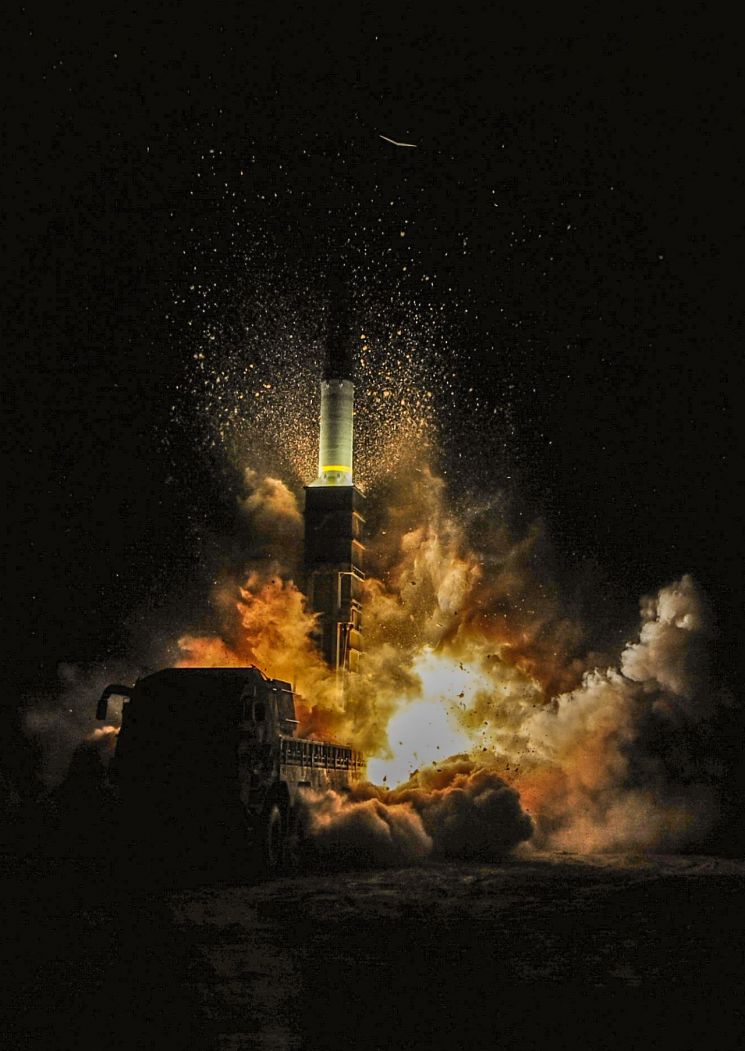
[Jang Sang-geun, Former Senior Researcher at the Agency for Defense Development] Unlike the classic action hero ‘Terminator,’ who defeated enemies with a large shotgun, the mega-blockbuster
Fortunately, the missiles accurately identify the target’s location. The reason missiles can reliably hit their targets is that they have a seeker acting as the eyes, an onboard computer guidance system serving as the brain, actuators and control fins functioning as hands and feet, and sophisticated operational software that makes the missile smart.
Missiles have three major characteristics: they can fly under their own power, have guidance systems, and carry warheads to destroy targets. To enable self-propelled flight, they generate their own thrust, mainly through rocket engines or jet engines. Rocket engines carry fuel in solid or liquid form and an oxidizer that acts as oxygen, burning fuel in a combustion chamber to produce high-pressure gas and thrust. Jet engines, like those on jet aircraft, intake air and burn fuel using oxygen from the air to generate thrust. Today, many missiles use solid rocket engines because of their simple structure and ease of use.
▲ Structure of a Missile = To guide a missile to its target, navigation, guidance, and control devices are necessary. Navigation devices estimate the missile’s position and speed; guidance devices use the target’s position and speed information to issue maneuver commands so the missile flies toward the target; and control devices decide how to move control fins so the missile can maneuver according to the guidance commands.
The warhead is the energy means to destroy the target and can be of various types such as explosive energy, kinetic energy, nuclear energy, or non-lethal chemical/biological agents. The warhead consists of explosives and a casing that holds the explosives. Initially, the casing was only needed to contain the explosives, but as its purpose and functions have become more advanced and diverse, it has evolved into a complex structure with intelligent features.
Ballistic missiles begin flight influenced by Earth's gravity
Cruise missiles use jet engines aiming for precision strikes
Interceptor missiles intercept various moving targets
▲ Characteristics of Ballistic Missiles = Ballistic missiles use rocket propulsion and can perform ballistic flight, often targeting large-scale strikes. The term “ballistic” in ballistic missile refers to the fact that most of the missile’s flight trajectory is a free-fall trajectory, the same as the path of a projectile. Assuming no air resistance, a projectile fired from a barrel reaches maximum speed and then begins ballistic flight influenced by Earth’s gravity.
After the powered flight phase ends, ballistic missiles enter a ballistic flight phase, moving along a free-fall trajectory based on their speed and position at that moment. Improvements in inertial navigation systems, satellite navigation systems, and onboard computers have enabled fine guidance and control to increase accuracy. The missile goes through launch and propulsion, midcourse flight, and terminal phases to strike the target. During the terminal phase, the re-entry vehicle can be a single warhead or multiple warheads.
There are various forms such as MRV (Multiple Independently Targetable Re-entry Vehicle), which attacks a single target with multiple warheads. Ballistic missiles are also evolving to include seekers in the front to detect and track moving targets like aircraft carriers.
▲ Characteristics of Cruise Missiles = Cruise missiles use air-breathing jet engines and carry only fuel, making them efficient. They perform atmospheric cruise flight and mainly aim for precision strikes on point targets.
The broad definition of a cruise missile is a guided missile capable of cruise flight. Cruise flight means flying at a constant speed and altitude. Four forces act on flying bodies, including aircraft: thrust from the engine, weight, lift, and drag. When lift equals weight, altitude is maintained; when thrust equals drag, speed is constant. This condition is cruise flight, such as when a commercial airplane flies above clouds between takeoff and landing.
When necessary, cruise missiles utilize enemy terrain and target information. Targets are mainly ships or ground targets, and launch platforms vary widely, including ground, shipborne, surface, and air launches. In the terminal phase, various attack modes are used considering survivability and destruction effects, such as pop-up, low-level pop-up, bridge attack, air burst, and cave strike. Most cruise missiles fly at subsonic speeds, but some countries have developed supersonic cruise missiles, and countries like Russia are accelerating development of hypersonic cruise missiles.
▲ Characteristics of Interceptor Missiles = Interceptor missiles mainly use rocket propulsion to intercept various targets, including moving ones. Targets vary widely, including tanks, aircraft, rockets, ballistic missiles, and satellites, and configurations differ depending on the launch platform. Representative interceptor missiles, such as surface-to-air missiles, use early warning systems or onboard radar to detect and track targets and employ tracking radar and other target information measurement devices to acquire target data.
They perform friend-or-foe identification and assess engagement possibilities before launching guided missiles. Along with the development of surface-to-air missiles, missile defense systems (MD) that intercept ballistic missiles have recently made remarkable progress, achieving enhanced performance.
© The Asia Business Daily(www.asiae.co.kr). All rights reserved.
![User Who Sold Erroneously Deposited Bitcoins to Repay Debt and Fund Entertainment... What Did the Supreme Court Decide in 2021? [Legal Issue Check]](https://cwcontent.asiae.co.kr/asiaresize/183/2026020910431234020_1770601391.png)















