Increasing Generational Conflicts with Each New Real Estate Policy
Tenant-Landlord and Homeowners-Non-Homeowners Disputes
Changing Systems Every Time... "Government, National Division"
[Asia Economy Reporters Moon Jae-won, Lee Chun-hee]
"Are you saying that people in their 20s and 30s are more desperate to own a home than those who have been homeless for over 20 years?" (A in his 40s, Yeongdeungpo-gu, Seoul)
"I dream of owning a home, but soaring house prices and extremely low subscription points only make me sigh." (B, newlywed couple in their 30s, Dongjak-gu, Seoul)
Since the government announced the August 4 housing supply plan, stating that "more than half of the supplied houses will be allocated to youth and first-time homebuyers," intergenerational conflicts have intensified again. The government, which solidified a subscription system clearly unfavorable to young people and caused unnecessary conflicts between those in their 20s and 30s and those in their 40s and 50s, is now causing social confusion by adopting a 'divide-and-rule' policy even in housing supply.
According to the industry on the 6th, after significantly increasing the special supply quota for youth and first-time homebuyers in the July 10 plan last month, the government’s recent plan to allocate the entire supply quota to them has stirred strong anger among middle-aged people aged 40 and above. Criticism is growing that the real estate policies continuously implemented over the three years of the Moon Jae-in administration are not healing but rather exacerbating conflicts between generations and social classes.
Of the 132,000 housing units announced in the August 4 plan, more than half are allocated to first-time homebuyers, newlyweds, and youth. The intention is to ease the burden on young people who find it difficult to own a home due to lack of funds and insufficient subscription qualifications, but middle-aged people who have patiently waited their turn feel 'reverse discrimination.' In fact, numerous complaints have surfaced online, such as "My child is a bit older now, and I was saving money to buy a house, but even the opportunity to apply for a sale is being taken away."
The industry points out that the government has been fueling intergenerational conflicts by changing directions according to its preferences whenever it formulates real estate policies. The government has created a 'zero-sum' game atmosphere where a limited supply is taken from one side and given to the other.
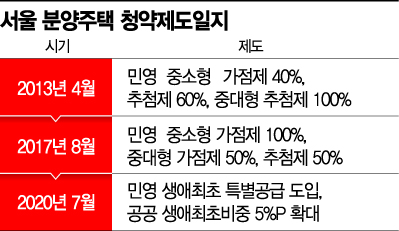
A representative example is the subscription system. At its inception, the subscription system focused on expanding opportunities for long-term homeless people such as middle-aged and older adults. The 'point system quota,' which determines winners by scoring subscription account duration, homelessness period, and number of dependents for small and medium-sized private housing under 85㎡ (exclusive area) in speculative and overheated speculation zones, was increased from 40% to 100%.
Half of the medium and large-sized lottery quota was converted to the point system, relatively reducing winning chances for people in their 30s and 40s. However, as house prices soared uncontrollably and young people’s criticism of government policies intensified, the policy was reversed 180 degrees. Through the July 10 plan last month, the special supply quota for young people such as newlyweds and first-time homebuyers was greatly increased. The subscription system, which should be operated with mid- to long-term predictability, was overturned on a whim based on public opinion.
The conflicts caused by policies are not limited to generations. The implementation of the three lease laws without sufficient discussion has increased conflicts between landlords and tenants, and the government has divided homeowners and non-homeowners by blaming multi-homeowners and older generations as the main culprits of rising house prices. In particular, landlord-tenant conflicts have caused various side effects such as accelerated conversion from jeonse (long-term deposit lease) to monthly rent, sharp rises in jeonse prices, and tenant housing instability, undermining the purpose of the amendments and distorting the real estate market.
Professor Song Jae-ryong of Kyung Hee University’s Department of Sociology said, "An important role of the administration is to reduce conflicts and divisions as much as possible and integrate society, but under this government, there have been many policies that strangely divide public opinion." He added, "Although the government may not have intended it, the growing antagonism between landlords and tenants, and between those who own real estate and those who do not, is worrisome."
He continued, "Before implementing policies, it is necessary to listen to diverse opinions from market-oriented experts and those who believe some checks and balances are needed, and to engage in a more in-depth discussion on the feasibility of policies."
© The Asia Business Daily(www.asiae.co.kr). All rights reserved.

![Clutching a Stolen Dior Bag, Saying "I Hate Being Poor but Real"... The Grotesque Con of a "Human Knockoff" [Slate]](https://cwcontent.asiae.co.kr/asiaresize/183/2026021902243444107_1771435474.jpg)















