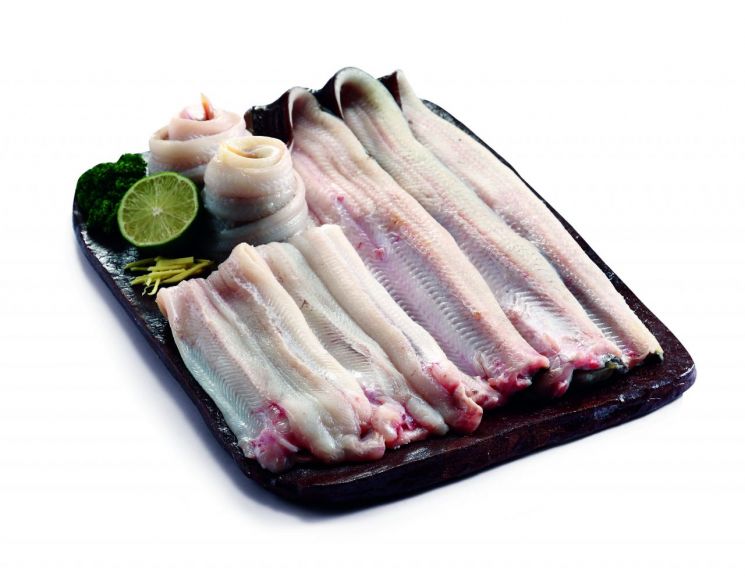
[Asia Economy Reporter Seungjin Lee] Emart is launching a consumption promotion campaign to support Tongyeong sea eel fishermen who are experiencing sluggish consumption due to the impact of the novel coronavirus (COVID-19), which has blocked exports to Japan.
Emart will offer three cleaned live sea eels (each weighing 100g-120g) for 7,992 KRW until the 12th. This translates to about 2,664 KRW per eel, which is approximately 45% cheaper compared to the usual Emart sea eel price of around 5,000 KRW per eel.
For this event, Emart secured a record volume of 40 tons of sea eels on a weekly basis. Considering that the sea eel sales volume during last year's last Bok week (August 8?14) was 8 tons, this is five times the amount of the peak season for sea eels.
In particular, Emart is offering a pack of sea eel sashimi (Bungjangeohoe) weighing about 160g for 9,920 KRW, which is rarely available in the distribution industry. Sea eel sashimi must be produced from live eels, making it difficult to find in the market. However, Emart processes live sea eels directly at the production site into sashimi, ages them for about 10 hours in a 0-2°C ultra-low temperature refrigerator, and distributes them, enabling the sale of sea eel sashimi rarely seen in large supermarkets.
The reason Emart can offer live sea eels at a low price is due to difficulties caused by the decline in exports to Japan and sluggish retail sales amid COVID-19, which has led to frozen sea eel stockpiles at the Tongyeong Coastal Trap Fishery Cooperative reaching their highest levels.
In fact, sea eel exports to Japan have significantly decreased. According to trade statistics, the export volume of sea eels to Japan from January to June this year was 1,075 tons, down about 33% compared to the same period last year. Export value was 11.944 million USD, a decrease of about 43% year-on-year.
As of June this year, the sea eel stock at the Tongyeong Coastal Trap Fishery Cooperative was approximately 782 tons, more than double the 367 tons recorded in June last year. In particular, the frozen sea eel stock is so large that the freshly produced live sea eels cannot be frozen and stored, and although the amount of sea eels released into the market has increased, they are facing a double hardship of poor consumption due to the prolonged summer rainy season.
Moon Bu-sung, Emart’s eel buyer, said, “Since the spread of COVID-19, the eel fishing industry has faced great difficulties due to sluggish consumption and exports. We planned this event to create an opportunity for a turnaround.” He added, “Eel is a representative health food in Korea, and we will cooperate with eel fishermen to plan various events so that eel can be enjoyed as a healthy food not only in summer but throughout all seasons.”
© The Asia Business Daily(www.asiae.co.kr). All rights reserved.

















