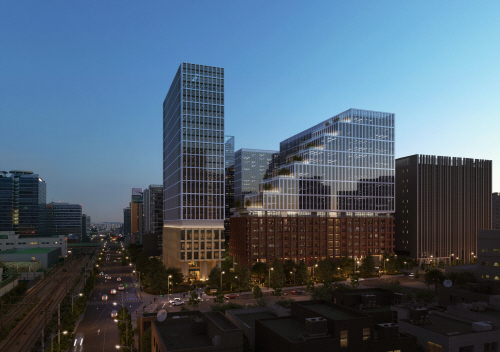
Recently, as the "Green New Deal" has become a hot topic, interest in green spaces is increasing. This is because the Green New Deal, along with the Digital New Deal, plays a key role in the "Korean New Deal Policy" announced by the government, highlighting the importance of eco-friendliness.
The Green New Deal is a policy that responds to climate change while promoting employment, with the government aiming for economic growth through the development of eco-friendly industries. With this policy direction, the value of green spaces has risen, increasing the likelihood that green spaces will become a factor in evaluating corporate value.
Green spaces can enhance competitiveness by improving work efficiency and reducing costs through creating a pleasant environment, thus creating an environment where they can be recognized as a form of capital alongside intellectual capital, human capital, and physical capital.
Research proving the economic effects of green spaces continues to emerge. The Seoul Metropolitan Government, through monitoring for rooftop park utilization, revealed that rooftop green spaces such as rooftop parks and rooftop gardens can save heating and cooling costs. According to the study, creating rooftop parks can reduce cooling costs by approximately 7,356 KRW/㎡ (an average of 1,839 KRW/㎡ per month) during the summer period (June to September), and heating costs by about 4,180 KRW/㎡ (an average of 836 KRW/㎡ per month) during the winter period (November to March).
Furthermore, a 2014 study published in the
Global companies are also following the trend of creating abundant green spaces in their office buildings. For example, Facebook, the world's largest social media company, has a rooftop park approximately 36,400㎡ in size?equivalent to seven soccer fields. There is an approximately 800-meter-long walking trail and over 400 trees planted, allowing employees to recharge ideas while strolling.
An industry insider explained, "The economic value of green spaces in real estate is not limited to providing a pleasant environment but is increasingly being recognized for its economic effects, as continuous research results show. Especially in areas with a shortage of green spaces, such as Seoul's business-dense or industrial areas, the effects could be even greater."
Hyundai Engineering & Construction has introduced "Hyundai Knowledge Industry Center Gasan Public" in Gasan-dong, Geumcheon-gu, within the Seoul Digital Industrial Complex, planning to supply "green capital" to tenant companies by securing large-scale green spaces within the complex.
"Hyundai Knowledge Industry Center Gasan Public" is being developed as the largest complex in Seoul, with five basement floors to 27 above-ground floors, three buildings, and a total floor area of approximately 260,000㎡. Commercial facilities are located from the basement first floor to the second floor above ground, and a separate building from the 6th to 26th floors houses a total of 567 "Public Houses" (dormitories), enabling one-stop living with work, residence, and commercial facility use within the complex.
Hyundai Knowledge Industry Center Gasan Public applies a specialized design themed around green spaces, whose value has recently increased. First, 42% of the complex is filled with green spaces to enhance work efficiency in a pleasant environment. Various themed green spaces such as large planting areas, waterside gardens, and small gardens are arranged throughout the complex to help employees reflect and generate ideas.
Additionally, facilities such as a public hall (a lecture hall with about 375 seats), a premium drop-off zone connected to the office building, meeting rooms linked to this zone, shared meeting rooms and lounges, and a deli cafe are established. The underground parking lot secures about 176% more spaces than legally required, providing ample parking. The expanded parking spaces allow convenient use by large vehicles, and the ceiling height is designed up to 2.8 meters to improve accessibility for cargo and emergency vehicles.
The building incorporates eco-friendly architectural designs, including high insulation and airtight windows, high-efficiency equipment, standby power cut-off devices, LED lighting, and environmentally friendly building materials, achieving Seoul's highest green building certification and Seoul energy efficiency grade 1+.
Hyundai Knowledge Industry Center Gasan Public also boasts optimal location conditions for corporate activities. It is a station-area complex within walking distance of Gasan Digital Complex Station, a transfer station for subway lines 1 and 7, facilitating easy commuting for employees. Nearby road networks include Seobu Expressway, Nambu Beltway, and Export Bridge. Especially, using Seobu Expressway connects well to the Olympic-daero, Seohaean Expressway, Gangnam Circular Urban Expressway, and the 2nd Gyeongin Expressway, enabling access throughout Seoul and the metropolitan area.
© The Asia Business Daily(www.asiae.co.kr). All rights reserved.
![Clutching a Stolen Dior Bag, Saying "I Hate Being Poor but Real"... The Grotesque Con of a "Human Knockoff" [Slate]](https://cwcontent.asiae.co.kr/asiaresize/183/2026021902243444107_1771435474.jpg)
















