Park Neung-hoo's National Address at 11 AM... Requests Reconsideration of Resident Doctors' Collective Strike
Government Proposes 'Consultation Body' to Medical Association Ahead of General Strike
Medical Association: "Government's Consultation Body Proposal... Meaningless" - Is a Medical Sector General Strike Inevitable?
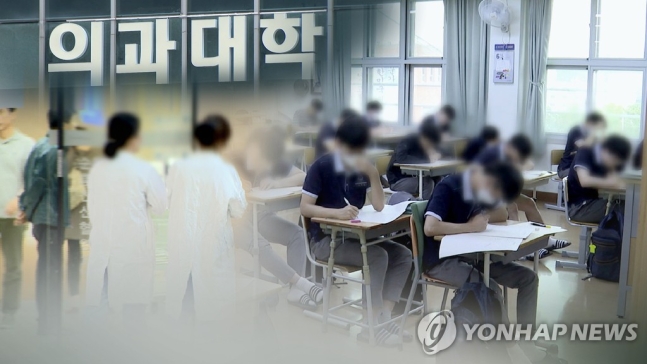
[Asia Economy Reporter Han Seung-gon] As the medical sector strike approaches in one day, citizens' anxiety is growing. Especially with the novel coronavirus infection (COVID-19) still spreading, concerns are rising that the collective medical staff's work stoppage might lead to a resurgence of COVID-19.
With the situation rapidly unfolding, the government has announced it will accept the formation of a consultative body, one of the medical sector's demands. However, the Korean Medical Association (KMA) has shown a skeptical response, leading to speculation that a full-scale medical strike may indeed materialize.
Among citizens, there are many negative opinions since the medical strike is directly linked to patient safety. However, some hold a cautious view that since doctors are going on a full strike, their opinions should also be heard.
Amid escalating conflicts between the government and the medical sector, Park Neung-hoo, Minister of Health and Welfare, is scheduled to deliver a statement at 11 a.m. today (6th) at the Seoul Government Complex in Gwanghwamun regarding the collective work stoppage announced by the medical sector.
Minister Park is expected to emphasize that a collective work stoppage during the ongoing COVID-19 situation could cause significant harm to the public and will likely request reconsideration of the strike.
◆ KMA: "Government's proposal to form a consultative body without amendments seems meaningless"
The government recently announced a plan to increase medical school admissions starting from the 2022 academic year, aiming to train an additional 4,000 doctors over ten years. The medical sector strongly opposes this, calling it a hasty administrative decision. The Korean Intern Resident Association (KIRA) strike is scheduled for tomorrow (7th), followed by a KMA general strike mainly involving private practitioners on the 14th.
Particularly, KIRA, composed of residents, has decided to include essential medical personnel such as emergency room, intensive care unit, delivery, surgery, and dialysis staff in the strike, raising fears of a so-called "medical crisis" due to treatment gaps. Additionally, with the ongoing COVID-19 situation, concerns are growing that infectious disease response could also be compromised.
While KIRA has announced a strike involving essential medical personnel including emergency room staff, the KMA holds a negative stance toward the government's proposal to form a consultative body.
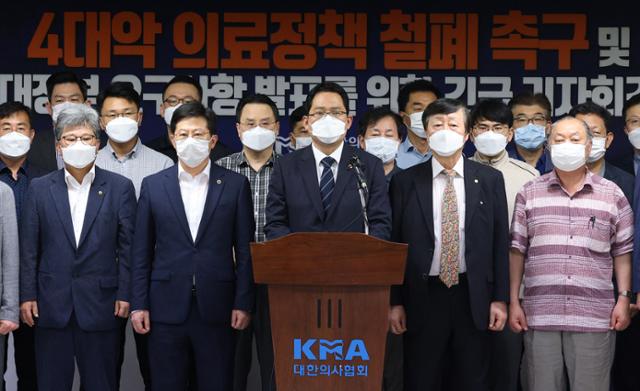 Choi Dae-jip (center), President of the Korean Medical Association, and the executive members are holding an emergency press conference on the afternoon of the 1st at the Korean Medical Association in Yongsan-gu, Seoul, to urge the abolition of the 'Four Major Evil Medical Policies' and to announce demands to the government. Photo by Yonhap News.
Kim Dae-ha, KMA spokesperson, criticized, "The government’s insistence on pushing forward the original plan without any intention to amend or slow down the expansion of medical school admissions, while only superficially accepting the formation of a consultative body?one of the very few demands from the medical sector?is insincere." He added, "It is tantamount to outright rejecting our demands. It seems like a mere formality to claim that opinions were gathered after the policy announcement due to growing backlash from the medical sector, so it appears meaningless."
Earlier, on the 1st, the KMA held a press conference at a temporary hall in Yongsan-gu, Seoul, condemning △ the increase in medical school admissions, △ the establishment of public medical schools, △ the inclusion of herbal medicine in insurance coverage, and △ the introduction of telemedicine.
In particular, the KMA criticized the government's policy to increase medical school admissions as a hasty plan that disregards rising medical costs, population decline, and the importance of medical education.
They also demanded the government form a consultative body to discuss resolving imbalances by specialty, region, and type of medical institution (tertiary hospitals, general hospitals, hospitals, clinics, etc.) and operate it for three years in consultation with the medical sector.
The KMA called for the immediate suspension of policies promoting non-face-to-face medical care. They proposed that face-to-face consultations and direct examinations between doctors and patients are fundamental principles, and that telemedicine should be limited and auxiliary, with the medical sector's opinions taken into account when necessary.
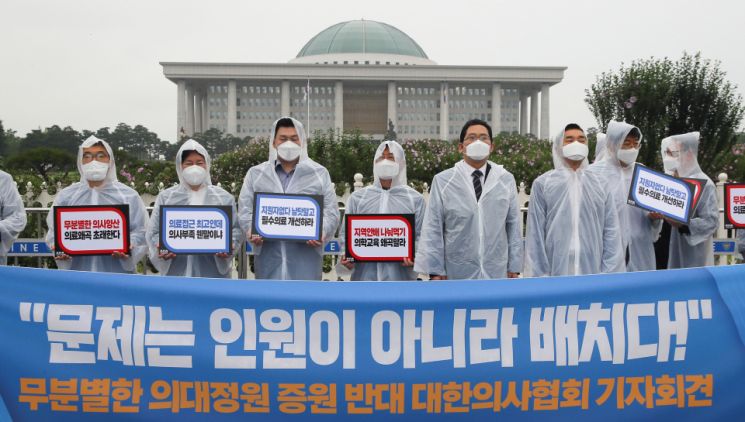 On July 23, in front of the main gate of the National Assembly where the 'Government-Party Consultation on Expanding Medical School Quotas and Establishing Public Medical Schools' was held, officials from the Korea Medical Association staged a protest against the increase in quotas.
 [Image source=Yonhap News]
KIRA emphasized that unless the government shows a progressive change in stance, there are no plans to halt the strike. Kim Hyung-chul, spokesperson for KIRA's Emergency Response Committee, stated, "The Ministry of Health and Welfare has fixed the increase in medical school admissions from the start of the meetings. If the government does not present a new position for discussion from the beginning, we will proceed with the collective work stoppage as planned."
Public opinion is generally negative toward doctors' strikes, as they directly affect patient safety. However, some believe that since the strike is a strong stance, doctors' voices should also be heard.
A man in his 40s, office worker A, said, "I oppose even emergency room doctors participating in the strike. Conflicts are inevitable in any organization, but there is a limit to what should be tolerated." He added, "The ICU medical staff refusing to work is frankly a form of intimidation."
Another office worker B in his 30s said, "In cases of strikes in transportation or logistics, citizens can sympathize and endure, but when it comes to medical strikes threatening patients' lives, who will take responsibility?" He added, "I think the strike should be reconsidered carefully once again."
On the other hand, some suggest looking into the medical sector's position. Office worker C in his 30s said, "Doctors going on a full strike must be due to some serious issues." He emphasized, "I hope such conflicts are a fight for the people." He also said, "Medical students are also protesting, so I hope the government listens well to the voices of the youth."
◆ Government: "Strict measures if harm to the public occurs"
Meanwhile, the government maintains its stance to continue dialogue with the medical sector until the last moment but plans to respond strictly to illegal acts.
Kim Kang-lip, Deputy Minister of Health and Welfare, said at a briefing on the 5th, "If illegal elements arise during the medical sector's collective actions, we will respond in principle according to laws and regulations, and if harm occurs to the public, we will take strict measures."
At the same time, the government is focusing on preparing measures to prevent treatment gaps and confusion at medical sites during the medical strike.
The Ministry of Health and Welfare plans to operate a 24-hour emergency medical situation room in cooperation with local governments. They also intend to assign substitute shifts or secure personnel in advance in emergency rooms and intensive care units to prevent treatment gaps.
© The Asia Business Daily(www.asiae.co.kr). All rights reserved.



















