Setting Post-Corona Science and Technology Policy Directions
Development of 30 Technologies Including Telemedicine and Surgical Robots
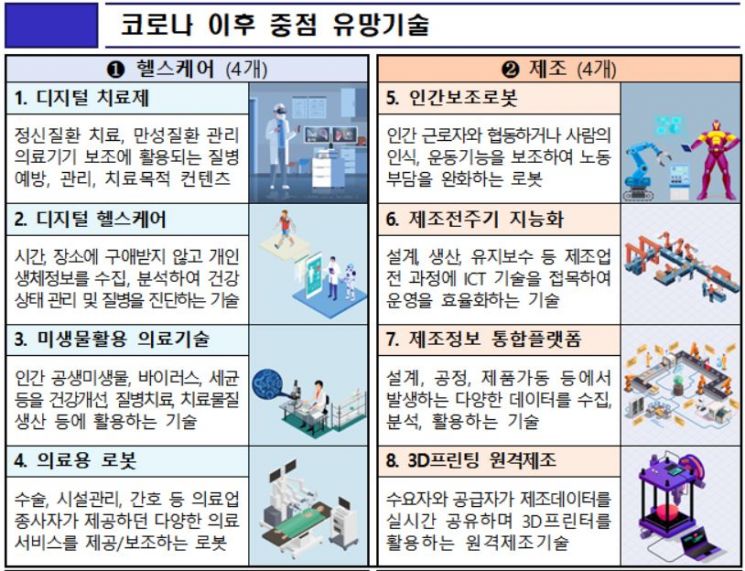
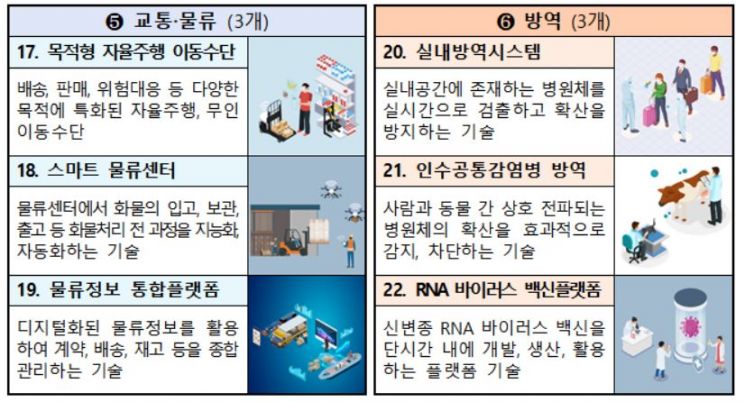
[Asia Economy Reporter Junho Hwang] The development of digital healthcare technology that manages health status by collecting and analyzing personal biometric information in real time without face-to-face consultation with doctors is set to begin. Robots providing medical services such as surgery and nursing, as well as digital therapeutics for disease prevention and treatment, will also be developed. Research will be conducted to develop technology that detects pathogens transmitted between humans and animals, detects pathogens in indoor spaces in real time, and rapidly develops vaccines for these pathogens. The government established these science and technology policy directions to prepare for the post-COVID era at the 12th Science and Technology Ministers' Meeting held on the 6th.
Promotion of 30 Private Sector-Led R&D Projects
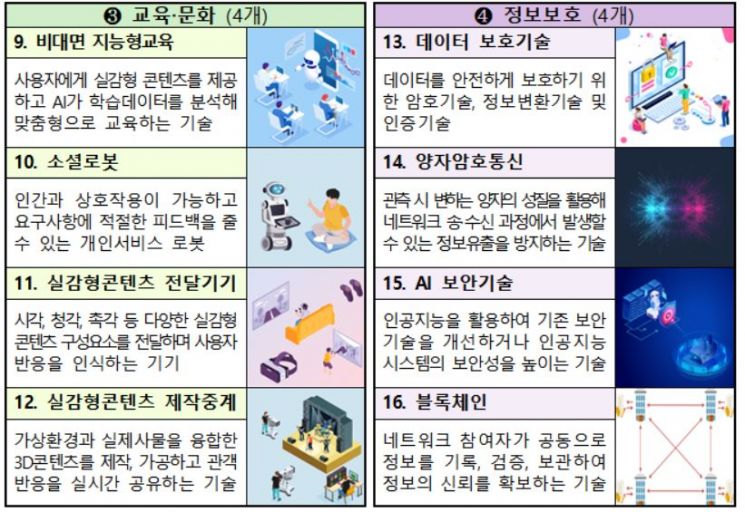
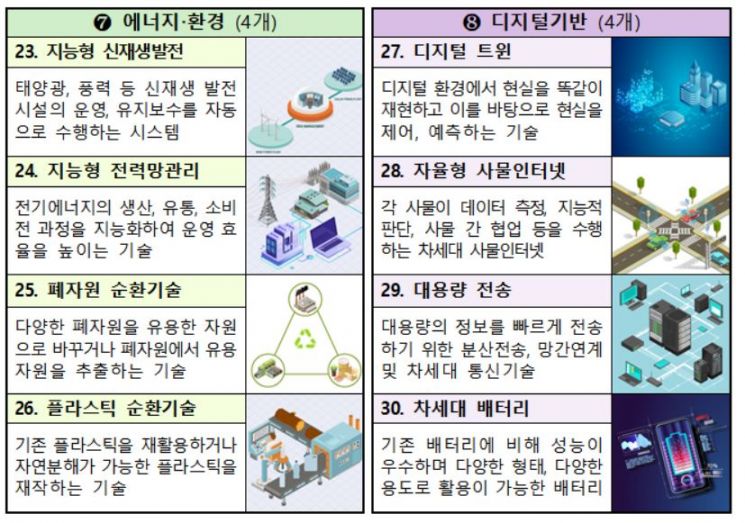
The government will focus on private sector-led science and technology development to respond to the post-COVID era. Through consultations between private experts and related ministries, 30 detailed technologies across eight areas including healthcare, quarantine, manufacturing, and transportation logistics will be developed. Additionally, to solve national problems, a research and development (R&D) model granting full authority to private experts for radical institutional improvements will be introduced. For example, R&D projects such as ultra-high capacity DNA memory and underwater/airborne mobile unmanned vehicles, which will be promoted from the second half of this year, will proceed under this model. For R&D projects with a preliminary feasibility study scale of over 50 billion KRW, pre-regulatory relaxation measures must be proposed from the planning stage, and for follow-up commercialization using excellent R&D outcomes, budget will be prioritized.
Strengthening Digital Transformation Including AI+X Projects
The government will also strengthen the digital transformation of existing industries. Large-scale investments will be made in digital infrastructure such as data, 5G, and artificial intelligence, and efforts will be made in non-face-to-face, 5G+AI convergence services, and manufacturing innovation. Specifically, the AI+X project will be promoted to expand AI introduction and utilization in seven fields with high public impact, and efforts will be made to advance smart factories, expand the 3N industry-academia-research cooperation system in materials, parts, and equipment, and foster specialized companies.
In addition, customized talent development for the post-COVID era will be pursued. To this end, digital re-education and career transition support platforms will be expanded. To secure global leadership through Korean science and technology, the Korea Institute of Science and Technology Planning and Evaluation will be designated as the Science and Technology Diplomacy Center, and efforts will be made to prepare a science and technology cooperation roadmap and promote strategic joint research.
The government selected tasks to implement these policy directions, and major tasks will be reflected in the 'National R&D Innovation Plan' to be prepared in the second half of this year. It is expected that if systematic implementation is carried out by each ministry, national innovation capabilities to respond to the post-COVID era can be expanded.
© The Asia Business Daily(www.asiae.co.kr). All rights reserved.
![User Who Sold Erroneously Deposited Bitcoins to Repay Debt and Fund Entertainment... What Did the Supreme Court Decide in 2021? [Legal Issue Check]](https://cwcontent.asiae.co.kr/asiaresize/183/2026020910431234020_1770601391.png)

















